Roses in a vase
Pierre-Auguste Renoir · 1890
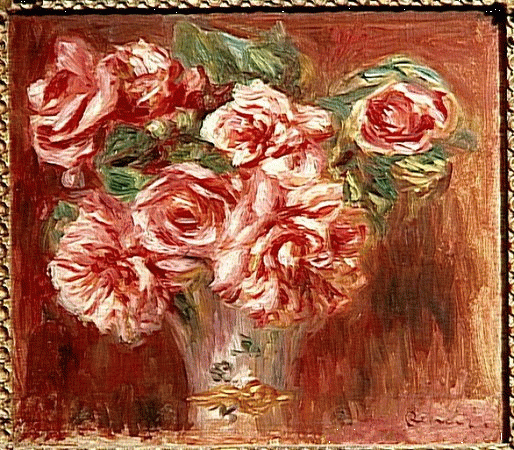
Fleshy roses swell in every direction from a white porcelain vase. Renoir admitted he painted flowers like these as studies for the skin of his nudes, and this small canvas survived seizure in the Second World War.
The story behind the painting
Renoir painted Roses in a Vase around 1890, after his Impressionist phase, during which he had turned more toward portraits and themes of modern life. In these years he took up still life again, and this picture is a strong example of that return. Renoir always linked flowers with feminine beauty. He admitted that he often painted still lifes of this kind as preparatory sketches for his female nudes, and he was struck by the close match in colour between the skin of the women he painted and the fragrant petals of flowers.
What to look for
This is a small canvas, 29.5 cm high and 33 cm wide. A large bouquet expands in all directions, filled with roses with big corollas and fleshy petals that crowd the whole painted surface. They stand in a white porcelain vase with a floral decoration. Look at how little space is left around the flowers: the roses almost push against the edges, so the picture becomes a field of petals rather than a vase on a table.
Meaning and intent
For Renoir the rose was more than a pleasant subject. He went so far as to model the complexion of his sitters on roses, so painting a bouquet like this was also a way of practising the warm, living colour he wanted in flesh. The picture is a still life, but it looks toward the human figure. It shows a painter using flowers as a sketchbook for skin, light and softness.
Legacy
The painting belonged to the dealer Ambroise Vollard before 1922. During the German Occupation it was seized from an unknown owner. In 1949 it was found at a private home in Bavaria with other paintings of the same origin, and on 4 May 1949 it was registered at the Munich Central Collecting Point. It left for France on 3 June 1949 and in 1951 was assigned to the Louvre, then moved at once to the Jeu de Paume. It belongs to the Musée d'Orsay as MNR 580, and since 1986 has been on deposit at the Musée de l'Évêché in Limoges, where it is shown.
Did you know?
- Painted by Renoir around 1890.
- Renoir used such flower pieces as studies for his nudes.
- Seized during the Occupation, found in Bavaria in 1949.
- Deposited at the Musée de l'Évêché in Limoges since 1986.
About the artist
Pierre-Auguste Renoir (1841-1919)
Department of Paintings of the Louvre · Musée d'Orsay · still life · vase · rose · floral painting
More by Pierre-Auguste Renoir
 Dance at Le Moulin de la Galette - Pierre-Auguste Renoir (1876)
 Luncheon of the Boating Party - Pierre-Auguste Renoir (1881)
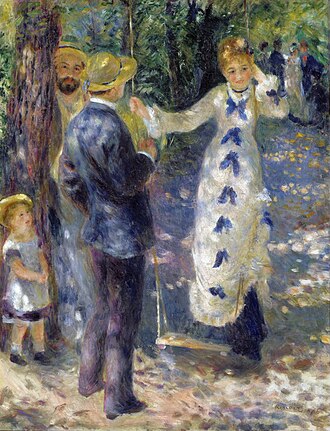 La Balançoire - Pierre-Auguste Renoir (1876)
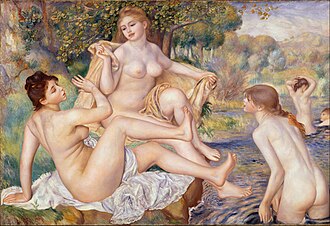 The Great Bathers - Pierre-Auguste Renoir (1884)
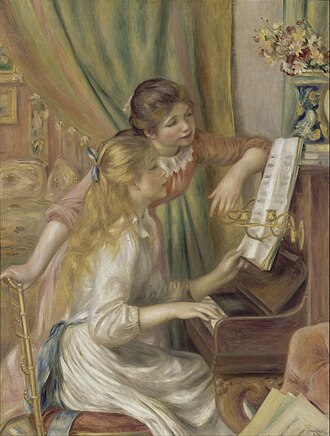 Girls at the Piano - Pierre-Auguste Renoir (1892)
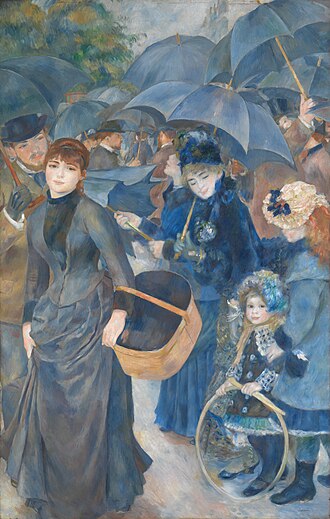 The Umbrellas - Pierre-Auguste Renoir (1880s)
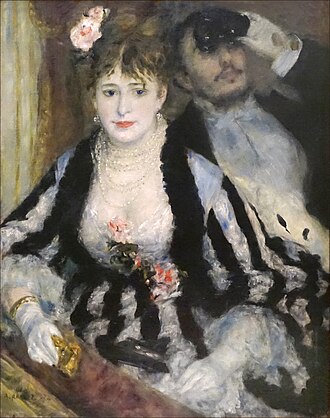 La loge - Pierre-Auguste Renoir (1874)
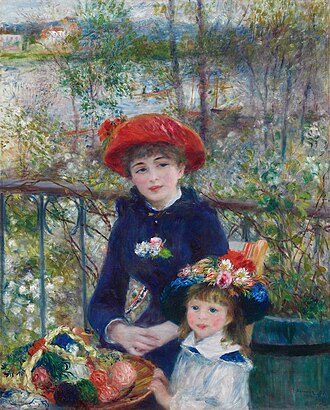 Two Sisters - Pierre-Auguste Renoir (1881)
Paintings by related artists
 Impression, Sunrise - Claude Monet (1872)
 Water Lilies - Claude Monet (1906)
 Luncheon on the Grass - Édouard Manet (1863)
 Olympia - Édouard Manet (1863)
 The Cradle - Berthe Morisot (1872)
 Summer's Day - Berthe Morisot (1879)
 L'Absinthe - Edgar Degas (1875)
 The Bellelli Family - Edgar Degas (1858)
 The Canal du Loing at Moret - Alfred Sisley (1892)
 The Watering Pond at Marly with Hoarfrost - Alfred Sisley (1876)
 Paris Street; Rainy Day - Gustave Caillebotte (1877)
 Les raboteurs de parquet - Gustave Caillebotte (1875)