Roses et lilas dans un vase
Édouard Manet · 1882
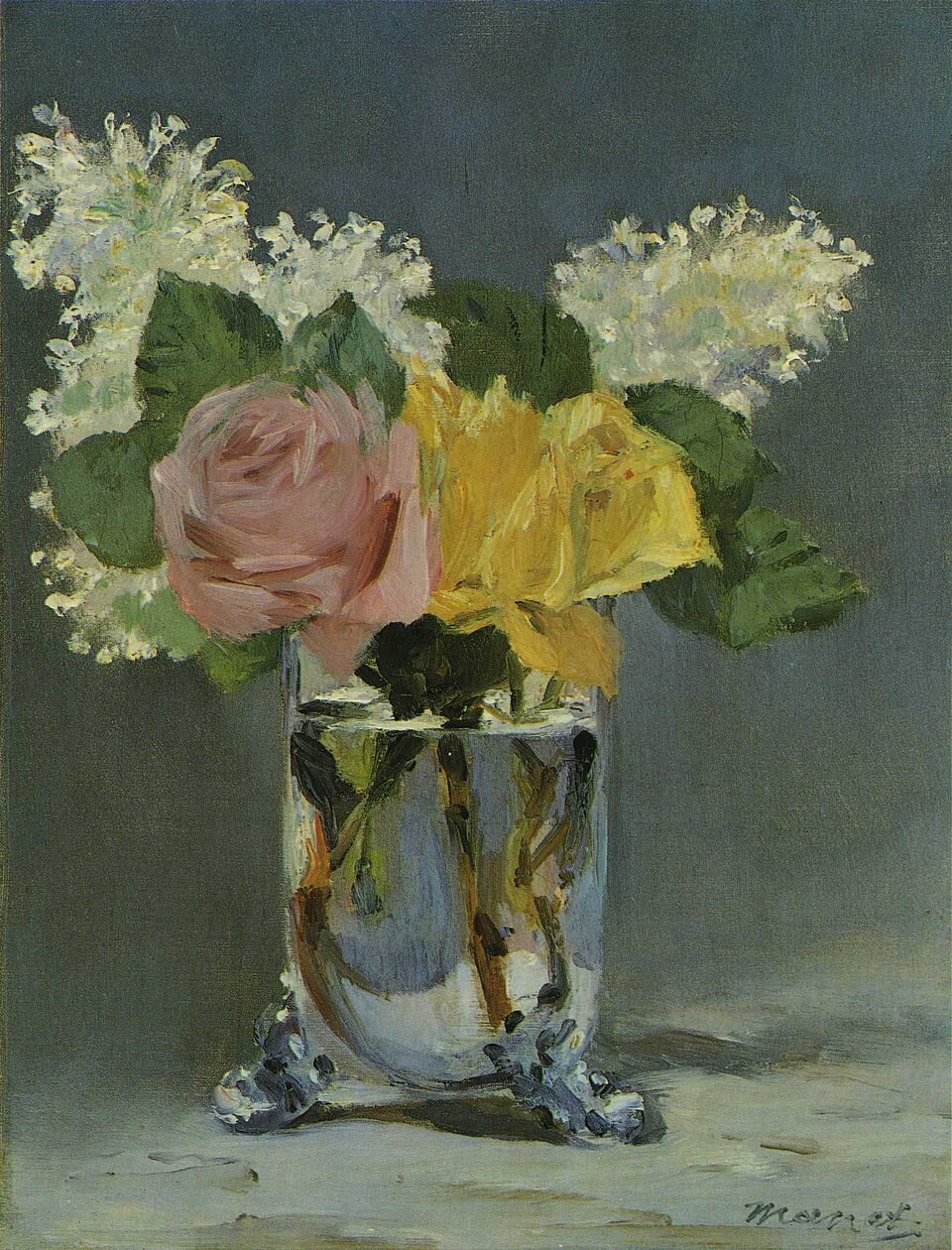
White lilac and two roses in a small glass of water, stems visible through the crystal. Manet, ill and unable to stand for long, painted it in 1882 and gave it to the daughter of one of his doctors.
The story behind the painting
Lilac and Roses is one of a series of flower still lifes Manet painted in the last months before his death. He suffered from the effects of syphilis, which caused him severe pain when walking and standing, so in this period he mostly made small pictures he could paint seated. His friends repeatedly brought him flowers to cheer him up, and Manet took these gifts as subjects, arranging them in different vases and glasses. He painted this one in 1882. The glass chosen here also appears in his Flowers in a Crystal Vase at the National Gallery of Art.
What to look for
The canvas is small, 32 by 24 cm. In the centre stands a little lead crystal glass, slightly bluish, a low cylinder on short feet, mostly filled with water. Through it you can see the stems and a single rose leaf; the art historian George L. Mauner said the clear glass gives a look behind the scenes. A pink rose on the left and a yellow one beside it lean forward over the rim, and white lilac rises on both sides behind them, painted in dabs. The glass stands on grey marble that blurs into a plain grey background. It is signed Manet at lower right.
Meaning and intent
For Mauner these last flower pictures are Manet's adieu, his farewell as a painter. Classic still lifes are often read as vanitas images about transience, but that is not necessarily the case here. Stéphane Guégan saw the last works as an expression of undiminished affirmation of life. Juliet Wilson-Bareau called the late flowers bold and haunting, of enchanting beauty. Ina Conzen noted that the unpretentious bouquets, brought mostly by women friends to the housebound artist, are set alone in the centre, and seem lit by an inner glow independent of passing light.
Legacy
Manet gave the painting to Ginerva Hureau de Villeneuve, whose father Abel was one of the doctors treating him in his last months. On 3 November 1882 she wrote to thank him, saying she loved flowers, white lilac and roses above all. Around 1905 it belonged to the Paris collector A. M. Galès, then passed through dealers in Paris, London and New York. Abby Aldrich Rockefeller bought it in April 1938, and her son David kept it until his death in 2017. It was sold at Christie's in 2018 and is in a private collection, rarely exhibited.
Did you know?
- Painted in 1882, in Manet's last months.
- Shows white lilac and two roses in a small crystal glass.
- A gift to the daughter of one of Manet's doctors.
- Owned by the Rockefeller family from 1938 to 2017.
About the artist
Édouard Manet (1832-1883)
More by Édouard Manet
 Luncheon on the Grass - Édouard Manet (1863)
 Olympia - Édouard Manet (1863)
 A Bar at the Folies-Bergère - Édouard Manet (1882)
 The Balcony - Édouard Manet (1868)
 Music in the Tuileries - Édouard Manet (1862)
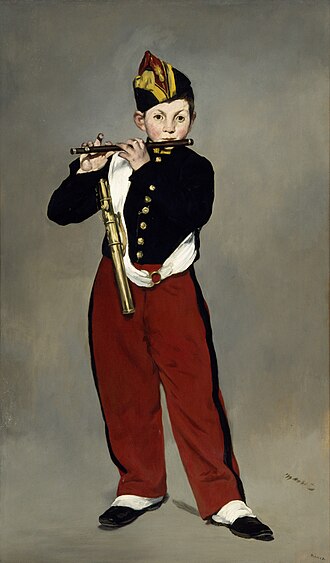 The Fif - Édouard Manet (1866)
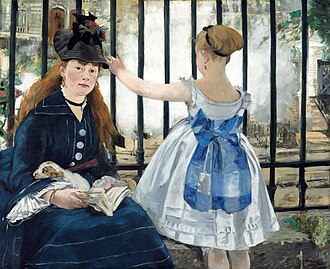 The Railway - Édouard Manet (1873)
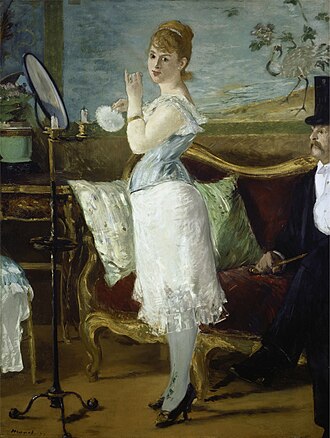 Nana - Édouard Manet (1877)
Paintings by related artists
 Impression, Sunrise - Claude Monet (1872)
 Water Lilies - Claude Monet (1906)
 Dance at Le Moulin de la Galette - Pierre-Auguste Renoir (1876)
 Luncheon of the Boating Party - Pierre-Auguste Renoir (1881)
 The Cradle - Berthe Morisot (1872)
 Summer's Day - Berthe Morisot (1879)
 L'Absinthe - Edgar Degas (1875)
 The Bellelli Family - Edgar Degas (1858)
 The Canal du Loing at Moret - Alfred Sisley (1892)
 The Watering Pond at Marly with Hoarfrost - Alfred Sisley (1876)
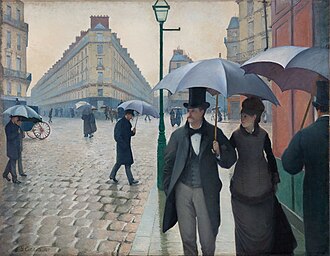 Paris Street; Rainy Day - Gustave Caillebotte (1877)
 Les raboteurs de parquet - Gustave Caillebotte (1875)