Religion saved by Spain
Titian · 1570s
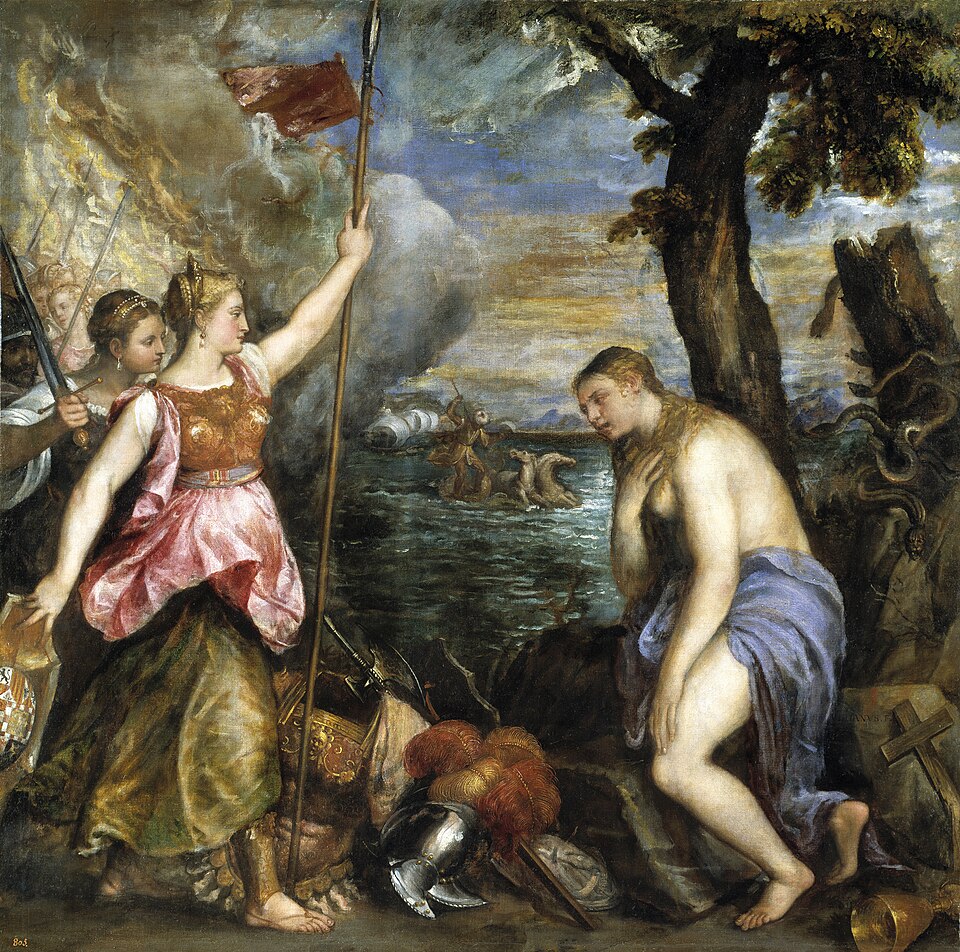
A kneeling woman in blue, threatened by snakes and a turbaned rider on the sea, is rescued by an armoured Spain. Late in life Titian turned a naval victory into a square canvas of allegory and propaganda.
The story behind the painting
Titian painted this oil on canvas between 1572 and 1575, late in his long career, to commemorate the Battle of Lepanto in 1571. In that battle the Holy League, an alliance of Spain, Venice and the Papal States, defeated the Ottoman navy of Selim II, and the victory halted the expansion of the Ottoman Empire further into Europe. The finished picture was sent to Philip II of Spain in 1576. It is also known as Spain succoring Religion or Religion assisted by Spain. Wikidata dates it simply to the 1570s.
What to look for
The canvas is square, about 168 by 168 cm. Spain is a woman in a dramatic landscape, holding a shield in her right hand and in her left a spear flying the flag of Victory. The fingers of both her hands form a symbolic V, for victory, and her shield bears the coat of arms of Philip II. Behind her a woman with a sword stands for Justice. To the right, Religion falls to her knees, wrapped in blue drapery. Out on the sea a turbaned man, perhaps Poseidon, drives a chariot pulled by two horses.
Meaning and intent
The painting is an allegory mixed with political propaganda. The turbaned figure on the sea stands for the Turkish threat, while the snakes around the kneeling Religion represent Protestantism, so the Christian faith is shown under attack from two sides at once. At the far left, behind Justice, appears the head of a man who may be Juan of Austria, Philip's half-brother and the commander of the Christian fleet at Lepanto. Spain arrives as the armed rescuer, and the royal arms on her shield make clear whose victory this is meant to be.
Legacy
The composition has an earlier life. Titian began a related picture for Alfonso d'Este, Duke of Ferrara, which was left unfinished at the Duke's death and was still unfinished when Giorgio Vasari saw it in Titian's studio in 1568. It showed a male nude bowing to Minerva, a woman with a laurel branch for Peace, and Amphitrite in a chariot at sea. That version was reworked for Emperor Maximilian II and engraved by Giulio Fontana around 1568, but the oil is now lost. This one stayed in the Spanish Royal Collection and has been in the Prado since the 19th century.
Did you know?
- Painted by Titian between 1572 and 1575 to commemorate Lepanto.
- Sent to Philip II of Spain in 1576.
- Snakes stand for Protestantism, the turbaned rider for the Turkish threat.
- In the Museo del Prado since the 19th century.
About the artist
Titian (1488-1576)
Museo del Prado · Venetian school · allegory · sword · body armor · spear · shield · cross · combat helmet
More by Titian
 Venus of Urbino - Titian (1538)
 Assumption of the Virgin - Titian (1510s)
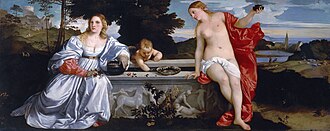 Sacred and Profane Love - Titian (1510s)
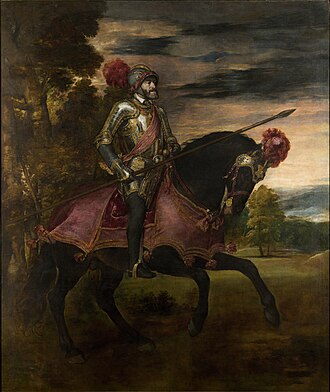 Equestrian Portrait of Charles V - Titian (1548)
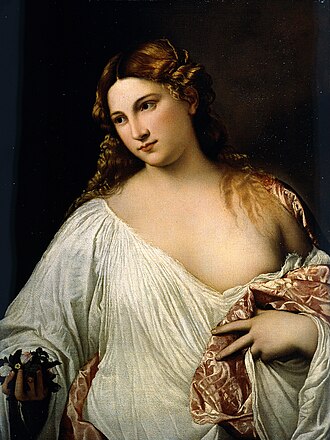 Flora - Titian (1517)
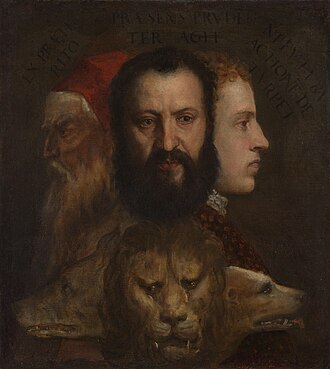 Allegory of Prudence - Titian (1550)
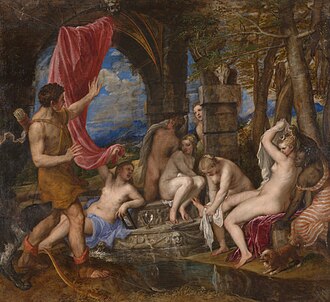 Diana and Actaeon - Titian (1550s)
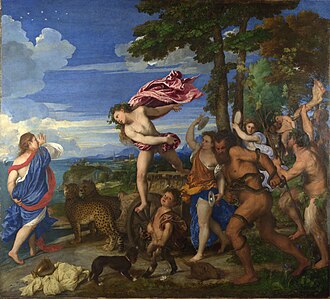 Bacchus and Ariadne - Titian (1520s)
Paintings by related artists
 Last Supper - Jacopo Tintoretto (1563)
 Miracle of the Slave - Jacopo Tintoretto (1540s)
 The Wedding at Cana - Paolo Veronese (1560s)
 The Feast in the House of Levi - Paolo Veronese (1573)