Proudhon and His Children
Gustave Courbet · 1865
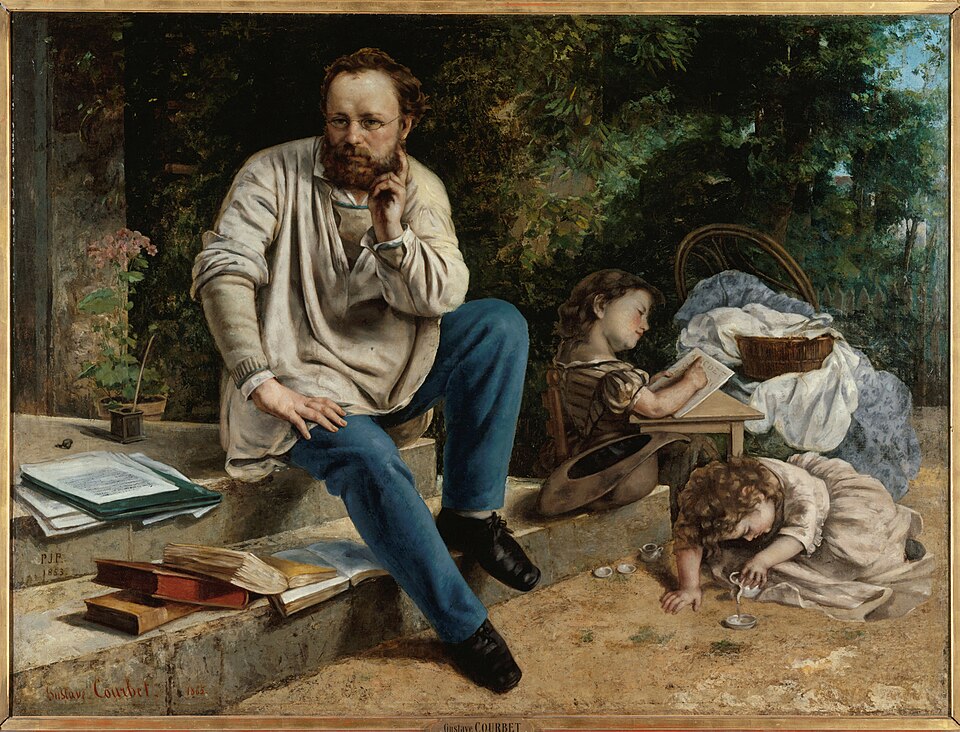
A philosopher sits on the steps of his Paris home in a work blouse, chin in hand, while his two daughters read and play beside him. Courbet painted his friend Proudhon in the year of his death, and later painted his wife out of the picture.
The story behind the painting
Pierre-Joseph Proudhon, the French philosopher, died on 20 January 1865, and the painting is dated that same year. It looks like a posthumous tribute, but the sources say Courbet, knowing his friend was ill, had the idea shortly before his death of making a series of portraits of him. He also painted two bust portraits, one of Proudhon and one of his wife. Courbet gave the picture other titles too: Proudhon and His Family, and Pierre Joseph Proudhon and his children in 1853, the year written into the stone of the step.
What to look for
Proudhon sits on the steps in front of the entrance of the Paris apartment where he lived, at the corner of the old Rue d'Enfer and 146 Rue Notre-Dame-des-Champs. He wears a blouse and trousers of toile de Nimes, one hand at his face, the other resting on his leg. To his left his two daughters are busy, one reading, the other playing. Look near his feet: four books, a pencil case and a manuscript, and under them, cut into the stone of the last step, the letters PJP 1853. The canvas measures about 147 by 198 cm.
Meaning and intent
The picture is a portrait of a thinker at home rather than at a lectern, surrounded by his books and his children. A letter Courbet wrote to Jules-Antoine Castagnary on 14 July 1867 suggests that Euphrasie, the philosopher's wife, originally appeared where the basket and the wicker armchair covered with fabrics now stand. The canvas was therefore repainted shortly before Courbet's large personal exhibition of 1867, leaving the philosopher alone with his daughters and his work. The sources do not say why Courbet made that change.
Legacy
The painting had a rough journey. In June 1873 it was seized together with other works by Courbet at the Durand-Ruel gallery. On 26 November 1877 it was sold to the collector Jean-Hubert Debrousse. After his death his collection was auctioned in April 1900, and the city of Paris bought the painting. Today it hangs in the Petit Palais, the Musee des Beaux-Arts de la Ville de Paris, where visitors can still find the date 1853 carved on the painted step beneath the philosopher's books.
Did you know?
- Painted by Courbet in 1865, the year Proudhon died.
- The date PJP 1853 is carved into the painted stone step.
- Proudhon's wife was painted over before the 1867 exhibition.
- Bought by the city of Paris in 1900; now in the Petit Palais.
About the artist
Gustave Courbet (1819-1877)
family portrait · Musée des Beaux-Arts de la ville de Paris
More by Gustave Courbet
 L'Origine du monde - Gustave Courbet (1866)
 A Burial at Ornans - Gustave Courbet (2020)
 The Sleepers - Gustave Courbet (1866)
 The Painter's Studio - Gustave Courbet (1855)
 Woman with a Parrot - Gustave Courbet (1866)
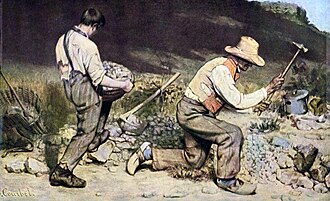 The Stone Breakers - Gustave Courbet (1850)
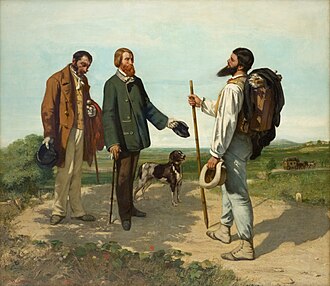 The Meeting, or Bonjour, Monsieur Courbet! - Gustave Courbet (1854)
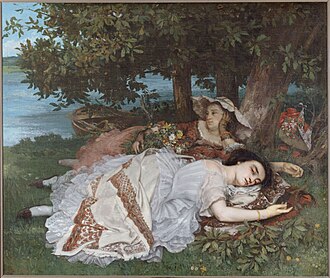 Young Ladies Beside the Seine - Gustave Courbet (1857)
Paintings by related artists
 Impression, Sunrise - Claude Monet (1872)
 Water Lilies - Claude Monet (1906)
 Luncheon on the Grass - Édouard Manet (1863)
 Olympia - Édouard Manet (1863)
 Breezing Up - Winslow Homer (1873)
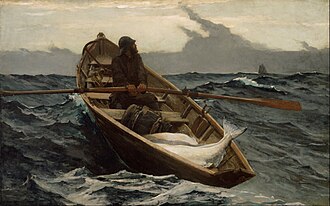 The Fog Warning - Winslow Homer (1885)
 The Starry Night - Vincent van Gogh (1889)
 Café Terrace at Night - Vincent van Gogh (1888)