Portrait of the Vendramin Family
Titian · 1540s
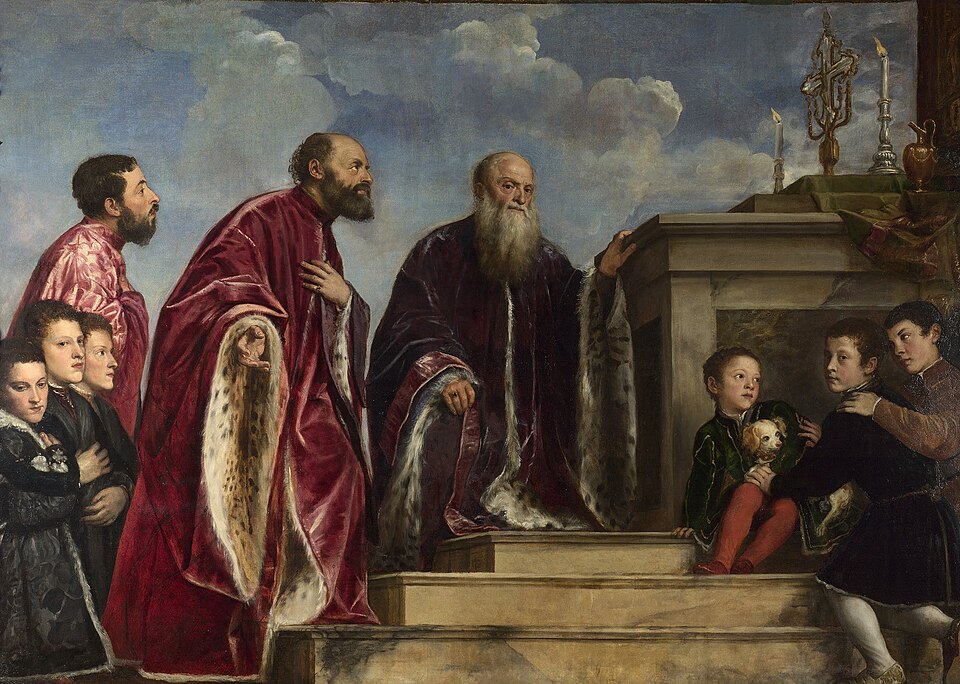
Nine men and boys of a Venetian patrician family gather around an altar and a golden reliquary of the True Cross. Titian's canvas has been called one of the greatest group portraits in history.
The story behind the painting
The patrician Vendramin family commissioned the canvas from Titian and his workshop in the early 1540s. As Venetian custom required, it portrays only male members of the dynasty: the brothers Andrea and Gabriele Vendramin and Andrea's seven sons. The relic on the altar ties the family to a famous story. In 1369 an earlier Andrea Vendramin, head of the Scuola Grande di San Giovanni Evangelista, received the relic of the True Cross. During a crowded procession it fell into a canal, did not sink but hovered over the water, evading others who tried to help, until this Andrea dived in and recovered it.
What to look for
The figures stand beside an altar holding the reliquary, which still exists and is still held by the Scuola. Look for the two elder men: Andrea was apparently only three years older than Gabriele, which you would not guess from the picture, and it remains uncertain which is which. The three young boys kneeling on the left were added later by another artist and are clearly weaker in quality. The very low vanishing point and the lighting suggest the painting was meant to be seen from its left side, with the lower edge at about head height, perhaps on a stairway in one of the Vendramin palaces.
Meaning and intent
The painting balances youth and wisdom, and it shows the power of the family and their public commitment to the Republic. The relic sits at its centre and served both as a symbol of the Serene Republic and as a personal emblem of the Vendramin. The miracle it recalls was painted by Gentile Bellini, in The Miracle of the True Cross near San Lorenzo Bridge of 1496 to 1500, and by Vittore Carpaccio in 1494; both works are now in the Accademia in Venice.
Legacy
The canvas stayed in Venice until at least 1636, when Anthony van Dyck, painter at the court of Charles I, bought it. After his death Sir John Wittewronge claimed it for his mother, Lady Anne Middleton, and sold it to Algernon Percy, 10th Earl of Northumberland. It descended through the Earls and Dukes of Northumberland and Somerset until the National Gallery in London acquired it in 1929. At some point it was cut down on both sides and at the bottom, and it still measures about 206 by 289 cm.
Did you know?
- Painted by Titian and his workshop in the early 1540s.
- Shows only the male members of the Vendramin family.
- The reliquary of the True Cross still exists in Venice.
- Bought by Van Dyck around 1636; in the National Gallery since 1929.
About the artist
Titian (1488-1576)
portrait · National Gallery · Venetian school
More by Titian
 Venus of Urbino - Titian (1538)
 Assumption of the Virgin - Titian (1510s)
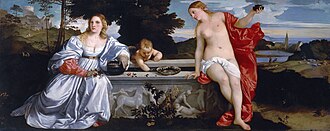 Sacred and Profane Love - Titian (1510s)
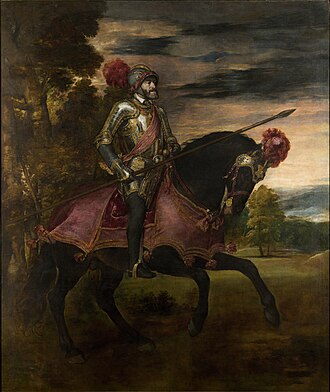 Equestrian Portrait of Charles V - Titian (1548)
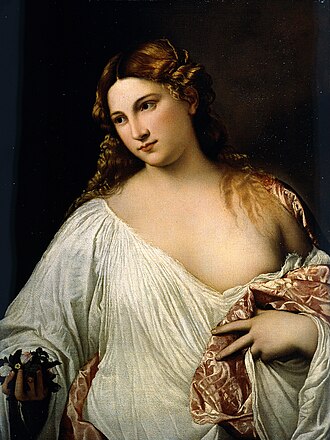 Flora - Titian (1517)
 Allegory of Prudence - Titian (1550)
 Diana and Actaeon - Titian (1550s)
 Bacchus and Ariadne - Titian (1520s)
Paintings by related artists
 Last Supper - Jacopo Tintoretto (1563)
 Miracle of the Slave - Jacopo Tintoretto (1540s)
 The Wedding at Cana - Paolo Veronese (1560s)
 The Feast in the House of Levi - Paolo Veronese (1573)