Portrait of Lavinia Vecellio
Titian · 1540s
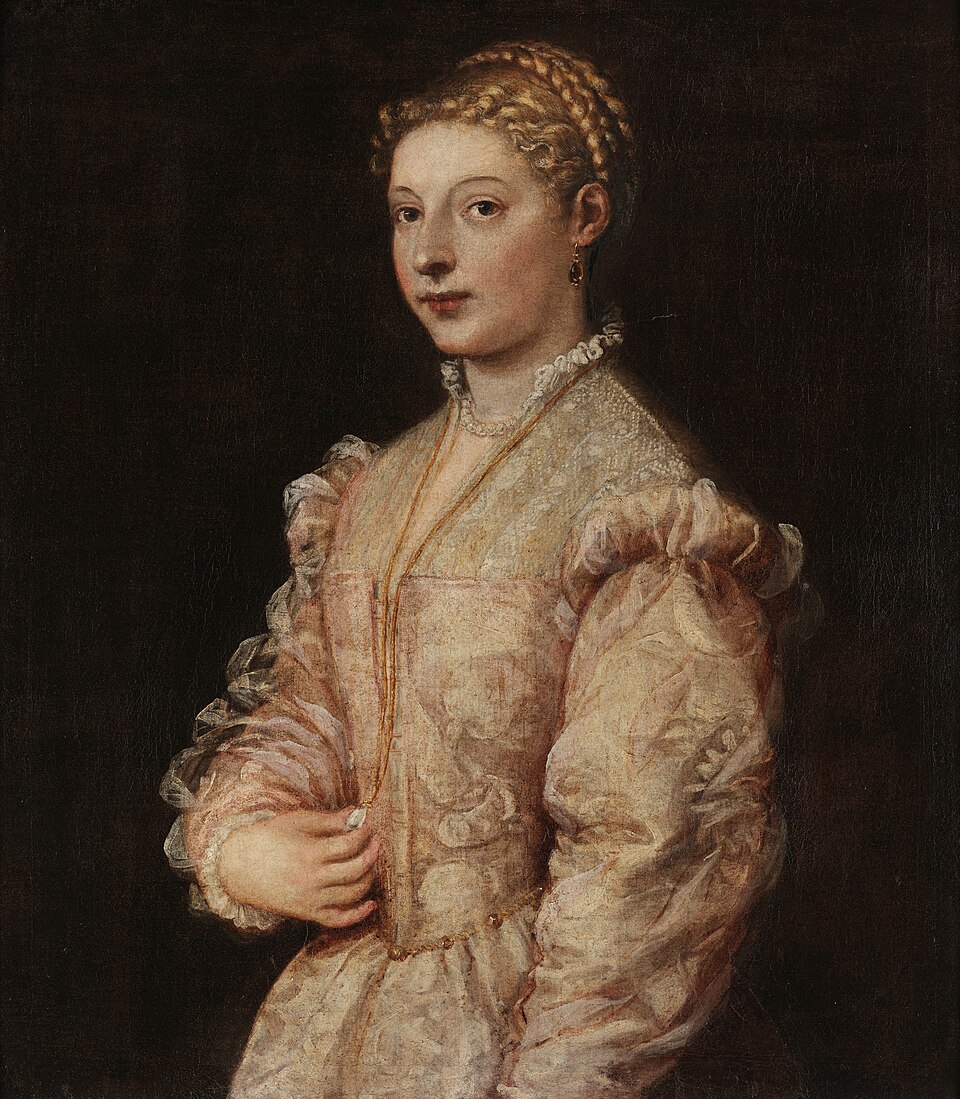
A young Venetian woman, serene and richly dressed, holds a pearl hanging from a gold thread at her neck. Is she Titian's daughter, a lady of the Farnese court, or a cardinal's lover? Nobody is sure, and the painting itself was once stolen by Nazi troops.
The story behind the painting
The portrait can be dated to 1545 to 1546, when Titian was in Rome working for the Farnese family. It is first mentioned in the mid-17th century at the Palazzo Farnese in Rome, described as a beautiful portrait of a young Venetian lady, by the hand of Titian. In 1662 it was among 103 works sent from Rome to Parma, first to the Palazzo del Giardino and then to the gallery of the Palazzo della Pilotta. In 1725 it was listed, with the Portrait of Paul III, among the hundred masterpieces of that collection.
What to look for
The woman appears to be of high social standing, judging by her rich clothing and jewellery. She has blonde hair and a serene face, and is shown at half-length, turned three-quarters. Her aristocratic dress is adorned with embroidery and trim, with white sleeves and shoulders. In her right hand she holds a pearl tied around her neck on a gold thread. Wikidata gives the size as 85 by 75 cm. The sources describe the support differently: the opening of the Wikipedia article calls it oil on wood, while its history section speaks of a canvas, and in 1960 a major restoration recovered its original colours.
Meaning and intent
Writers of the past, such as Tommaso Puccini, admired the painting, but the sitter's identity is disputed. Some critics see Titian's daughter Lavinia Vecellio, comparing a supposed portrait of her, the Portrait of a Lady in a White Dress of about 1561 in Dresden. Others suggest a woman of the Farnese court in Rome, or Clelia, daughter of Cardinal Alessandro Farnese. Another theory, partly supported by a 1544 letter from the papal nuncio in Venice, Giovanni Della Casa, to Alessandro Farnese, names a courtesan called Angela, the cardinal's lover and Titian's inspiration for the Danaë in the same museum.
Legacy
With much of the Farnese collection, the painting passed to Charles III of Spain, who took it to Naples in 1734. It appears in the catalogues of Capodimonte until 1799, then moved to the Palazzo dei Regi Studi, now the National Archaeological Museum. In the Second World War it shared the fate of Titian's Danaë: Nazi troops took it from the deposits of the Abbey of Montecassino, where it had been stored for safety. In 1947 it was found in the Altaussee mine in Austria and returned to Italy. It is now in the Museo di Capodimonte in Naples.
Did you know?
- Painted about 1545-1546, while Titian worked for the Farnese in Rome.
- The sitter may be his daughter Lavinia, but this is disputed.
- Stolen by Nazi troops from Montecassino and found at Altaussee in 1947.
- Now in the Museo di Capodimonte, Naples.
About the artist
Titian (1488-1576)
portrait · Venetian school · Munich Central Collecting Point · Museo di Capodimonte
More by Titian
 Venus of Urbino - Titian (1538)
 Assumption of the Virgin - Titian (1510s)
 Sacred and Profane Love - Titian (1510s)
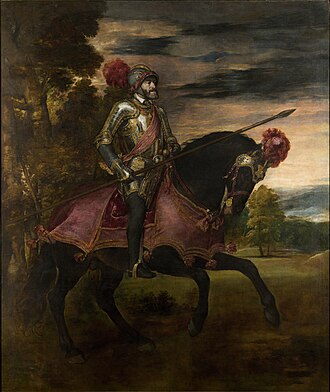 Equestrian Portrait of Charles V - Titian (1548)
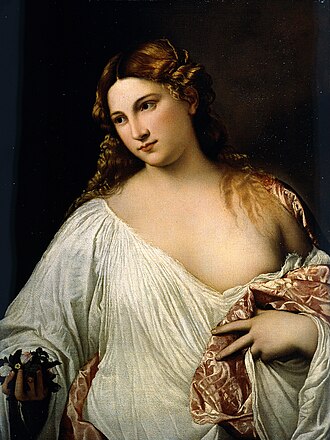 Flora - Titian (1517)
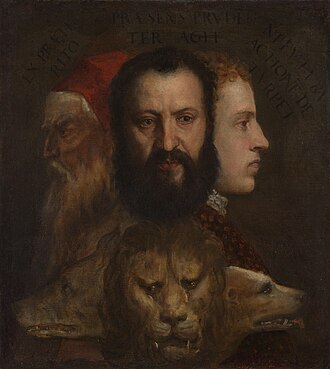 Allegory of Prudence - Titian (1550)
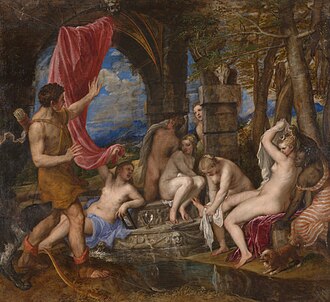 Diana and Actaeon - Titian (1550s)
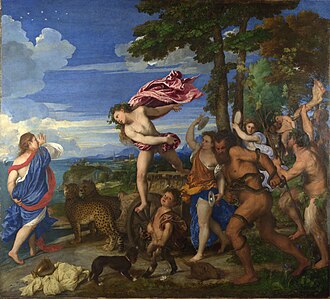 Bacchus and Ariadne - Titian (1520s)
Paintings by related artists
 Last Supper - Jacopo Tintoretto (1563)
 Miracle of the Slave - Jacopo Tintoretto (1540s)
 The Wedding at Cana - Paolo Veronese (1560s)
 The Feast in the House of Levi - Paolo Veronese (1573)