Portrait of Jules de Jouy
Édouard Manet · 1879
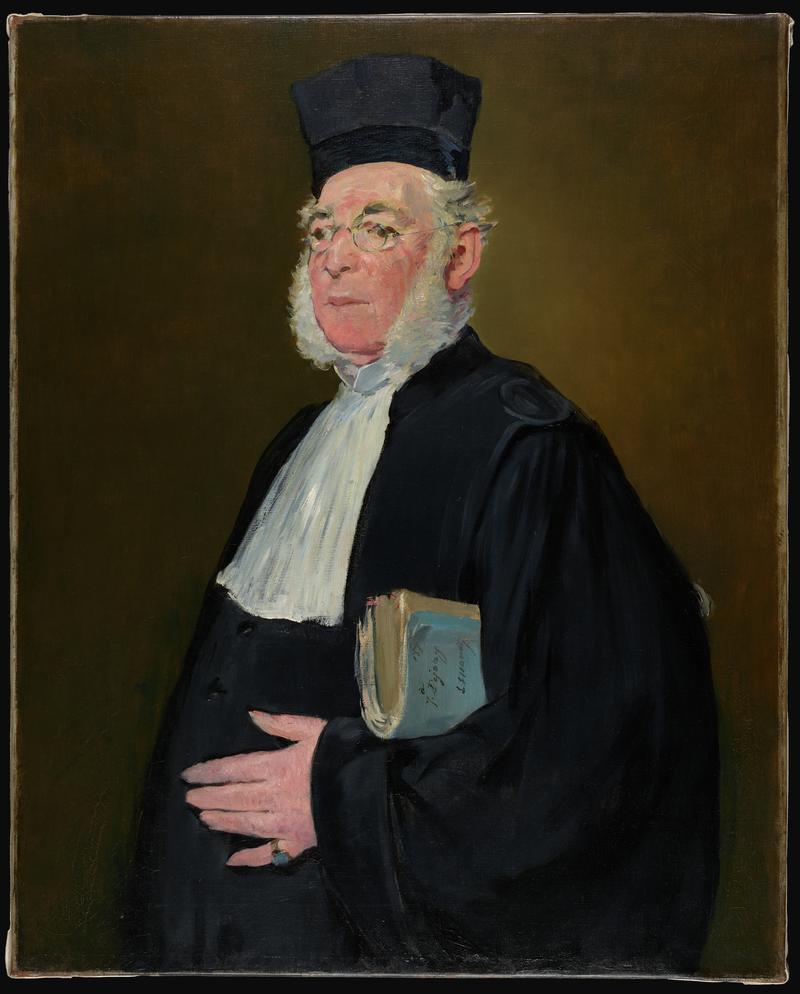
Manet painted his cousin the lawyer in robe and cap, a thick bundle of files under his arm and a blue-stoned ring on his little finger. For more than 140 years the picture stayed in private hands and was rarely seen, until it reached Cardiff in 2020.
The story behind the painting
Jules de Jouy was born in 1815, seventeen years before his cousin Édouard Manet; his mother Emilie was a sister of Manet's father Auguste. The two were close. A surviving letter Manet wrote to him from Rio de Janeiro on 26 February 1849 calls him a dear friend, and in that same year de Jouy became a lawyer at the Court of Cassation. The Manet family consulted him again and again on legal matters, and Manet named him executor of his will. The Manets spent the summer of 1874 in de Jouy's house in Gennevilliers. In 1879 Manet painted him, signing and dedicating the picture to him.
What to look for
This is a half-length portrait, 79 by 64 cm. The body turns to the left, the head is in half profile. De Jouy wears the black robe of his profession, a white standing collar and a white jabot, with the black cap on his head. The face, painted in many shades of red and pink, shows a lively brushstroke, framed by bushy white side whiskers, already a key feature in a preparatory sketch now in the Musée Marmottan Monet. The eyebrows are almost black, the brown eyes enlarged by his spectacles. His left hand, laid across his stomach, is more roughly painted, with a gold ring set with a large, square bluish stone. A similar blue appears on the cover of the files, inscribed 1879 à J. Dejouy E. Manet.
Meaning and intent
Manet mostly painted women, but in 1879 he also portrayed several men close to him: his school friend Antonin Proust as a Parisian flâneur, Georges Clemenceau with crossed arms behind a desk, and the writer George Moore in pastel. He rarely used professional models. Here the files, like Clemenceau's manuscript, gather the arguments that matter in court, while the hand on the stomach can be read as a sign of comfortable ease. The biographer Gotthard Jedlicka called the work a masterpiece of portrait painting and saw its eyes as seeking contact with the viewer, and the critic Karl Scheffler called it brilliantly painted. Both saw echoes of Honoré Daumier's lawyers.
Legacy
De Jouy lent the portrait to the Manet memorial exhibition in Paris in 1884 and kept it until his death in 1894; it is not known whether it was a gift. He left it to his friend the lawyer Maugras. It was shown in Berlin in 1926 and 1928, and in 1932 the textile industrialist Erich Goeritz lent it to the Manet retrospective at the Orangerie. To escape persecution as a Jew, Goeritz emigrated in 1934 and took the painting to London. It stayed with his family until 2020, when it passed to the National Museum Cardiff in settlement of inheritance tax.
Did you know?
- Manet's cousin Jules de Jouy, a lawyer, painted in 1879.
- Inscribed on the files: 1879 à J. Dejouy E. Manet.
- Taken to London in 1934 by Erich Goeritz, who fled Nazi Germany.
- Entered the National Museum Cardiff in 2020.
About the artist
Édouard Manet (1832-1883)
portrait · Amgueddfa Cymru - Museum Wales
More by Édouard Manet
 Luncheon on the Grass - Édouard Manet (1863)
 Olympia - Édouard Manet (1863)
 A Bar at the Folies-Bergère - Édouard Manet (1882)
 The Balcony - Édouard Manet (1868)
 Music in the Tuileries - Édouard Manet (1862)
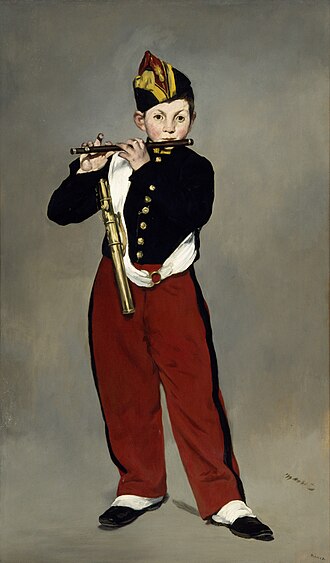 The Fif - Édouard Manet (1866)
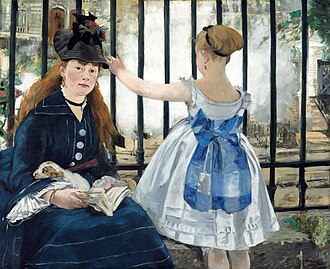 The Railway - Édouard Manet (1873)
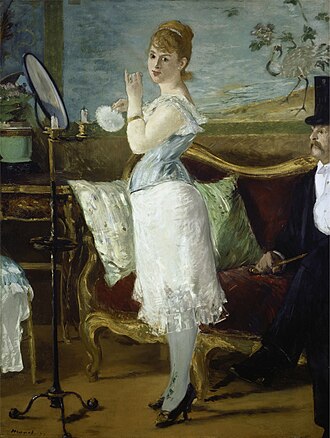 Nana - Édouard Manet (1877)
Paintings by related artists
 Impression, Sunrise - Claude Monet (1872)
 Water Lilies - Claude Monet (1906)
 Dance at Le Moulin de la Galette - Pierre-Auguste Renoir (1876)
 Luncheon of the Boating Party - Pierre-Auguste Renoir (1881)
 The Cradle - Berthe Morisot (1872)
 Summer's Day - Berthe Morisot (1879)
 L'Absinthe - Edgar Degas (1875)
 The Bellelli Family - Edgar Degas (1858)
 The Canal du Loing at Moret - Alfred Sisley (1892)
 The Watering Pond at Marly with Hoarfrost - Alfred Sisley (1876)
 Paris Street; Rainy Day - Gustave Caillebotte (1877)
 Les raboteurs de parquet - Gustave Caillebotte (1875)