Portrait of Elisabeth Lederer
Gustav Klimt · 1910s
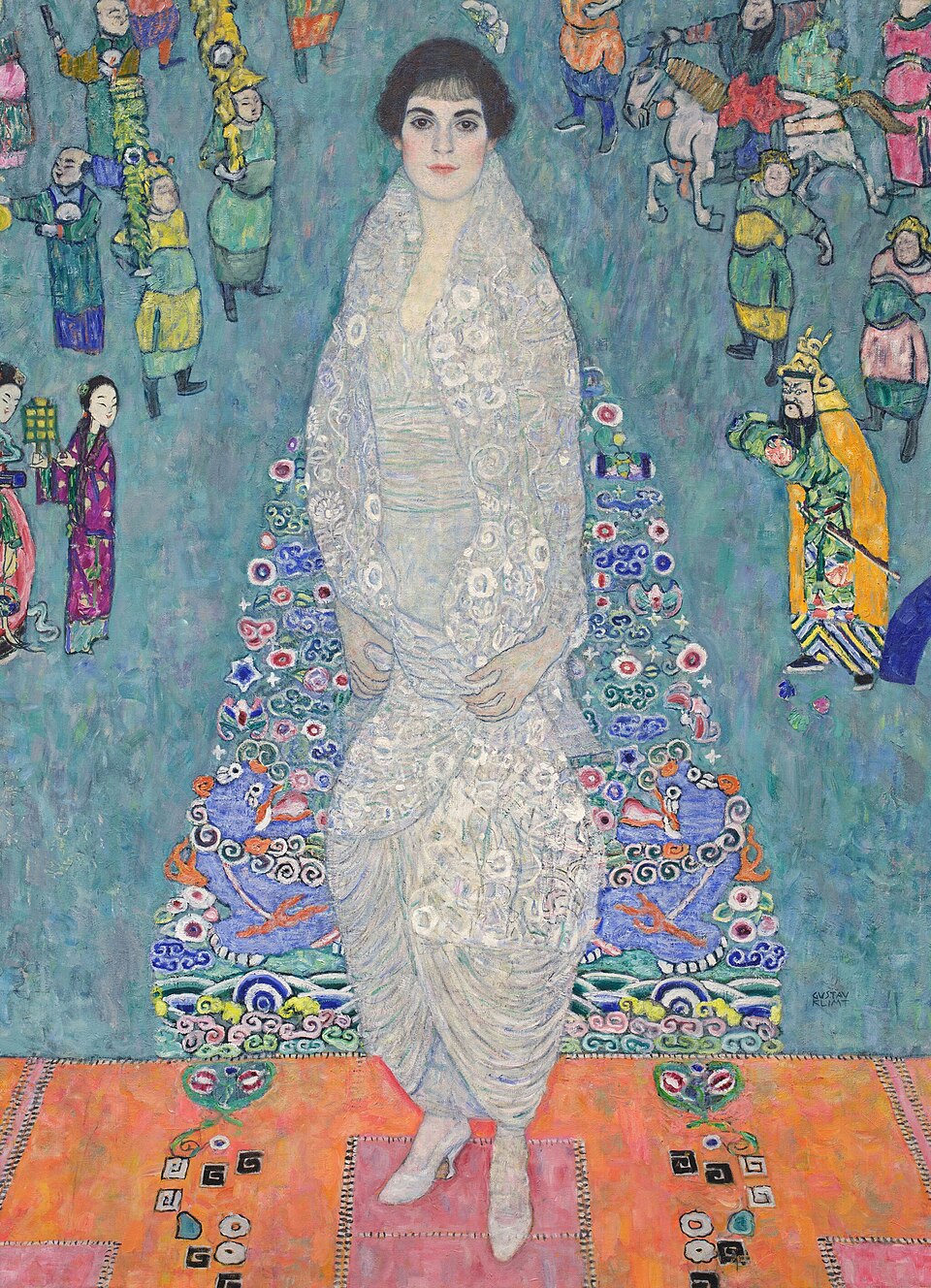
A young woman in white stands on a bright carpet, surrounded by dreamlike figures. Klimt never thought this portrait finished; her mother simply took it from his studio. Years later, the painting helped save the life of the woman it shows.
The story behind the painting
August and Serena Lederer, Jewish industrialists and among Klimt's most important patrons, commissioned this portrait of their daughter Elisabeth in 1914. Klimt lived nearby and visited often, and he had painted Serena in 1899. He worked on Elisabeth's portrait for several years and was reluctant to call it finished. In 1916, the story goes, Serena took it from his studio believing it complete, while Klimt insisted it was not. Wikipedia dates the work 1914 to 1916, while Wikidata gives simply the 1910s. After the Nazi annexation of Austria in 1938, Elisabeth obtained a document stating that Klimt was her father, which let her stay in Vienna until her death from illness in 1944.
What to look for
The life-size canvas, about 180 by 131 cm, shows Elisabeth at twenty in white: not a loose gown like her mother's, but a close-fitting top and skirt, with a white chiffon shawl patterned with flowers. The outfit follows Parisian fashion of the time, especially the designs of Paul Poiret, and the skirt has an ambiguous, trouser-like effect. Beneath her white silk shoes is a carpet in bold pink-orange with black and white borders, recalling Wiener Werkstätte designs, and green and white circles that recall Chinese jade. Behind her float figures drawn from Chinese material culture and Peking opera: soldiers, scholars, courtiers. Look closely at the white dress, where traces of underdrawing remain visible.
Meaning and intent
The portrait belongs to Klimt's late work, which left behind the hard-edged gold shapes of his golden phase for richer colour and East Asian motifs. Klimt owned ukiyo-e prints, kimonos, Qing court robes and books on East Asian art. Tobias G. Natter wrote that the background figures resemble figures from a dream. Emily Braun argues that the mix of fashions stresses the sophistication and cosmopolitanism of the Lederers, and notes a triangular structure that steadies the composition. Infrared images show Klimt painted over further background figures. Frank Whitford, less admiring, called this and the portrait of Friederike Maria Beer gorgeous fashion plates that avoid deeper psychological questions.
Legacy
The painting left the family only once, for a 1917 exhibition in Stockholm, until the Nazis seized it after 1938. In 1945 retreating German forces set fire to Immendorf Castle, destroying much of the Lederer collection, including fifteen Klimt paintings. This portrait survived because portraits of Jewish sitters were deemed not worth sending there; it stayed at the Dorotheum auction house. It was returned in 1948 to Elisabeth's brother Erich, who sold it in 1983. Leonard Lauder acquired it in 1985 and hung it for decades above his dining table in New York. After his death, it was sold at Sotheby's in November 2025, setting an auction record for modern art.
Did you know?
- Commissioned in 1914 by Elisabeth's parents, August and Serena Lederer.
- Wikipedia dates it 1914-1916; Wikidata gives the 1910s.
- Survived the 1945 Immendorf Castle fire that destroyed fifteen Klimt paintings.
- Sold in November 2025 as the most expensive work of modern art ever auctioned.
About the artist
Gustav Klimt (1862-1918)
More by Gustav Klimt
 The Kiss - Gustav Klimt (1907-1908)
 Portrait of Adele Bloch-Bauer I - Gustav Klimt (1907)
 Danaë - Gustav Klimt (1907)
.jpg) Judith I - Gustav Klimt (1901)
Judith I - Gustav Klimt (1901)%20Google%20Art%20Project.jpg) The Three Ages of Woman - Gustav Klimt (1905)
The Three Ages of Woman - Gustav Klimt (1905) Woman With a Fan - Gustav Klimt (1917)
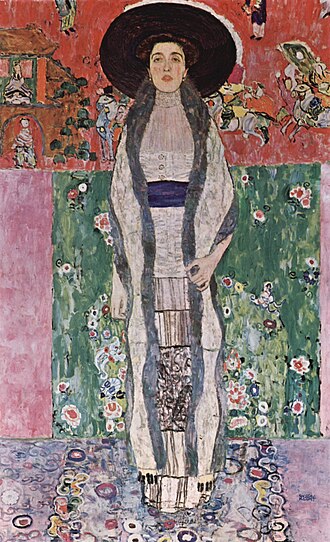 Adele Bloch-Bauer II - Gustav Klimt (1912)
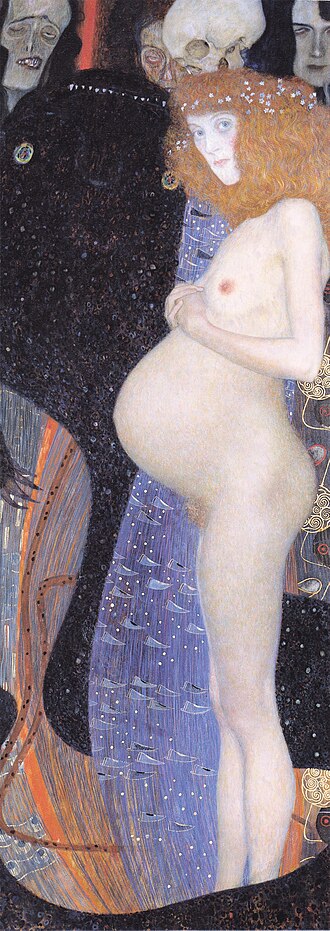 Hope I - Gustav Klimt (1903)