Pastorales tahitiennes
Paul Gauguin · 1892
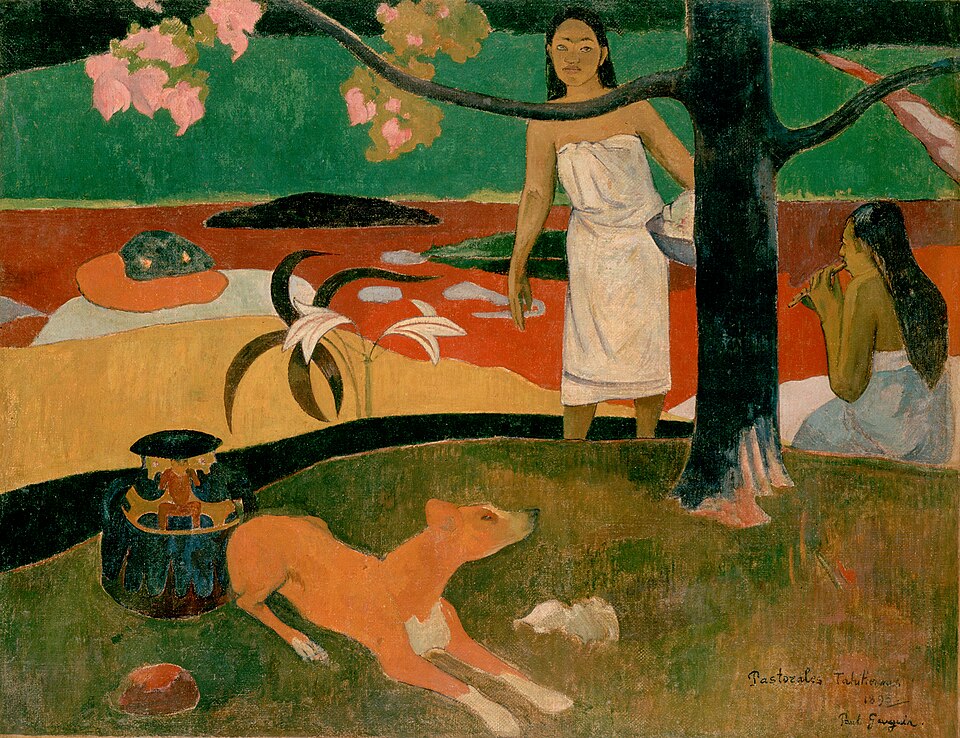
A red dog asleep under a blossoming tree, a girl playing the flute with her back to us, a red plain under green hills. Gauguin wrote the title right onto his Tahitian idyll.
The story behind the painting
Pastorales tahitiennes belongs to Gauguin's Tahitian cycle, painted during his first stay on the island. Gauguin signed and dated it 1893 in the lower right corner, in three lines: Pastorales Tahitiennes, 1893, Paul Gauguin. Wikidata, however, gives the date as 1892, so the sources disagree by a year. In 1893 the canvas was sent to Europe and shown at the gallery of Paul Durand-Ruel. A watercolour sketch for it, mentioned by A. G. Kostenevich, is in the Thiel Gallery in Stockholm; it is less stylised and shows three girls.
What to look for
In the foreground rises a small mound with a flowering tree. On the left, before the plant, stand a large painted jug and a red dog lying down, and beside the dog a small offering vessel made from a gourd. Behind a tree on the left a young Tahitian woman holds a large basin. On the right, on the slope, another girl sits with her back to us, playing the flute. Beyond them spreads a red plain with two small hills, then the rising side of a large hill with a road climbing it. The canvas is about 88 by 114 cm.
Meaning and intent
The title, written in French by Gauguin himself, calls the scene a pastoral: an old European word for idyllic shepherd life, applied to Tahiti. The flute, the offering vessel and the resting dog create a calm, timeless mood, and the unnatural red of the ground and the dog shows how freely Gauguin used colour. According to Barskaya, he reused similar motifs in Mata Mua, now in the Thyssen-Bornemisza Museum in Madrid, and in Arearea in the Musée d'Orsay, which directly recalls this picture. A similar lily appears in Nave nave moe, also in the Hermitage.
Legacy
On 18 February 1895 the painting was offered at the sale of Gauguin's paintings and drawings at the Hôtel Drouot in Paris, which helped fund his return to Tahiti. It then passed through the gallery of Bernheim-Jeune, to the Prince of Wagram, and through the gallery of Ambroise Vollard. On 14 September 1908 the Moscow industrialist and collector Ivan Morozov bought it. After the October Revolution his collection was nationalised, and from 1923 the work was in Moscow's State Museum of New Western Art. In 1948 it went to the Hermitage, and since late 2014 it hangs in the General Staff Building, room 412.
Did you know?
- Signed and dated 1893 by Gauguin; Wikidata gives 1892.
- Part of Gauguin's Tahitian cycle.
- Bought by Ivan Morozov in 1908.
- In the Hermitage since 1948.
About the artist
Paul Gauguin (1848-1903)
More by Paul Gauguin
 Where Do We Come From? What Are We? Where Are We Going? - Paul Gauguin (1897-1898)
 The Yellow Christ - Paul Gauguin (1889)
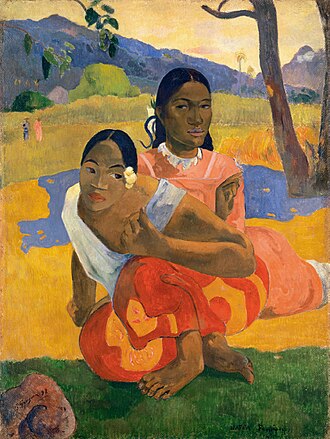 When Will You Marry? - Paul Gauguin (1892)
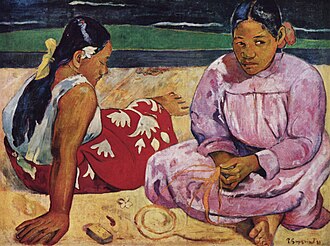 Tahitian Women on the Beach - Paul Gauguin (1890)
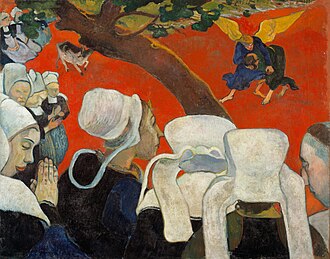 Vision After the Sermon - Paul Gauguin (1888)
Manaò tupapaú - Paul Gauguin (1892)
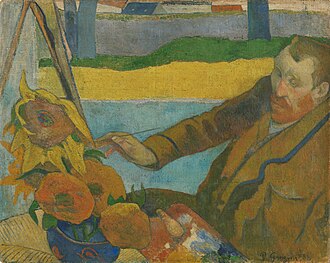 Vincent van Gogh Painting Sunflowers - Paul Gauguin (1888)
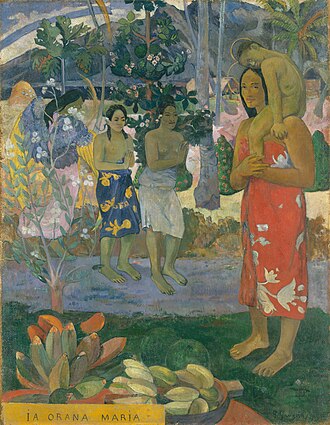 Ia Orana Maria - Paul Gauguin (1891)
Paintings by related artists
 The Starry Night - Vincent van Gogh (1889)
 Café Terrace at Night - Vincent van Gogh (1888)
 Walk on the mountain - Joaquín Sorolla (1909)
 Sad Inheritance - Joaquín Sorolla (1898)
 Les Grandes Baigneuses - Paul Cézanne (1900s)
 The Boy in the Red Vest - Paul Cézanne
 Dance at Le Moulin de la Galette - Pierre-Auguste Renoir (1876)
 Luncheon of the Boating Party - Pierre-Auguste Renoir (1881)
 At the Moulin Rouge - Henri de Toulouse-Lautrec (1892)
 La Toilette - Henri de Toulouse-Lautrec (1896)