Manaò tupapaú
Paul Gauguin · 1892
%20-%201965-1%20-%20Albright%E2%80%93Knox%20Art%20Gallery.tiff)
Gauguin's own title can be read two ways: a girl thinking of a ghost, or a ghost thinking of her. Today the painting is also read for what Gauguin left out of his own account.
The story behind the painting
Painted in Tahiti in 1892 in oil on burlap, Manao tupapau, or Spirit of the Dead Watching, shows a Tahitian girl lying face down on a bed, with an old woman seated behind her. The source identifies the girl as Teha'amana, called Tehura in Gauguin's letters, who was 13 years old and whom Gauguin had taken as his child-wife. According to Gauguin, he came home late one night and found her lying motionless in fear, and he imagined she took him for a tupapau, a spirit of the dead. Writing to his wife Mette, he did not mention that the girl was his lover. The source also records that he passed a venereal disease on to Teha'amana.
What to look for
Gauguin described the colour plan himself in a letter to Daniel Monfreid: a general harmony of dark dull violet, dark blue and chrome yellow. He explained that the chrome draperies suggest night without spelling it out, and act as a bridge between yellow-orange and green. Look for the small flowers scattered in the dark; he likened them to phosphorescent lights, which he said the Tahitians took to be souls of the dead. The girl's wide eyes carry the fear at the centre of the picture, while the seated old figure in the background stands for the watching spirit. Gauguin himself admitted the painting was "not according to nature".
Meaning and intent
Gauguin offered the ghost story as the reason for the girl's fear, but historians have questioned it. Nancy Mowll Mathews links the picture to his earlier "frightened Eves" and, following Sweetman, suggests the fear may instead reflect Gauguin's aggressive behaviour. Stephen F. Eisenman calls the painting and its story an encyclopaedia of colonial racism and misogyny. Naomi E. Maurer sees the narrative as a device to make the subject acceptable to European viewers. Griselda Pollock reads it as an avant-garde gambit answering Manet's Olympia, through which Gauguin placed himself as artist, owner and colonist. Gauguin's five written accounts of the work, from letters of 1892 to the 1901 Noa Noa, do not fully agree.
Legacy
Gauguin clearly valued the work: it appears, reversed, in the background of his Self-portrait with Hat. He showed it at his 1893 Durand-Ruel exhibition in Paris, where it did not sell. Critics noticed its debt to Manet's Olympia; Thadée Natanson called it the "Olympia of Tahiti". Art historians count it, with Te arii vahine and Nevermore, among the great South Pacific nudes in which Olympia is a constant presence. Today it belongs to the Buffalo AKG Art Museum, according to Wikidata. It remains a central work in debates about how museums and viewers should look at Gauguin's Tahitian paintings, and about the girl whose own voice the record does not preserve.
Did you know?
- Painted in 1892, oil on burlap; 72.4 × 92.4 cm.
- Gauguin translated the title as "Think of the Ghost, or, The Spirits of the Dead are Watching".
- Shown at the 1893 Durand-Ruel exhibition in Paris.
- Collection: Buffalo AKG Art Museum (Wikidata).
About the artist
Paul Gauguin (1848-1903)
woman · genre art · Post-impressionism · waist-length hair · nude · nudity · bed · lying · black hair · pillow
More by Paul Gauguin
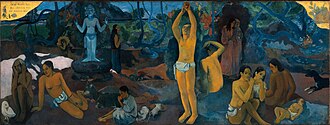 Where Do We Come From? What Are We? Where Are We Going? - Paul Gauguin (1897-1898)
%201889.jpg) The Yellow Christ - Paul Gauguin (1889)
The Yellow Christ - Paul Gauguin (1889)%201892%2C%20oil%20on%20canvas%2C%20101%20x%2077%20cm.jpg) When Will You Marry? - Paul Gauguin (1892)
When Will You Marry? - Paul Gauguin (1892)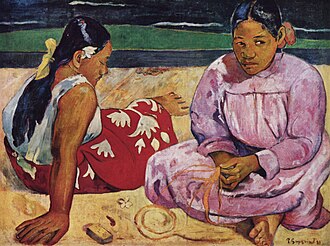 Tahitian Women on the Beach - Paul Gauguin (1890)
.jpg) Vision After the Sermon - Paul Gauguin (1888)
Vision After the Sermon - Paul Gauguin (1888)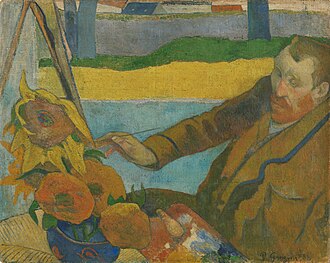 Vincent van Gogh Painting Sunflowers - Paul Gauguin (1888)
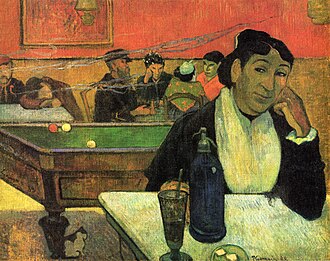 The Night Café in Arles - Paul Gauguin (1888)
%20-%201926.198%20-%20Art%20Institute%20of%20Chicago.jpg) Day of the God - Paul Gauguin (1894)
Day of the God - Paul Gauguin (1894)
Paintings by related artists
 The Starry Night - Vincent van Gogh (1889)
.jpg) Café Terrace at Night - Vincent van Gogh (1888)
Café Terrace at Night - Vincent van Gogh (1888) Dance at Le Moulin de la Galette - Pierre-Auguste Renoir (1876)
 Luncheon of the Boating Party - Pierre-Auguste Renoir (1881)