Martinique Landscape
Paul Gauguin · 1887
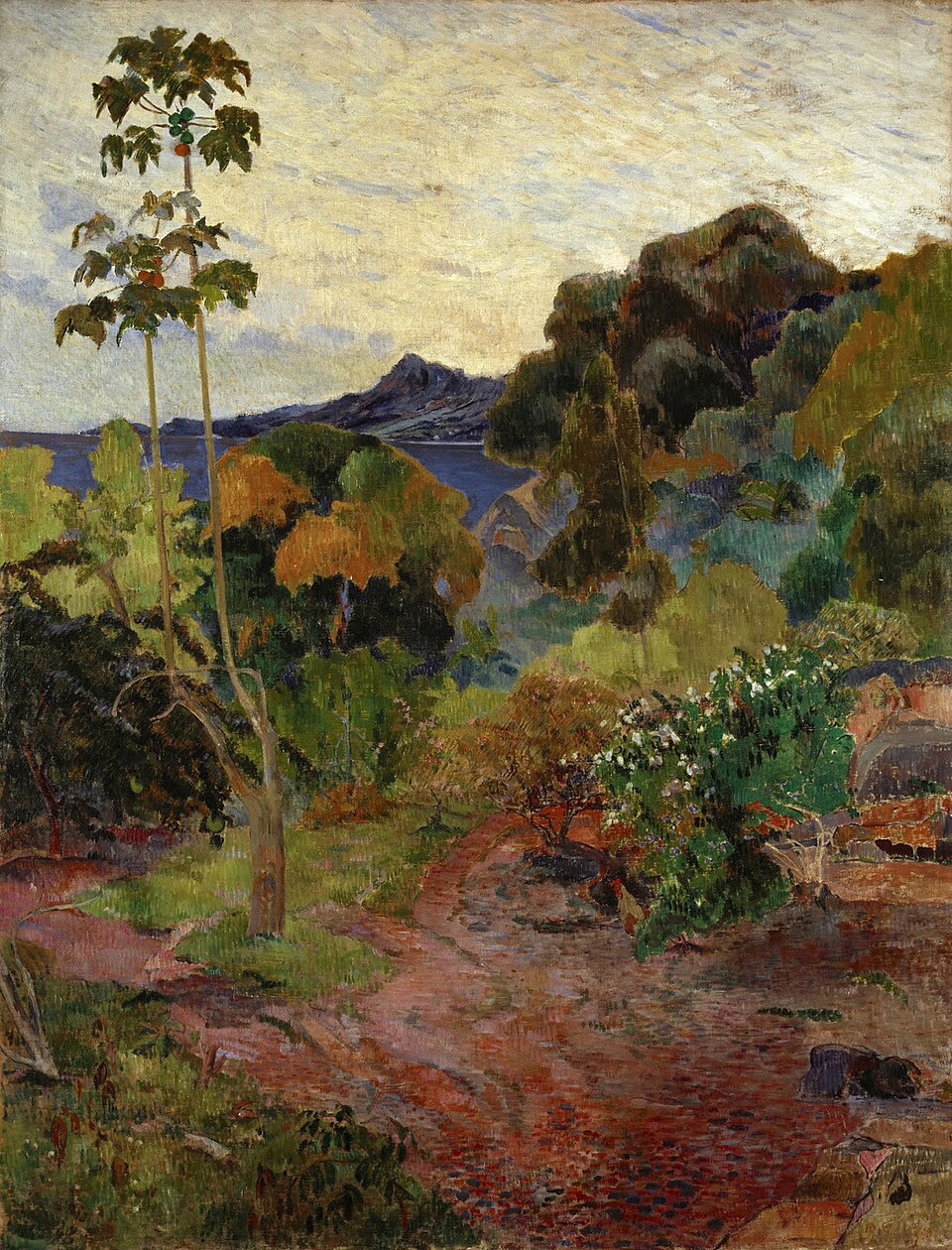
Bright tropical leaves crowd a hillside above the bay of Saint-Pierre, with a lone papaya tree against the sky. Gauguin painted it in Martinique in 1887, deliberately leaving out every sign of the town below.
The story behind the painting
Gauguin spent several months in Martinique in 1887 with the painter Charles Laval. They had come from working on the Panama Canal to pay for the journey, and settled at Le Carbet, near the old capital Saint-Pierre. The bay of Saint-Pierre is seen splendidly from Morne d'Orange, the hill to the south near Le Carbet, with a bare plain at the top and a monument to Notre-Dame-du-Port. To the north rises Mount Pelee, the volcano that erupted in 1902, fifteen years after this picture, destroying the old capital and the whole area. The work is also known as Tropical Vegetation and is listed as W.232 in the Wildenstein catalogue.
What to look for
The view is the bay of Saint-Pierre from Morne d'Orange, but Gauguin removed all traces of civilisation and added vegetation, probably plants he saw near Le Carbet, moving them onto the hill in front of the bay. In the background are the last slopes of the volcano near the sea. A two-branched papaya tree is cut out against the sky. The foliage in the foreground is painted with visible, Impressionist brushstrokes, while the lower plants and the trees take more stylised shapes in flat colours. Look among the bushes for a rooster. The inscription 1887 / P.Gauguin is at lower right.
Meaning and intent
Bright colour carries the exotic feeling of the place. The harmony of colours and the simplified forms are described as the first steps of Post-Impressionism, and the mix of loose Impressionist strokes with flat, stylised areas shows Gauguin moving between two ways of painting. The rooster among the bushes is read as a likely symbol of the French presence. Just before, Gauguin had been at the Panama Canal works and had seen how Western culture changed native landscapes and customs, which may explain why he chose to paint a bay without its town.
Legacy
The source sees the Martinique experience as the prelude to the maturity Gauguin reached years later in Tahiti. Gauguin himself sold the painting to the composer Ernest Chausson. Today it belongs to the National Galleries of Scotland in Edinburgh. Looking at it now carries an extra weight: the town that Gauguin chose to leave out of the view was wiped away by Mount Pelee only fifteen years later, while his imagined, untouched hillside remains on the canvas.
Did you know?
- Painted in Martinique in 1887, near Le Carbet.
- Gauguin left out all traces of the town of Saint-Pierre.
- Mount Pelee destroyed Saint-Pierre in 1902.
- Now in the National Galleries of Scotland, Edinburgh.
About the artist
Paul Gauguin (1848-1903)
genre art · landscape painting · National Galleries Scotland
More by Paul Gauguin
 Where Do We Come From? What Are We? Where Are We Going? - Paul Gauguin (1897-1898)
 The Yellow Christ - Paul Gauguin (1889)
 When Will You Marry? - Paul Gauguin (1892)
 Tahitian Women on the Beach - Paul Gauguin (1890)
 Vision After the Sermon - Paul Gauguin (1888)
Manaò tupapaú - Paul Gauguin (1892)
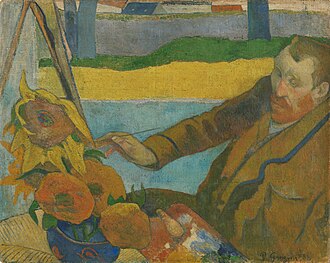 Vincent van Gogh Painting Sunflowers - Paul Gauguin (1888)
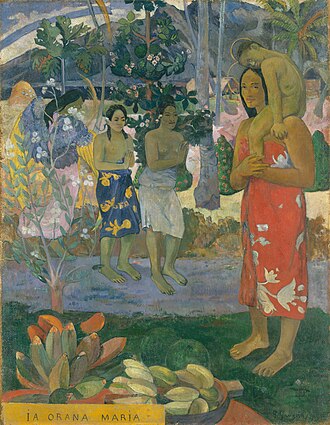 Ia Orana Maria - Paul Gauguin (1891)
Paintings by related artists
 The Starry Night - Vincent van Gogh (1889)
 Café Terrace at Night - Vincent van Gogh (1888)
 Walk on the mountain - Joaquín Sorolla (1909)
 Sad Inheritance - Joaquín Sorolla (1898)
 Les Grandes Baigneuses - Paul Cézanne (1900s)
 The Boy in the Red Vest - Paul Cézanne
 Dance at Le Moulin de la Galette - Pierre-Auguste Renoir (1876)
 Luncheon of the Boating Party - Pierre-Auguste Renoir (1881)
 At the Moulin Rouge - Henri de Toulouse-Lautrec (1892)
 La Toilette - Henri de Toulouse-Lautrec (1896)