Madonna of the Cherries
Titian · 1510s
%20-%20GG%20118%20-%20Kunsthistorisches%20Museum.jpg)
A wriggling baby offers cherries to his mother across a stone ledge, while old saints close in from the sides. Titian takes a Venetian formula and lets it move.
The story behind the painting
Titian painted this work in 1515, heavily influenced by Giovanni Bellini. It was first painted in oil on wood and later transferred to canvas. In the seventeenth century it belonged to Archduke Leopold Wilhelm, whose collection was recorded by the painter David Teniers the Younger. Teniers copied it, included it in his painted views of the Archduke's gallery, and listed it in his catalogue, the Theatrum Pictorium, published in 1659 and again in 1673. Wikidata dates it to the 1510s.
What to look for
A red curtain damasked with gold hangs behind the half figures of the Madonna and child. Jesus wriggles on a parapet, offering cherries to his mother, while the infant John the Baptist leans in, also offering a cherry and holding a scroll that reads ECCE AGNVS DEI. Saints Joseph and Zechariah, John's father, close the sides. Compare the idealised Virgin and child with the realistic saints, especially the detailed face of Zechariah.
Meaning and intent
The cherries point to original sin and the red blood of the Passion, and in John's hand they are a symbol of virginity. The Virgin and child form a triangle, a shape of eternity and harmony, against the upright saints. The layout follows Bellini's Madonnas, and also Albrecht Dürer, whose Madonna painted in Venice in 1506 shows John with a lily of the valley. Titian adds movement, figures looking up and down, and bright, full colours.
Legacy
The painting is now in the Kunsthistorisches Museum in Vienna, which also holds The Gypsy Madonna, a Titian with a similar triangular composition placing the infant between the balustrade and the cloth. Its record in the Theatrum Pictorium and in Teniers' gallery pictures shows that it was already well known in the seventeenth century, as one of the treasures of Archduke Leopold Wilhelm. It measures about 81 by 99.5 cm.
Did you know?
- Painted by Titian in 1515, influenced by Bellini.
- Transferred from wood to canvas.
- Copied by David Teniers in the Archduke's collection.
- Now in the Kunsthistorisches Museum, Vienna.
About the artist
Titian (1488-1576)
religious art · Mary · High Renaissance · Christ Child · Venetian school · Kunsthistorisches Museum · Saint Joseph · Child Saint John
More by Titian
.jpg) Venus of Urbino - Titian (1538)
Venus of Urbino - Titian (1538)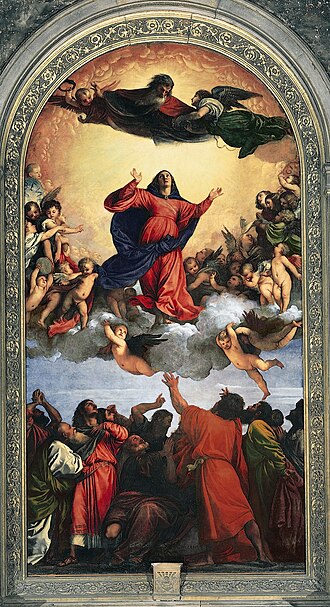 Assumption of the Virgin - Titian (1510s)
FXD.jpg) Sacred and Profane Love - Titian (1510s)
Sacred and Profane Love - Titian (1510s)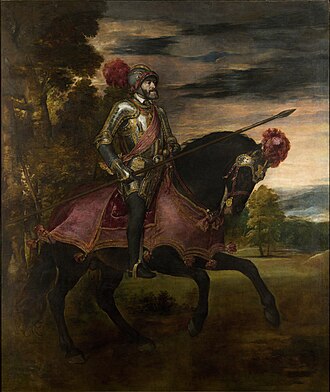 Equestrian Portrait of Charles V - Titian (1548)
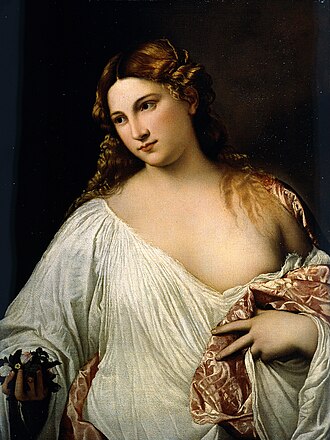 Flora - Titian (1517)
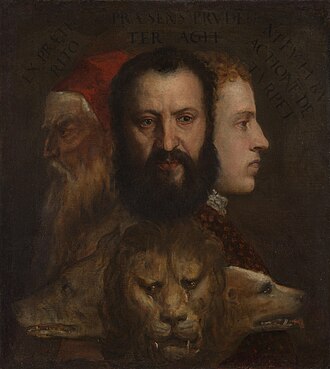 Allegory of Prudence - Titian (1550)
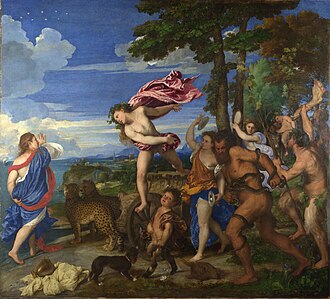 Bacchus and Ariadne - Titian (1520s)
%20nave%20left%20-%20Altar%20of%20Madona%20di%20Ca'Pesaro.jpg) Pesaro Madonna - Titian
Pesaro Madonna - Titian