Madonna of Borgo San Lorenzo
Giotto · 1290
%2C%20madonna%20di%20borgo%20san%20lorenzo%2C%201290%20ca.jpg)
Once dismissed as a dark-faced "Byzantine image", this fragment hid a tender secret under its grime: a tiny hand holding its mother's finger.
The story behind the painting
The Madonna of Borgo San Lorenzo, also called the Madonna of Omobono or Madonna Nera, is a fragment of a tempera painting on a gold ground on wood, attributed to Giotto and dated around 1290-1295; Wikidata gives 1290. It is kept in the Pieve di San Lorenzo at Borgo San Lorenzo. Originally an enthroned Virgin, it stood in an altar niche of the oratory of the Company of Sant'Omobono, opposite the church. If it is by Giotto, it is probably one of his earliest works, painted when he was about twenty.
What to look for
What survives is small, about 81.5 by 41 cm. The Virgin holds the Child in her arms, but the child has almost disappeared through poor preservation. Look closely and you can still see his two forearms: one small hand caresses his mother's face, the other holds the index finger of her left hand. Notice her elongated eyes and expressive face, the long, delicate hands, the fine drapery and the gilded edge of her garment.
Meaning and intent
The gesture follows the Byzantine type of the Glykophilousa, the Virgin of tenderness, already used by Cimabue in the Madonna di Castelfiorentino. In Giotto's version, according to the source, the scene becomes even more tender and familiar through the little hand gripping the mother's finger, an emphasis on feeling that marked the Tuscan school compared with Byzantine models. There is already a pronounced sense of volume and space, with influences of the Roman school probably absorbed on an early trip to Rome with his master Cimabue.
Legacy
For a long time the panel's colours were so darkened by dirt that early nineteenth-century guides described it as a Byzantine image with a dark face, which explains the name Madonna Nera. Between 1982 and 1984 it was restored by the Opificio delle pietre dure in Florence, which revealed its quality and linked it to the Crucifix of Santa Maria Novella and the Madonna of San Giorgio alla Costa. Luciano Bellosi first attributed it to Giotto in 1985; the attribution was confirmed in an exhibition but is not unanimous.
Did you know?
- Dated around 1290-1295 (French Wikipedia); 1290 in Wikidata.
- Restored 1982-1984 by the Opificio delle pietre dure.
- First attributed to Giotto by Luciano Bellosi in 1985; not unanimously accepted.
- Size: 81.5 x 41 cm (Wikidata).
About the artist
Giotto (1267-1337)
religious art · woman · Mary · Christ Child · boy
More by Giotto
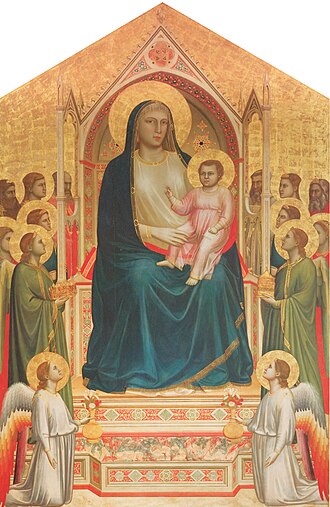 Madonna Enthroned - Giotto (1300s)
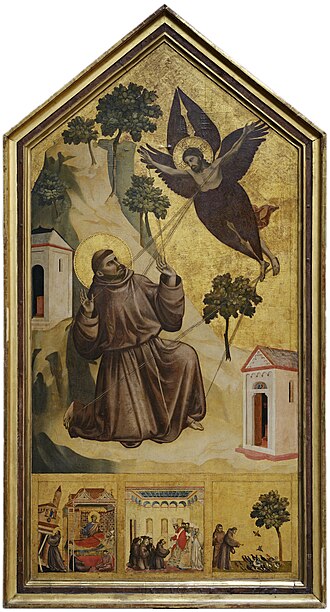 St. Francis of Assisi Receiving the Stigmata - Giotto (1290s)
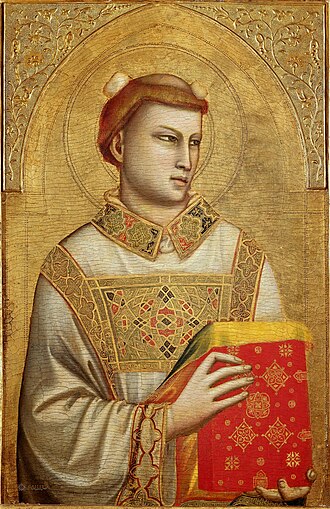 Saint Stephen - Giotto (1320)
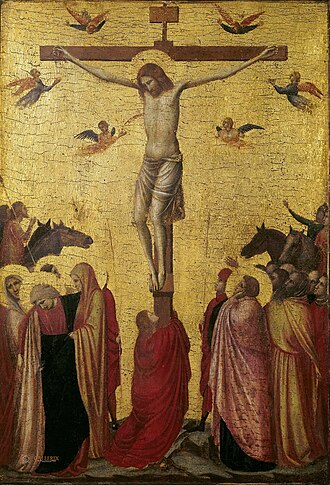 Crucifixion of Strasbourg - Giotto (1315)
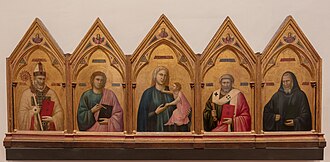 Badia Polyptych - Giotto (1300s)
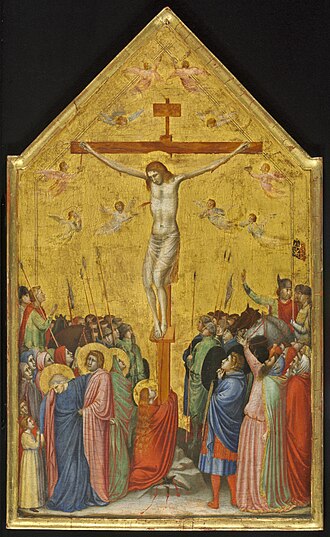 The Crucifixion of Christ - Giotto (1310s)
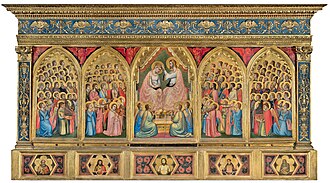 Coronation of Mary with Angels and Saints - Giotto (1328)
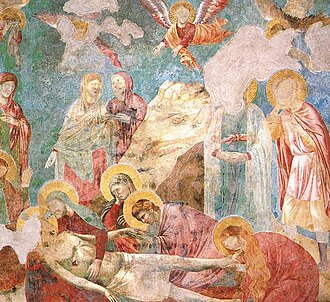 Scenes from the New Testament: Lamentation - Giotto (1291)