Mademoiselle V. . . in the Costume of an Espada
Édouard Manet · 1862
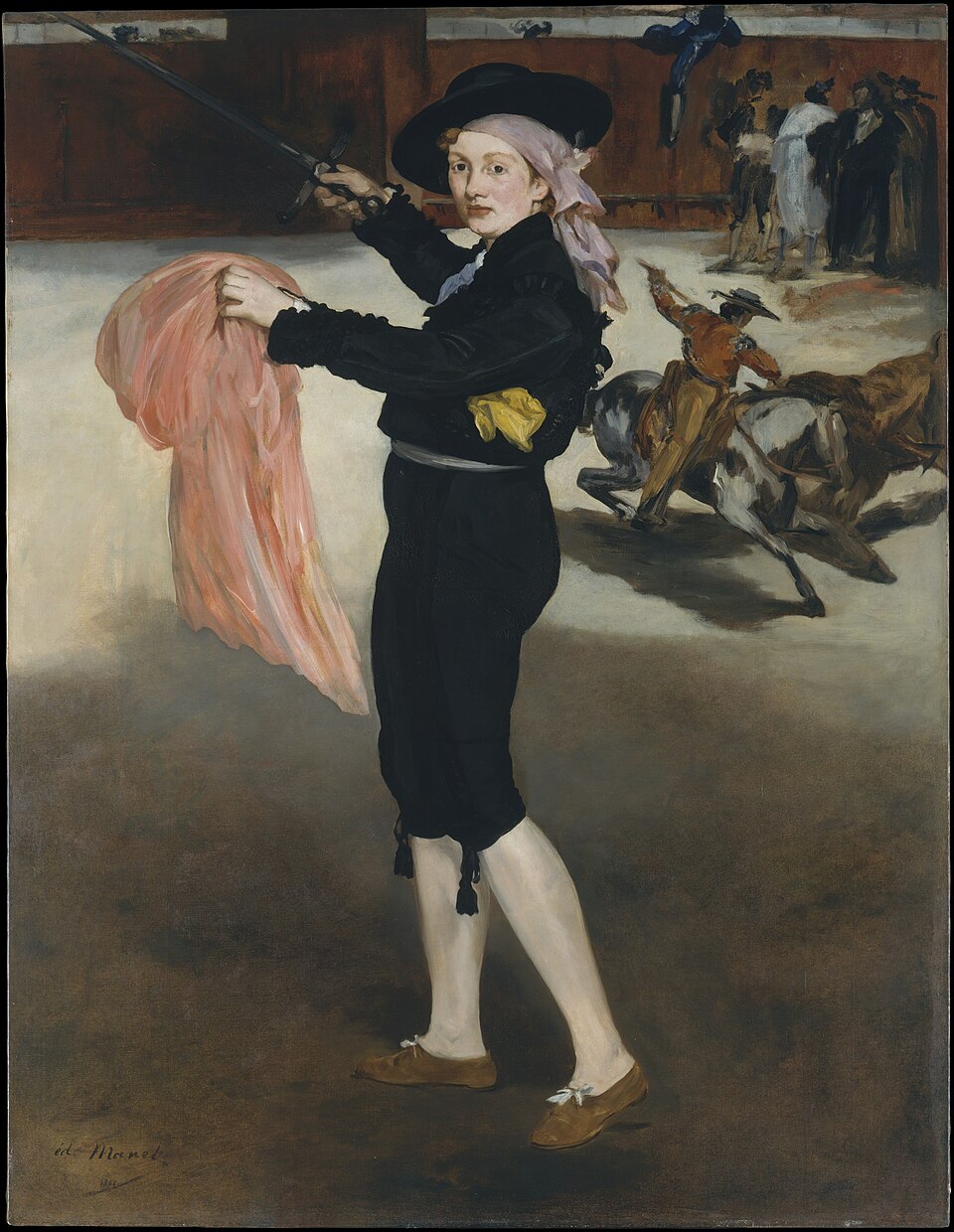
A young woman in a bullfighter's costume stares straight at us, sword in hand, while a bull charges a horseman far behind her. Manet never hid the trick: the title itself tells you this is a model in a costume, posing in a Paris studio.
The story behind the painting
Manet painted this canvas in 1862, and his model was Victorine Meurent, the woman who also posed for some of his best known pictures. The bullring around her was never real: she stood in his studio, and the arena was assembled from other artists' images. The following year Manet sent the painting to the Salon des Refusés of 1863, the exhibition of works turned away by the official Salon, where it hung alongside Young Man in the Costume of a Majo and Le Déjeuner sur l'herbe. It is often cited as a clear sign of how strongly Spanish art was shaping Manet in these years.
What to look for
Victorine stands dressed as an espada, the bullfighter who kills the bull, with a sword in her right hand. Yet she does not look at the bull at all. She looks at you. Behind her a bull is about to attack a picador on horseback, and further back a group of toreros watch from a safe distance. Look at her cape: it is pink, not the colour a male bullfighter would carry, and her shoes are not traditional either. The canvas is large, about 165 by 128 cm. The background scene comes almost directly from plate 5 of Francisco Goya's Tauromaquia prints, though Manet dressed the picador in contemporary clothes.
Meaning and intent
Like many of Manet's works, the painting is about artifice: dressing up and make-believe. Manet wanted his paintings to be seen as fiction, so that attention would move from the story to the painting itself, and the title openly admits that Mademoiselle V. is a model in costume. He also borrowed freely from older art and made no secret of it. Victorine's stance echoes the figure of Temperance, and the angle of her sword echoes Justice, in Marcantonio Raimondi's engravings of the Virtues. Mixing staged artifice with borrowings from earlier masters, as he did with Titian's Venus of Urbino for Olympia, is one of the marks of Manet's style.
Legacy
The Metropolitan Museum of Art in New York acquired the painting in 1929, and it is still there. In the 1980s the museum examined it with X-radiography and found a surprise: beneath Victorine lies another figure, a female nude painted upside down. She closely resembles one of the nudes in François Boucher's Diana Leaving Her Bath. The discovery shows Manet reusing a canvas, and it fits the picture's own story, an image built from layers of other images. Today the painting is still read as an early statement of Manet's modern idea that a picture can openly show that it is staged.
Did you know?
- Painted in 1862, with Victorine Meurent as the model.
- Shown at the Salon des Refusés in 1863.
- The background borrows from Goya's Tauromaquia, plate 5.
- X-rays revealed an upside-down female nude beneath the surface.
About the artist
Édouard Manet (1832-1883)
woman · genre art · Metropolitan Museum of Art · standing · Victorine Meurent · stocking
More by Édouard Manet
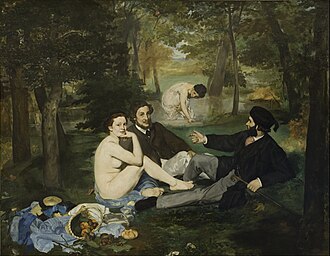 Luncheon on the Grass - Édouard Manet (1863)
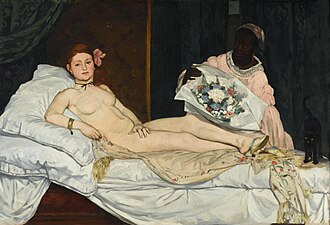 Olympia - Édouard Manet (1863)
%20(33539037428).jpg) A Bar at the Folies-Bergère - Édouard Manet (1882)
A Bar at the Folies-Bergère - Édouard Manet (1882)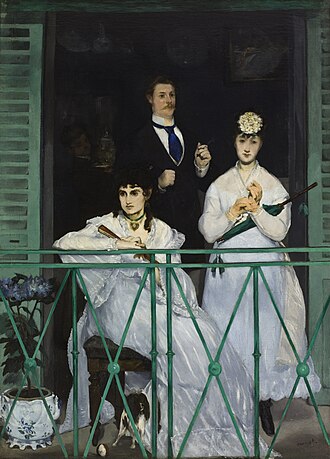 The Balcony - Édouard Manet (1868)
.jpg) Music in the Tuileries - Édouard Manet (1862)
Music in the Tuileries - Édouard Manet (1862).jpg) The Fif - Édouard Manet (1866)
The Fif - Édouard Manet (1866)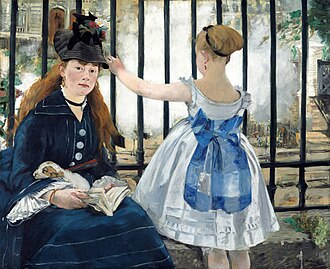 The Railway - Édouard Manet (1873)
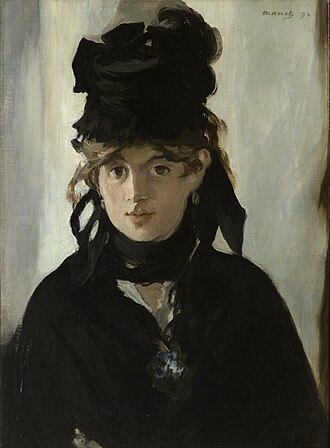 Berthe Morisot with a Bouquet of Violets - Édouard Manet (1872)
Paintings by related artists
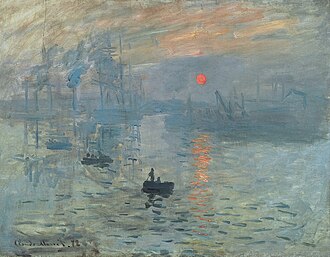 Impression, Sunrise - Claude Monet (1872)
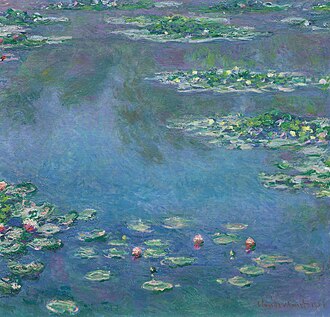 Water Lilies - Claude Monet (1906)
 Dance at Le Moulin de la Galette - Pierre-Auguste Renoir (1876)
 Luncheon of the Boating Party - Pierre-Auguste Renoir (1881)
 The Fighting Temeraire - J. M. W. Turner (1839)
 Rain, Steam and Speed - The Great Western Railway - J. M. W. Turner (1844)
 The Starry Night - Vincent van Gogh (1889)
.jpg) Café Terrace at Night - Vincent van Gogh (1888)
Café Terrace at Night - Vincent van Gogh (1888)