Landscape with Saint John on Patmos
Nicolas Poussin · 1640
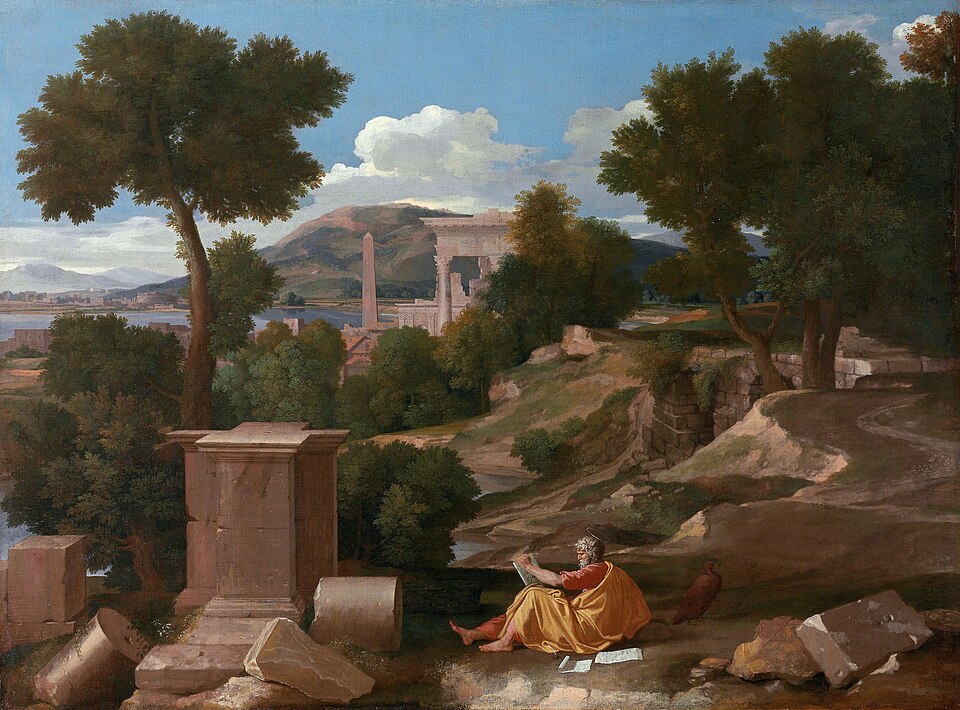
An old saint reclines among ruined temples and writes the visions of the Apocalypse in a bright, calm landscape. Poussin painted Saint John on Patmos in 1640, a world rebuilt from the ruins of the old.
The story behind the painting
Saint John was banished to the island of Patmos by the Roman emperor Domitian for his Christian beliefs, and there he recorded the visions of the Book of Revelation. Poussin painted the scene in 1640. He is widely regarded as a champion of seventeenth-century classicism, and in unfinished notes he described what he called the grand manner: paintings with a grand motif and appropriate arrangement, measure and form. This picture applies that ideal.
What to look for
As often with Poussin, the landscape dominates the canvas, about 100 by 136 cm. In the foreground lies Saint John, posed much like an ancient Greek god, writing. Behind him stand two oak trees, an obelisk and the ruins of an ancient temple, under a sunny sky. The hills and sky form an imaginary setting that, according to the source, defies the rules of atmospheric perspective. Everything is calm and ordered.
Meaning and intent
Patmos appears as an open world, a new world built from the old, symbolised by the ruined Greek buildings. Ancient buildings were often repurposed by the Church, so their decay here suggests the old ways giving place to Christianity. The saint writing in the sun among broken stones carries that idea quietly, without drama. The exile becomes a place of creation rather than of punishment, and the broken past becomes the ground of a new faith.
Legacy
The painting was one of a pair; the other showed Saint Matthew, and both were presented to Gian Maria Rosicoli, secretary to Pope Urban VIII. Today Saint John on Patmos hangs in the Art Institute of Chicago. Its open landscape, where the scenery matters as much as the saint, shows Poussin's classical ideal of a grand motif with fitting arrangement, measure and form. Painted in 1640, it remains a clear example of the large landscapes that typically dominate his canvases.
Did you know?
- Painted in 1640.
- Saint John writes the Book of Revelation in exile.
- Pair with a Saint Matthew, for Pope Urban VIII's secretary.
- Held by the Art Institute of Chicago.
About the artist
Nicolas Poussin (1594-1665)
religious art · Art Institute of Chicago · historical landscape
More by Nicolas Poussin
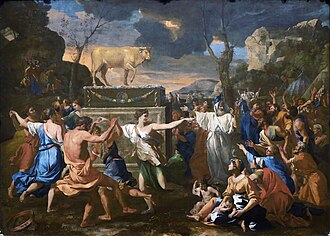 The Adoration of the Golden Calf - Nicolas Poussin (1634)
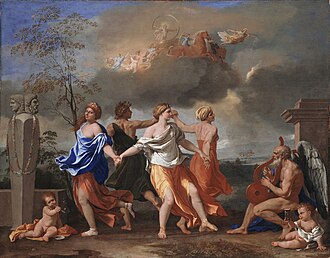 A Dance to the Music of Time - Nicolas Poussin (1630s)
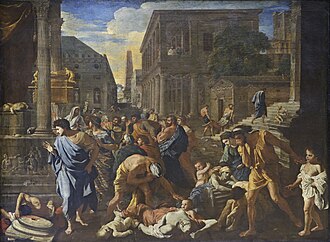 The Plague at Ashdod - Nicolas Poussin (1630)
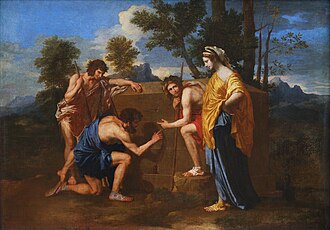 Et in Arcadia ego - Nicolas Poussin (1638)
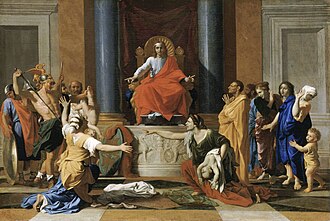 The Judgment of Solomon - Nicolas Poussin (1649)
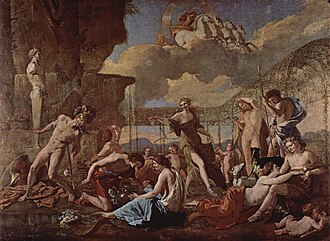 The Empire of Flora - Nicolas Poussin (1631)
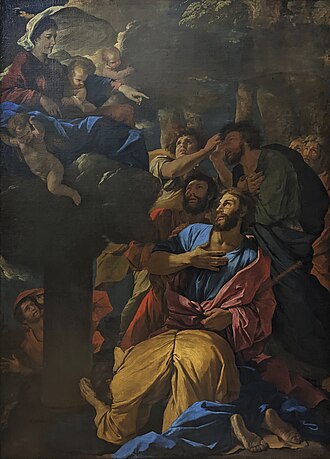 The Apparition of the Virgin to Saint James the Great - Nicolas Poussin (1620s)
 The Martyrdom of Saint Erasmus - Nicolas Poussin (1628)