The Judgment of Solomon
Nicolas Poussin · 1649
.jpg)
Two mothers kneel before a king who has ordered a baby cut in two. Poussin painted The Judgement of Solomon in Rome in 1649 and called it his best work.
The story behind the painting
The picture was made in 1649, during Poussin's stay in Rome from 1647 to 1649, for Jean Pointel, a silk merchant and banker from Lyon who had settled in Paris. Pointel had become a close friend of the artist on an earlier visit to Rome around 1645 to 1646, and commissioned this painting during his second stay. Their trust was deep: Pointel kept large sums in Poussin's bank, and Poussin named him executor of his will, though Pointel died first, in 1660. Meanwhile another patron, Chantelou, wrote jealous letters accusing Poussin of sending his finest works to Pointel. On sending this one around 1649 to 1650, Poussin called it his best work.
What to look for
The canvas, about 101 by 150 cm, shows the biblical story: two women each claim the same child, and Solomon orders it divided so each can have half. Watch the two mothers. As the curator Alexandre Lenoir wrote in 1823, the painting shows at once the tenderness of the true mother, who would give up her son rather than see him die, and the feelings of the woman who only pretends. Poussin, often called the French Raphael, drew on Raphael's treatment of the same subject and his Conversion of the Proconsul. The 17th century writer André Félibien admired its correct drawing and the beauty of its expressions.
Meaning and intent
Lenoir compared Poussin to the playwright Racine, saying he knew a mother's heart just as well, and held the picture up as the model for anyone wishing to show a mother seeing her child about to be sacrificed. The scene sets wisdom against raw emotion. The historian Oskar Bätschmann has even argued that, in the years when the Fronde made it hard to reach his patrons in France, Poussin used this picture to express a wish for an end to France's conflicts, placing an idea of justice, wisdom and equity over an emotional quarrel. Art historians widely count it among his masterpieces and among the high points of French art.
Legacy
After Pointel's death the painter Philippe de Champaigne catalogued his collection. The painting then passed to the financier Nicolas du Plessis-Rambouillet, to Achille III de Harlay of the Paris Parlement, and to Charles-Antoine Hérault, who sold it to Louis XIV in 1685. It hung at Versailles and in royal offices; a note of 1784 asked that five hidden inches under the frame be left visible, and in 1789 it was cleaned and repaired. Seized by the revolutionary state, it was in the Louvre when it opened as a public museum in 1793, and has stayed there since. Several engravings spread the image.
Did you know?
- Painted in Rome in 1649 for Jean Pointel of Lyon.
- Poussin called it his best work.
- Bought by Louis XIV in 1685.
- In the Louvre since 1793.
About the artist
Nicolas Poussin (1594-1665)
religious art · woman · man · Department of Paintings of the Louvre · history painting · crowd · soldier
More by Nicolas Poussin
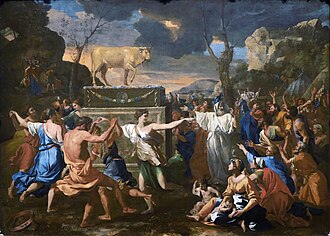 The Adoration of the Golden Calf - Nicolas Poussin (1634)
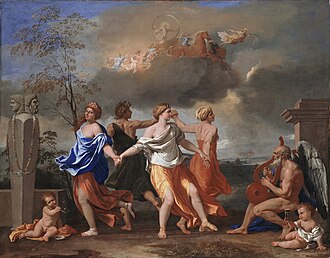 A Dance to the Music of Time - Nicolas Poussin (1630s)
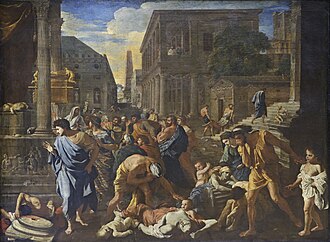 The Plague at Ashdod - Nicolas Poussin (1630)
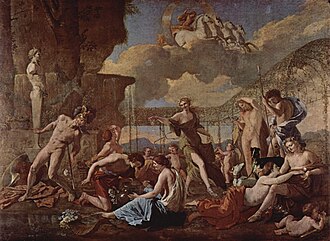 The Empire of Flora - Nicolas Poussin (1631)
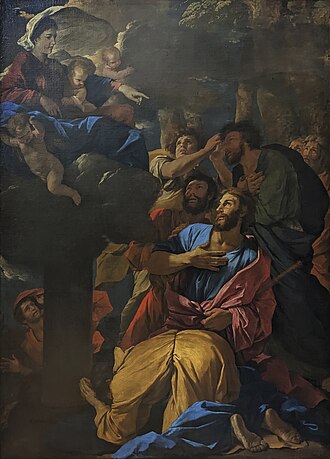 The Apparition of the Virgin to Saint James the Great - Nicolas Poussin (1620s)
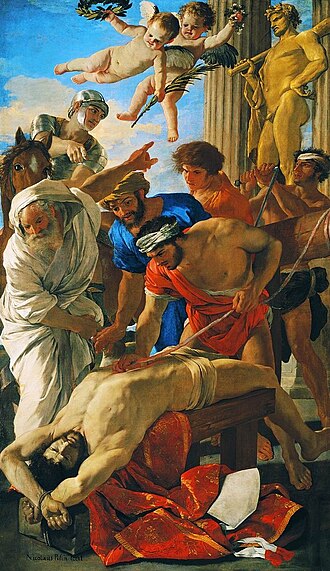 The Martyrdom of Saint Erasmus - Nicolas Poussin (1628)
 A Bacchanalian Revel Before a Term - Nicolas Poussin (1630s)
 Midas and Bacchus - Nicolas Poussin (1630)