La Schiavona
Titian · 1510s
%20-%20Google%20Art%20Project.jpg)
A confident woman rests her hand on a stone ledge, and beside her, carved like an ancient cameo, is her own profile. Young Titian painted her twice in one picture.
The story behind the painting
La Schiavona, "the woman from Dalmatia", also called Portrait of a Lady, was painted by Titian around 1510-1512. The name is traditional, used before the start of the seventeenth century and inspired by her dress and features. In reality she was probably a noblewoman, dressed like wealthy women in the territories of the Venetian Republic. Some have tried to identify her as Catherine Cornaro, but nothing confirms it. The picture was once given to Giorgione; today it is generally accepted as a youthful masterpiece by Titian, close to the woman in his Paduan fresco Miracle of the Newborn Child of 1511.
What to look for
She is shown three-quarter length against a plain grey background. Her body turns slightly while her head faces us directly, in a pose of remarkable ease. The wide earth-coloured dress emphasises her full, curving form, painted with striking realism. Then look at the parapet: on its raised section appears what seems to be the same woman in profile, carved in relief like an ancient cameo. That raised part is a revision by Titian himself, and the drapery he painted underneath still shows through. The letters TV on the parapet probably stand for Tiziano Vecellio.
Meaning and intent
The picture sets a living face beside a stone one, as if comparing painting and sculpture. It also changed over time. According to the source, Titian reworked it drastically around 1540, entirely repainting the face, neck and red drapery, with the result that the colour now looks rather dead and heavy. So what we see is a young artist's portrait reshaped by his older self. Instead of the soft sweetness associated with Giorgione, critics see a pulsating vitality, which is one reason the attribution moved to Titian.
Legacy
The portrait belonged to the Cook collection and was presented to the National Gallery in London in 1942 by Sir Francis Cook, 4th Baronet, in memory of his father Herbert, through the Art Fund. It remains there as NG5385. Its play between painted flesh and carved stone gave it a role beyond the gallery: from October 2009 to January 2010 it was lent to the Henry Moore Institute in Leeds for an exhibition titled "Sculpture in Painting".
Did you know?
- Painted about 1510-1512 (Wikipedia).
- Signed TV on the parapet, probably Tiziano Vecellio.
- Given to the National Gallery, London, in 1942 (NG5385).
- Size: 119.4 x 96.5 cm (Wikidata).
About the artist
Titian (1488-1576)
woman · portrait · High Renaissance · National Gallery · Venetian school · Cook collection
More by Titian
.jpg) Venus of Urbino - Titian (1538)
Venus of Urbino - Titian (1538)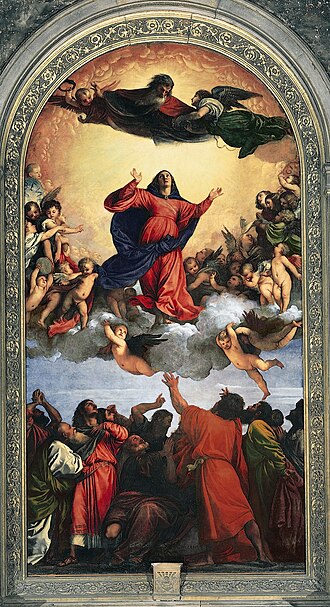 Assumption of the Virgin - Titian (1510s)
FXD.jpg) Sacred and Profane Love - Titian (1510s)
Sacred and Profane Love - Titian (1510s)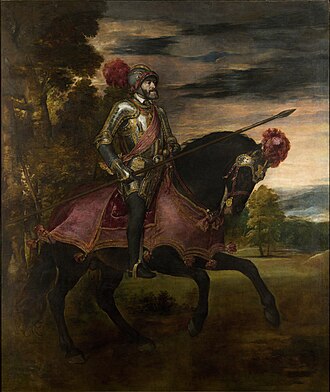 Equestrian Portrait of Charles V - Titian (1548)
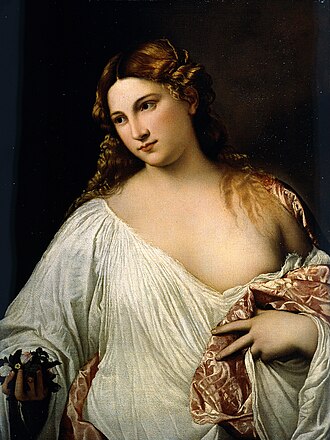 Flora - Titian (1517)
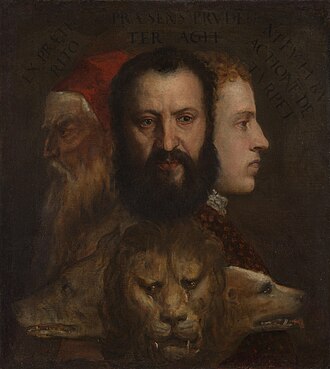 Allegory of Prudence - Titian (1550)
 Bacchus and Ariadne - Titian (1520s)
%20nave%20left%20-%20Altar%20of%20Madona%20di%20Ca'Pesaro.jpg) Pesaro Madonna - Titian
Pesaro Madonna - Titian