Jeune Femme en rose
Édouard Manet · 1879
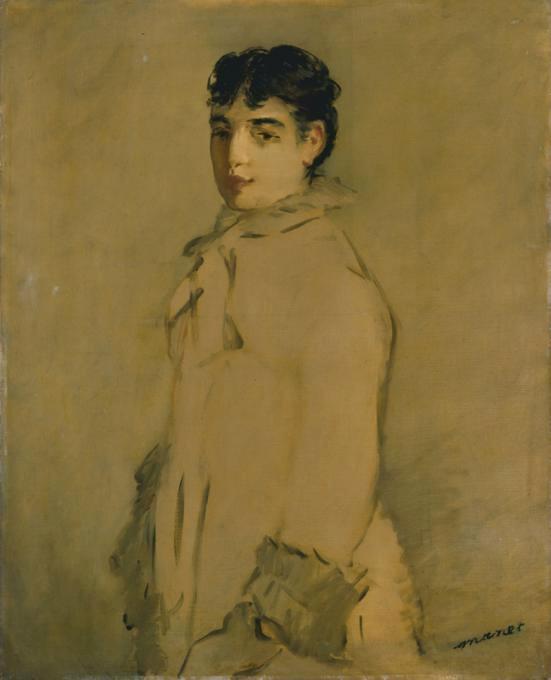
The prima ballerina of the Paris Opera, not on stage but in a pale pink dressing gown, glancing back over her shoulder. Manet left her half sketched, and that lightness is exactly what people came to love.
The story behind the painting
The sitter is Rosita Mauri, a Catalan dancer who already had international success when Charles Gounod engaged her for the Paris Opera in 1878. Soon after, she began a long love affair with the politician Antonin Proust, Manet's friend since their school days, and Proust brought her to Manet's studio. Proust's biography of Manet says nothing of her, and Manet left no notes about the picture, so its date is disputed. Julius Meier-Graefe gave 1876 to 1877, but Mauri was not performing in Paris then and the affair began later. 1879 is more likely, though the Pushkin Museum's 1880 is also possible.
What to look for
Mauri stands in the middle, cut off at the hip, turned to the left with her head looking back over her shoulder in half profile. The background is almost monochrome beige and grey, and the pale pink of her clothes is set off only by fleeting lines. Broad vertical strokes even run from the background onto the clothing. Only the head is finished: blue-black short hair parted in the middle, wide black brows, brown eyes, reddish lips blurred on the shadow side. She wears a kind of dressing gown with a high collar, a bow and ruffled sleeves. Nothing in the picture says she is a dancer.
Meaning and intent
Unlike his 1862 Lola de Valence, shown on stage in costume, Manet gives Mauri no props of her profession and no clear place, neither a home nor a theatre dressing room. He shows the private woman, not the celebrated star, and the dressing gown can be read as a sign of the intimate relationship between his friend and his lover. Manet rarely painted stage performers on stage. Sandra Orienti suggests he never finished because the dancer had little time to sit, and the painting is unsigned: the Manet signature at lower right was added after his death by his wife Suzanne.
Legacy
Adolphe Tabarant and others called the picture a sketch, yet later writers praised it precisely for that. In 1909 Georg Biermann spoke of its ravishing lightness, and Julius Meier-Graefe wrote that Manet worked wonders with barely wetted surfaces in his Rosita Mauri, lighter than any of his pastels. The painting stayed out of public view for more than a hundred years, in private collections and then for decades in a Moscow storeroom, and it is now in the Pushkin Museum as so-called trophy art. Hans Arp mentioned it in a poem in Der Sturm in December 1913.
Did you know?
- Portrait of Rosita Mauri, prima ballerina of the Paris Opera.
- Most likely painted in 1879; other dates proposed range from 1876 to 1880.
- Unsigned by Manet; the signature was added by his widow.
- Now in the Pushkin Museum in Moscow.
About the artist
Édouard Manet (1832-1883)
woman · portrait · standing · Pushkin Museum of Fine Arts · gaze towards the viewer · black hair · overcoat
More by Édouard Manet
 Luncheon on the Grass - Édouard Manet (1863)
 Olympia - Édouard Manet (1863)
 A Bar at the Folies-Bergère - Édouard Manet (1882)
 The Balcony - Édouard Manet (1868)
 Music in the Tuileries - Édouard Manet (1862)
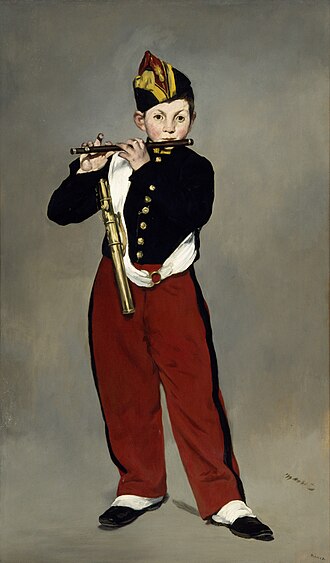 The Fif - Édouard Manet (1866)
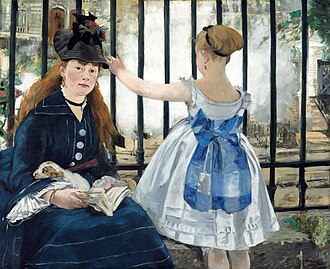 The Railway - Édouard Manet (1873)
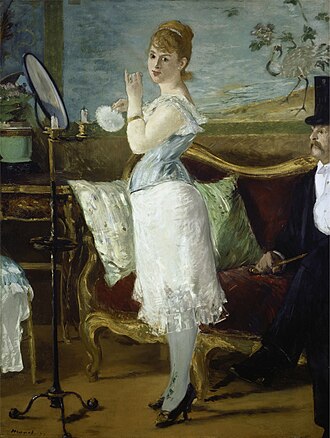 Nana - Édouard Manet (1877)
Paintings by related artists
 Impression, Sunrise - Claude Monet (1872)
 Water Lilies - Claude Monet (1906)
 Dance at Le Moulin de la Galette - Pierre-Auguste Renoir (1876)
 Luncheon of the Boating Party - Pierre-Auguste Renoir (1881)
 The Cradle - Berthe Morisot (1872)
 Summer's Day - Berthe Morisot (1879)
 L'Absinthe - Edgar Degas (1875)
 The Bellelli Family - Edgar Degas (1858)
 The Canal du Loing at Moret - Alfred Sisley (1892)
 The Watering Pond at Marly with Hoarfrost - Alfred Sisley (1876)
 Paris Street; Rainy Day - Gustave Caillebotte (1877)
 Les raboteurs de parquet - Gustave Caillebotte (1875)