Florence of the Cinquecento and Quattrocento
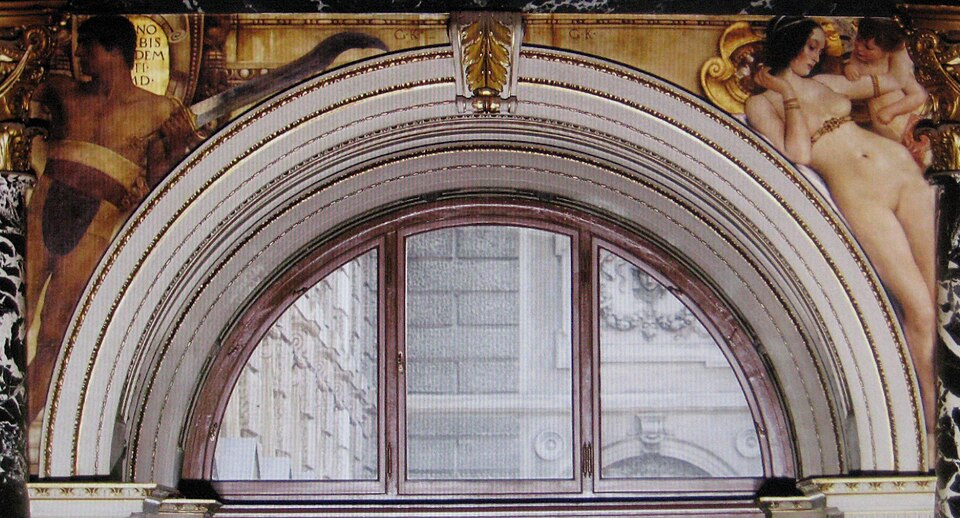
High on a staircase wall in Vienna, a young Klimt set David with a bloody sword beside a naked Venus holding Cupid. The two turn their faces away from each other, and a Latin warning about madness hangs between them.
The story behind the painting
In 1891 Gustav Klimt painted this pair of pictures, a spandrel and an intercolumniation, on the west wall of the grand staircase of the Kunsthistorisches Museum in Vienna. They are allegories of the Cinquecento and the Quattrocento in Florence, the 16th and 15th centuries of the Renaissance. Klimt painted other spandrel and intercolumniation pictures for the same staircase, among them Roman and Venetian Quattrocento, Greek Antiquity and Egypt, and Old Italian Art. Following the way leading Florentine artists of those centuries drew on antiquity, he chose classical and biblical subjects for his scenes.
What to look for
The Cinquecento shows David after his victory over Goliath. Wearing only a loincloth, he leans on the arcade holding a great sword with traces of blood, its blade straight and its tip curved like a sickle, with Klimt's signature G.K. beside it. With outstretched arm he sets Goliath's dark head on a plinth inscribed with a Latin proverb: those whom God wishes to destroy, he first makes mad. His body faces us, his head is in heroic profile, his black hair set against gold. The Quattrocento is Venus, naked except for a jewelled belt and gold bracelets, a shell behind her, embracing a small Cupid.
Meaning and intent
The Latin line about the blinding of reason seems to be the key. Folly and madness belong not only to the loser Goliath but also to the hero David, so possessed by bloody combat that he takes no notice of Venus and cannot give himself to the joys of love. Venus, a symbol of love and the feminine spirit, has no interest in the mad warrior and embraces Cupid instead. The poor light on that side of the staircase strengthens the effect: David holds Goliath's head into the corner, into nothing, and gazes into darkness. Klimt turned a weak position into meaning.
Legacy
Michelangelo's David is probably the most important model for the Cinquecento figure. Botticelli's Birth of Venus and Venus and Mars, and Piero di Cosimo's Venus, Mars and Cupid can be assumed as inspirations for the Venus, but where Mars finds peace with Venus in those works, Klimt chose the opposite. The pose of Venus echoes his 1889 drawing Allegory of Sculpture. In 1898 Klimt reused David's profile for the initial D in the March issue of Ver Sacrum, the magazine of the Vienna Secession. Wikidata gives no date for the work; the German Wikipedia article dates it 1891.
Did you know?
- Painted in 1891 in the staircase of the Kunsthistorisches Museum, Vienna.
- David with Goliath's head stands for the Cinquecento, Venus and Cupid for the Quattrocento.
- A Latin proverb about God first making mad those he would destroy is inscribed beside David.
- David's profile reappeared in Ver Sacrum in 1898.
About the artist
Gustav Klimt (1862-1918)
More by Gustav Klimt
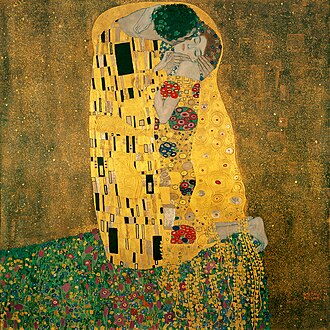 The Kiss - Gustav Klimt (1907-1908)
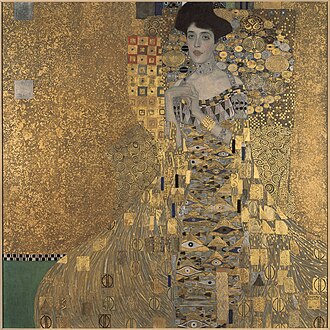 Portrait of Adele Bloch-Bauer I - Gustav Klimt (1907)
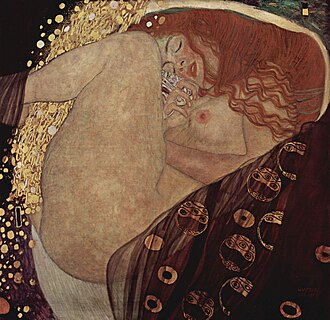 Danaë - Gustav Klimt (1907)
 Judith I - Gustav Klimt (1901)
 The Three Ages of Woman - Gustav Klimt (1905)
 Woman With a Fan - Gustav Klimt (1917)
 Adele Bloch-Bauer II - Gustav Klimt (1912)
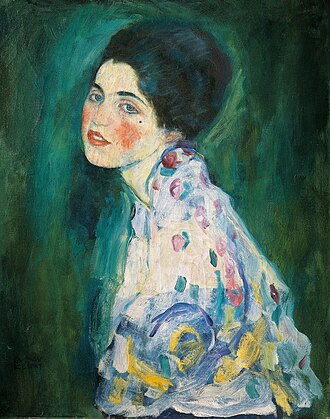 Portrait of a Lady - Gustav Klimt (1910s)