Finding of the body of St Mark
Jacopo Tintoretto · 1562
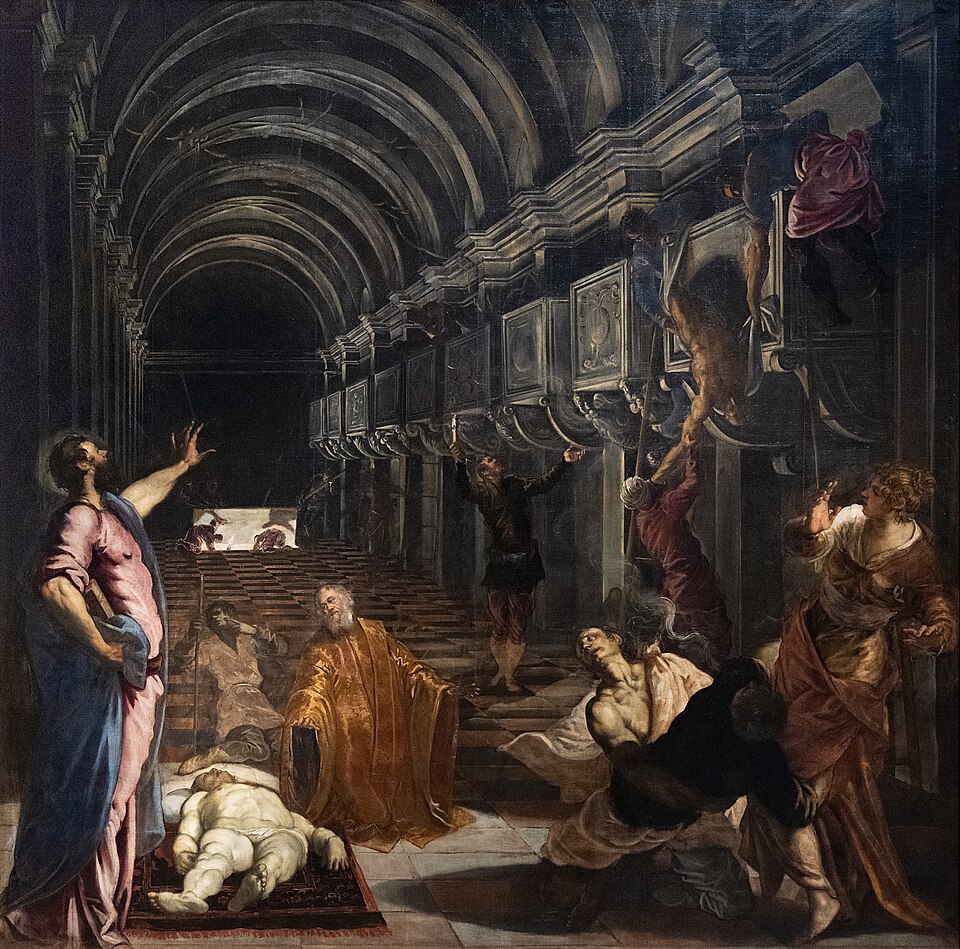
A saint with his feet on the ground, a man twisting in the grip of demons, and light pouring from a crypt down a long hall of tombs. Tintoretto's huge canvas carries a famous title that may not describe its real subject at all.
The story behind the painting
The painting was commissioned from Tintoretto by Tommaso Rangone, the grand guardian of the Scuola Grande di San Marco in Venice. It belonged to a series of large canvases showing how Venice acquired the body of Saint Mark, the patron saint of the city. Wikipedia dates the work to between 1562 and 1566, while Wikidata gives 1562. Today it hangs in the Pinacoteca di Brera in Milan, far from the Venetian confraternity for which it was made. Wikidata records it at about 396 by 400 cm, an almost square canvas of great size.
What to look for
Saint Mark is shown curing the sick, raising the dead and driving out a demon. In the centre an old man kneels, acknowledging the miracles: he is a portrait of Tommaso Rangone, the patron himself. In the right foreground a contorted, half-naked man is described as possessed by demons, with strands of smoke hovering above him. The floor tiles, the tombs set into the walls and the rays of light rising from the crypt at the back pull the eye deep into the space. Look closely and parts seem unfinished: tiles and cornices still show through some of the clothing and figures.
Meaning and intent
The traditional title says the body of the saint is being found, but the scholar Augusto Gentili argued the iconography shows the Miracles of Saint Mark in the church of Boucolis in Alexandria. The saint is alive and standing, not flying as in scenes after death. The mistaken title goes back to Carlo Ridolfi, who in 1648 wrote of the way the body of Saint Mark was taken away. The historian Thomas Nichols noted that the empty, boxlike perspective is undermined by an irrational play of light and shade, suggesting different levels of reality existing at once.
Legacy
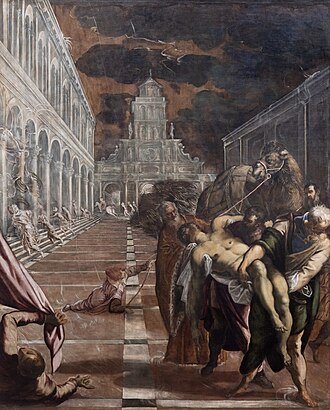
Like its companion piece, Saint Mark's Body Brought to Venice, this canvas is a prime example of Tintoretto's love of dramatic perspective and light. The same scene had already been carved by Jacopo Sansovino in reliefs for Saint Mark's Basilica, so Tintoretto was entering a conversation already alive in Venice. The debate about its subject, still unresolved in its very name, has become part of how the painting is looked at. Visitors to the Brera can stand before it and decide for themselves whether they see a finding or a miracle.
Did you know?
- Commissioned by Tommaso Rangone for the Scuola Grande di San Marco in Venice.
- Dated 1562 to 1566; Wikidata gives 1562.
- The kneeling old man in the centre is a portrait of the patron.
- Now in the Pinacoteca di Brera, Milan.
About the artist
Jacopo Tintoretto (1518-1594)
religious art · Venetian school · Mannerism · Pinacoteca di Brera · Mark the Evangelist
More by Jacopo Tintoretto
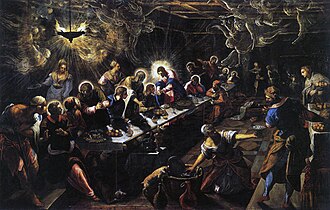 Last Supper - Jacopo Tintoretto (1563)
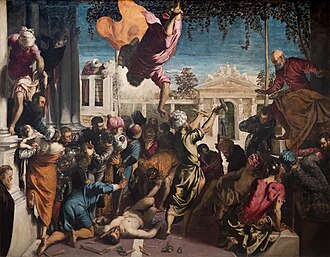 Miracle of the Slave - Jacopo Tintoretto (1540s)
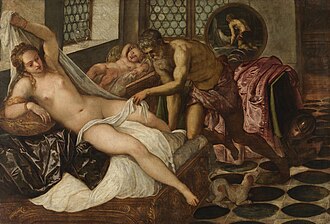 Venus and Mars Surprised by Vulcan - Jacopo Tintoretto (1555)
 The Origin of the Milky Way - Jacopo Tintoretto (1575)
 Susanna and the Elders - Jacopo Tintoretto (1550s)
 St Mark's Body Brought to Venice - Jacopo Tintoretto (1560s)
%20Jacopo%20Tintoretto%20-%20Gloria%20del%20Paradiso%20-%20Sala%20del%20Maggior%20Consiglio.jpg) Paradise - Jacopo Tintoretto
Paradise - Jacopo Tintoretto Temptation of Adam - Jacopo Tintoretto (1550s)
Paintings by related artists
.jpg) Venus of Urbino - Titian (1538)
Venus of Urbino - Titian (1538) Assumption of the Virgin - Titian (1510s)