Feast of the Rosary
Albrecht Dürer · 1506
.jpg)
In 1506, far from home in Venice, Albrecht Dürer painted a heavenly gathering so splendid that the Doge himself came to his workshop to see it.
The story behind the painting
The commission began with the banker Jakob Fugger, while Dürer was his guest in Augsburg, but the painting itself was made in Venice. There the contract was renewed by a fraternity of German traders, many from Dürer's own Nuremberg, who were devoted to Our Lady of the Rosary. The panel was meant to be finished before May 1506 and to hang in San Bartolomeo on the Rialto, the German church of the city. Dürer was still at work in September, when the Doge, the Patriarch, Venetian nobles and several artists, perhaps including Giovanni Bellini, visited to admire it. Years later, in a 1523 letter, Dürer recalled that he had turned down Doge Leonardo Loredan's offer to become official painter to the Republic.
What to look for
At the centre the Virgin sits enthroned with the Christ Child, while two flying angels hold a crown of gold, pearls and gems above her. A green drape covers the throne, and at her feet a single angel plays a lute, a clear homage to Bellini's altarpieces. Mary hands rose garlands to two kneeling rows. On the left, Pope Julius II leads a procession of clergy and is crowned by the Child; on the right, Emperor Frederick III, given the face of his son Maximilian I, leads the lay faithful and is crowned by Mary. Saint Dominic stands nearby. On the right, beside an Alpine landscape, Dürer painted himself holding a small sheet with his signature.
Meaning and intent
The garlands of roses are the heart of the image: the faithful of every rank receive them directly from the Virgin and Child, and pope and emperor have set down tiara and crown to kneel as equals. The painting has also been read as a tribute to Maximilian's first wife, Mary of Burgundy, with the Virgin standing for her, the Child for their son Philip the Fair, and a kneeling Maximilian receiving the rosary. The scholar David Rothenberg called it a direct visual counterpart to Heinrich Isaac's motet Virgo Prudentissima, linked to Maximilian's coronation, where the Virgin crowns the wise king at the moment she is crowned Queen of Heaven.
Legacy
Emperor Rudolf II acquired the panel in 1606 and brought it to Prague. It was placed at the Strahov Monastery, where several restorations over the centuries damaged its surface; about two thirds of the work, including many of the heads, was later repainted. It moved to the Rudolfinum and finally to the National Gallery Prague, where it hangs today. Even in its altered state, the Czech art historian Jaroslav Pešina judged it probably the most superb painting a German master ever created. Its quiet monumental calm still recalls the Bellini altarpieces Dürer studied in Venice.
Did you know?
- Oil painting dated 1506, 162 × 192 cm (Wikidata).
- Made in Venice for the German church of San Bartolomeo.
- Acquired by Emperor Rudolf II in 1606 and moved to Prague.
- About two thirds of the surface was later repainted.
About the artist
Albrecht Dürer (1471-1528)
woman · religious art · Mary · boy · Christ Child · High Renaissance · Albrecht Dürer
More by Albrecht Dürer
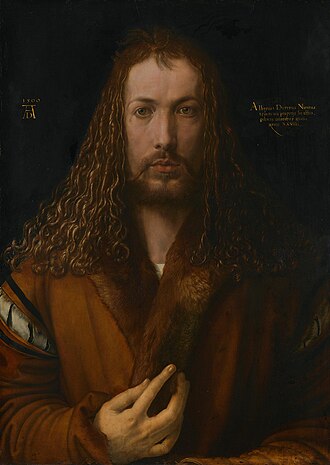 Self-Portrait with Fur-Trimmed Robe - Albrecht Dürer (1500)
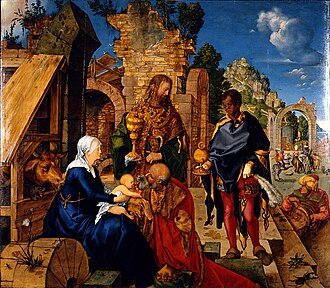 Adoration of the Magi - Albrecht Dürer (1504)
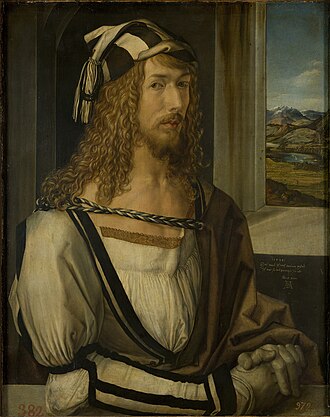 Self-Portrait - Albrecht Dürer (1498)
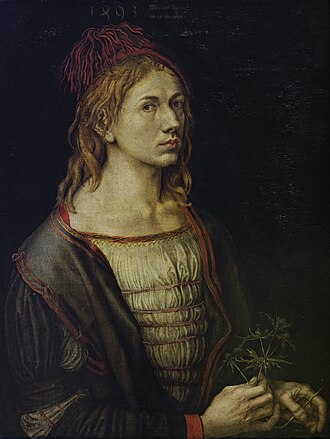 Portrait of the Artist Holding a Thistle - Albrecht Dürer (1493)
 Heller Altarpiece - Albrecht Dürer (1500s)
 Martyrdom of the Ten Thousand - Albrecht Dürer (1508)
%20-%20Google%20Art%20Project.jpg) Adoration of the Trinity - Albrecht Dürer (1511)
Adoration of the Trinity - Albrecht Dürer (1511) Christ Among the Doctors - Albrecht Dürer (1506)
Paintings by related artists
 Mona Lisa - Leonardo da Vinci (1503-1519)
 Lady with an Ermine - Leonardo da Vinci (1490)
.jpg) Venus of Urbino - Titian (1538)
Venus of Urbino - Titian (1538) Assumption of the Virgin - Titian (1510s)
 The Birth of Venus - Sandro Botticelli (c. 1485)
 Primavera - Sandro Botticelli (1480s)