Despair
Edvard Munch · 1894
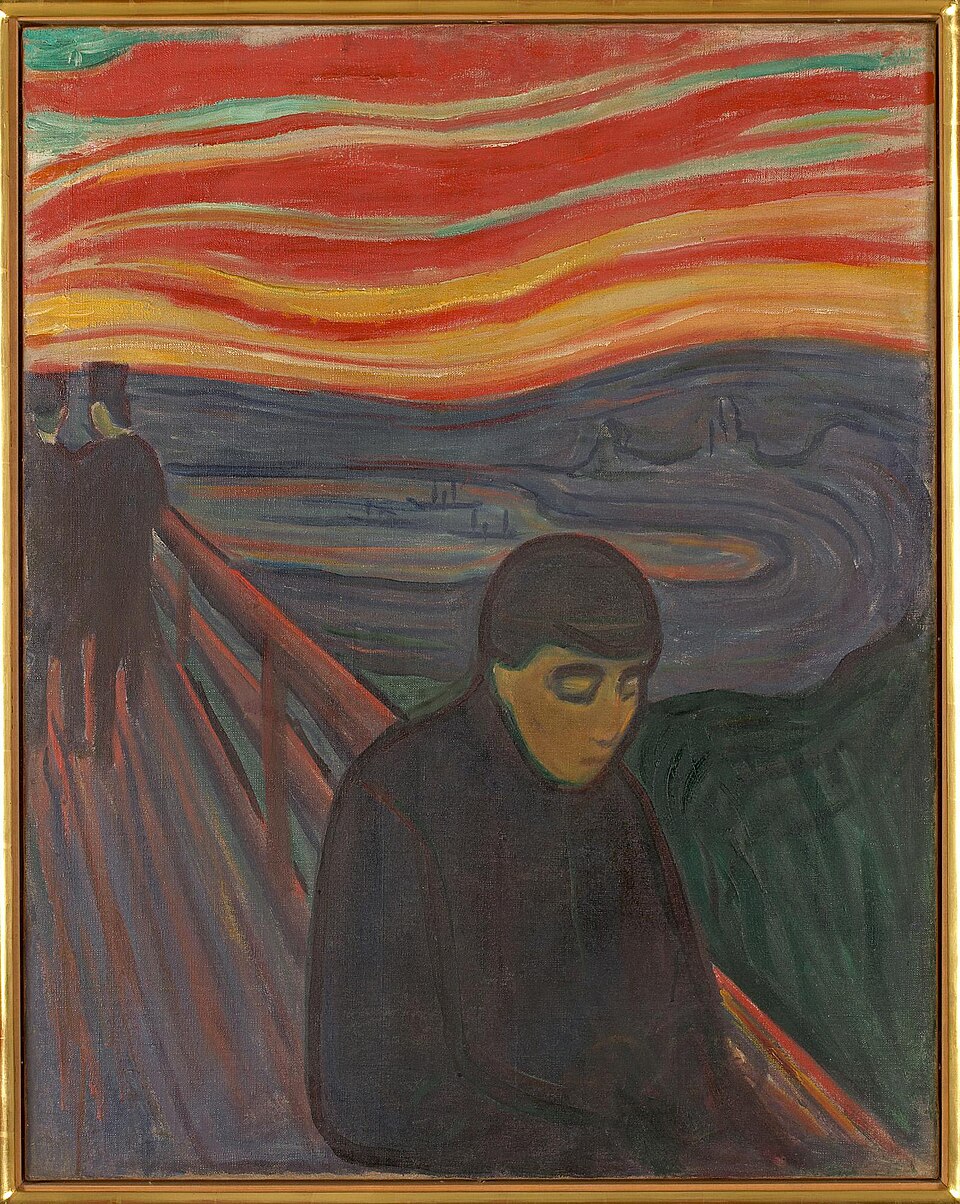
After The Scream, Munch went back to the bridge at sunset one more time. This time the lone figure is his friend Jappe Nilssen, head bowed, turned away from both the burning sky and from us.
The story behind the painting
Once The Scream was finished, Munch decided to continue the theme of the sunset on the bridge. It came from a summer walk in Oslo, when he felt a sudden moment of despair that he later wanted to capture in paint. A first painting followed in 1892, showing a man in a hat watching the sunset from the bridge. This second version, painted in 1894 at the same time as Anxiety, puts his friend Jappe Nilssen in the foreground, in a pose close to the one he had taken in Munch's Melancholy. The canvas, oil on canvas, measures about 92 by 72.5 cm.
What to look for
Look at how Nilssen is placed. He faces neither the sunset behind him nor the viewer. Instead he is folded in on himself, head bent forward, a figure that recalls similar ones in Munch's The Woman in Three Stages and Separation. The colours are brighter than in the first version: the sky is a saturated red and yellow, and a pale violet appears in the middle ground, a colour also found in Anxiety. The result is flatter and more decorative than the 1892 painting. Notice how the sky, the bridge and the hunched man are held together by these strong, simplified colours rather than by loose brushwork.
Meaning and intent
The French source gives two readings. For the Munch scholar Frank Høifødt, the flatter, more decorated surface recalls the Synthetism of Paul Gauguin. Reinhold Heller is more severe: he sees the work as only reusing the important themes of the first Despair and of The Scream, without reflecting the melancholy of the first version or the intensity of The Scream. Between these views the painting stands as a quieter, inward variation. Where the 1892 man stares out across the fjord, Nilssen seems closed in his own thoughts, as if the despair had moved from the landscape into the body of a single person.
Legacy
When Munch died, this painting passed with his entire collection to the city of Oslo. The city later opened the Munch Museum, where it can be seen today. Its sister picture, the first Despair of 1892, is in another collection, so the two versions of the same motif live apart. Together with The Scream and Anxiety, the 1894 Despair belongs to a group of works in which Munch returned again and again to the same bridge, the same steep perspective and the same red sky, testing what a single figure under that sky could express.
Did you know?
- Second version of Despair, painted in 1894 alongside Anxiety.
- The figure is Munch's friend Jappe Nilssen.
- Brighter, flatter colours, with a new pale violet.
- Left to the city of Oslo; now in the Munch Museum.
About the artist
Edvard Munch (1863-1944)
human · bridge · Munch Museum · Oslofjord
More by Edvard Munch
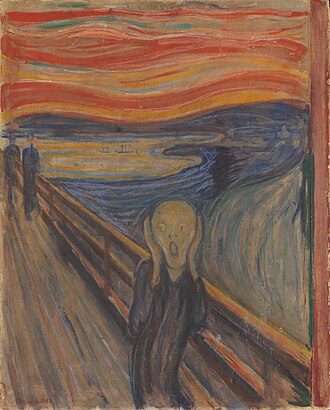 The Scream - Edvard Munch (1893)
 Dance of Life - Edvard Munch
 The Kiss - Edvard Munch (1897)
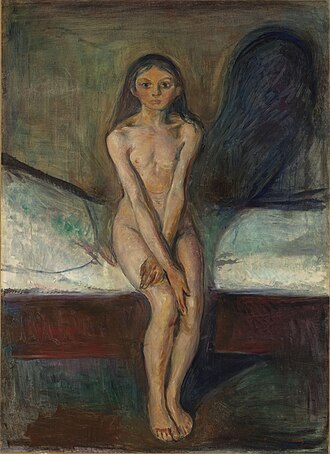 Puberty - Edvard Munch (1895)
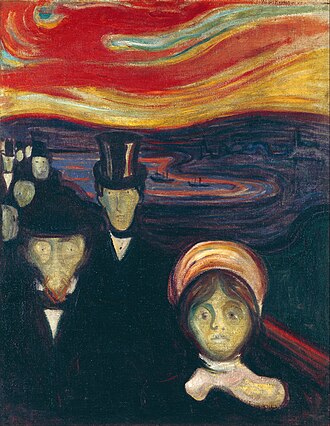 Anxiety - Edvard Munch (1894)
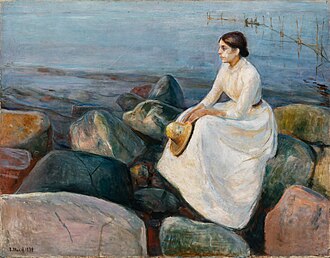 Inger on the Beach - Edvard Munch (1889)
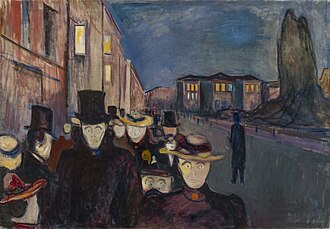 Evening on Karl Johan - Edvard Munch (1892)
 Night in Saint-Cloud - Edvard Munch (1890)