Day of the God
Paul Gauguin · 1894
%20-%201926.198%20-%20Art%20Institute%20of%20Chicago.jpg)
Gauguin painted this Tahitian dream not in Tahiti but in Paris, after he had come home. What he gives us is less a place he saw than a place he remembered and reimagined.
The story behind the painting
Mahana no atua, which means Day of the God, is an oil painting Paul Gauguin made in 1894. He had just returned to Paris from his first period of living and working in Tahiti, and the picture was executed there, far from the islands it shows. That distance matters. Wikipedia describes the work as more imaginative than real, a vision assembled from memory rather than a scene observed on the spot. Wikidata records the canvas as 66 by 87 centimetres. Today it belongs to the Art Institute of Chicago, and Wikidata also links it to the collection of Edgar Degas, a detail the Wikipedia text does not discuss.
What to look for
Start in the centre, where a carved idol of the goddess Hina stands on a rock by the beach. Everything else is arranged around her in a symmetrical pattern, almost like an altarpiece. On the left, two women carry votive offerings. On the right, two others dance the upaupa, a Tahitian dance the colonial authorities tried to ban. Then lower your eyes to the foreground, where three bathers lie and sit at the water's edge. Notice how the forms are simplified into flat, clear shapes, and how the colour is used dramatically rather than descriptively. This is the Post-Impressionism the painting is known for.
Meaning and intent
The three bathers are the painting's quiet riddle. Their poses suggest they may stand for birth, life and death, yet Gauguin never spoke about them, so the reading remains an interpretation rather than a stated intention. Around them, the scene balances worship and celebration: offerings on one side, a forbidden dance on the other, and a goddess holding the centre. Because Gauguin painted it in Paris, the work can be seen as an act of remembering, a Tahiti rebuilt in the imagination, ordered and symmetrical, perhaps more ideal than any real afternoon on the shore.
Legacy
Mahana no atua is often seen as typical of Gauguin's Post-Impressionist style, with its simplified forms and bold colour. Hanging in the Art Institute of Chicago, it invites visitors to ask how much of what they see is Tahiti and how much is Gauguin's own longing. The painting's Japanese title on Wikidata, and its French title Jour de Dieu, show how widely it has travelled in name. Yet its central mystery, the meaning of the three bathers, has stayed unspoken since 1894, which is perhaps why people keep returning to look.
Did you know?
- Painted in 1894 in Paris, after Gauguin's first stay in Tahiti (Wikipedia).
- The central figure is a carved idol of the goddess Hina (Wikipedia).
- The dancers on the right perform the upaupa, which colonial authorities tried to ban (Wikipedia).
- Canvas size 66 x 87 cm; Art Institute of Chicago (Wikidata).
About the artist
Paul Gauguin (1848-1903)
genre art · Post-impressionism · Art Institute of Chicago
More by Paul Gauguin
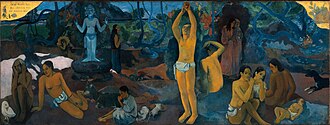 Where Do We Come From? What Are We? Where Are We Going? - Paul Gauguin (1897-1898)
%201889.jpg) The Yellow Christ - Paul Gauguin (1889)
The Yellow Christ - Paul Gauguin (1889)%201892%2C%20oil%20on%20canvas%2C%20101%20x%2077%20cm.jpg) When Will You Marry? - Paul Gauguin (1892)
When Will You Marry? - Paul Gauguin (1892)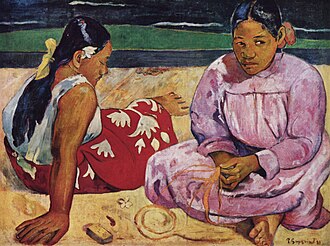 Tahitian Women on the Beach - Paul Gauguin (1890)
.jpg) Vision After the Sermon - Paul Gauguin (1888)
Vision After the Sermon - Paul Gauguin (1888)Manaò tupapaú - Paul Gauguin (1892)
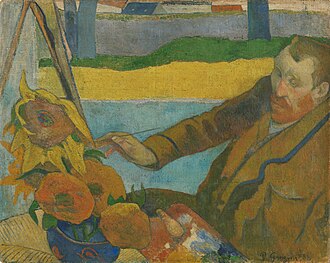 Vincent van Gogh Painting Sunflowers - Paul Gauguin (1888)
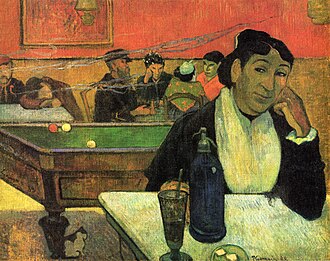 The Night Café in Arles - Paul Gauguin (1888)
Paintings by related artists
 The Starry Night - Vincent van Gogh (1889)
.jpg) Café Terrace at Night - Vincent van Gogh (1888)
Café Terrace at Night - Vincent van Gogh (1888) Dance at Le Moulin de la Galette - Pierre-Auguste Renoir (1876)
 Luncheon of the Boating Party - Pierre-Auguste Renoir (1881)