Dance Class at the Opera
Edgar Degas · 1870s
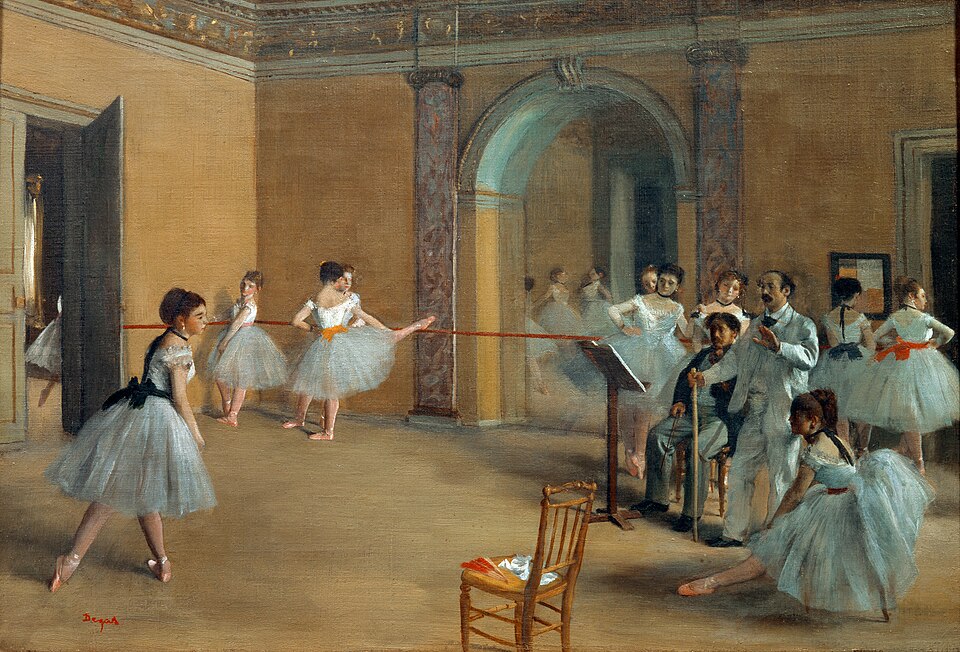
White tutus, yellow-ochre walls, a ballet master tapping time with his cane. In a canvas barely larger than a sheet of paper, Degas opened a whole rehearsal room at the Paris Opera around 1872.
The story behind the painting
Degas painted this small canvas, about 32.7 by 46.3 cm, around 1872. Its French title places it in the dance foyer of the Opera on the rue Le Peletier. He chose a precise moment in the lesson: the dancers have finished their exercises at the barre and are beginning, one by one, their work in the centre of the room. The scene is not a performance but the daily routine of a class, with a teacher, a musician and young dancers waiting their turn.
What to look for
On the left, Mademoiselle Hughes prepares to perform her exercise. On the right stands the ballet master Louis-Alexandre Mérante, dressed in white, leaning on a cane with which he marks the rhythm and corrects movements, his hand raised to ask the dancer for more restraint. Beside him a violinist sits at a music stand. Look also at the seated dancer next to the master, her face slightly in shadow, drawn with particular precision, and at the girls at the barre along the back wall, each in a different pose, one simply resting.
Meaning and intent
The composition is arranged around a large empty space in the middle of the floor, with the figures placed around it. Mirrors reflecting other scenes and an open doorway make the room seem larger still. Light comes from the right, where a window may be assumed, and the contours of the figures are softened to catch the atmosphere. Yet Degas keeps a firmer base in drawing than the Impressionists. The violinist's dark clothes and heavy figure deliberately break the harmony of white tutus and pale walls.
Legacy
The painting belongs to the Musée d'Orsay in Paris. Its source describes the scene as especially idyllic and delicate, and the whole room seems to breathe between two exercises: the dancers waiting, practising, resting, while the master gives his last advice before the next step. It shows the world Degas returned to again and again, not the ballet as audiences saw it, but the patient work behind it, kept here in a modest canvas that invites a slow look at every corner.
Did you know?
- Painted around 1872, about 32.7 x 46.3 cm.
- The ballet master shown is Louis-Alexandre Mérante.
- Mirrors and an open door widen the room.
- In the Musée d'Orsay, Paris.
About the artist
Edgar Degas (1834-1917)
genre art · Musée d'Orsay · mirror · Paris
More by Edgar Degas
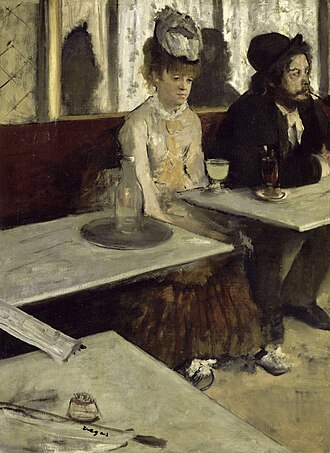 L'Absinthe - Edgar Degas (1875)
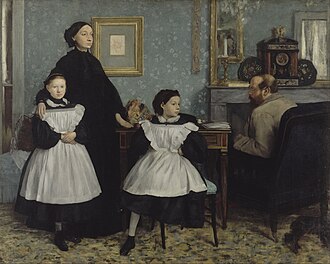 The Bellelli Family - Edgar Degas (1858)
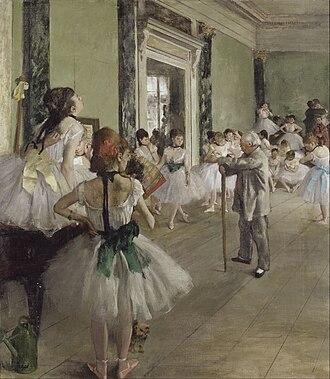 The Ballet Class - Edgar Degas (1871)
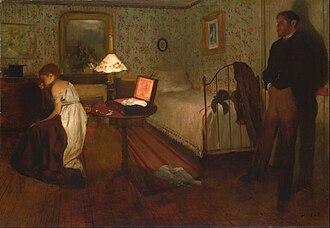 Interior - Edgar Degas (1868)
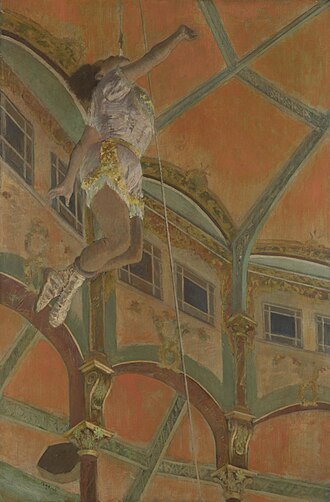 Miss La La at the Cirque Fernando - Edgar Degas (1879)
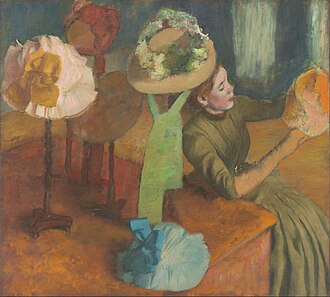 The Millinery Shop by Edgar Degas - Edgar Degas
.jpg) The Tub - Edgar Degas (1886)
The Tub - Edgar Degas (1886)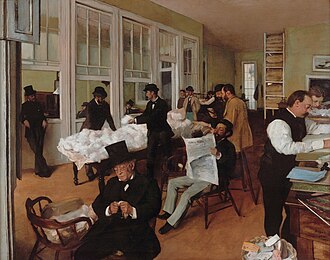 A Cotton Office in New Orleans - Edgar Degas (1873)
Paintings by related artists
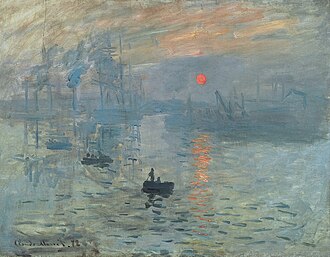 Impression, Sunrise - Claude Monet (1872)
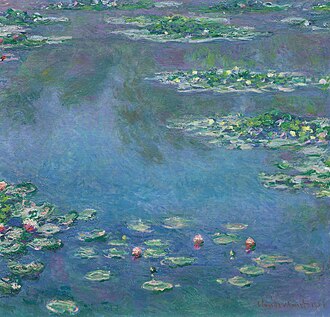 Water Lilies - Claude Monet (1906)
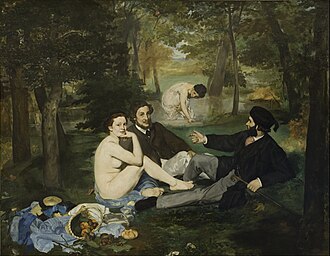 Luncheon on the Grass - Édouard Manet (1863)
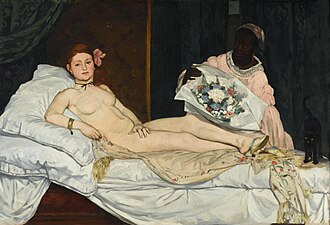 Olympia - Édouard Manet (1863)
 Dance at Le Moulin de la Galette - Pierre-Auguste Renoir (1876)
 Luncheon of the Boating Party - Pierre-Auguste Renoir (1881)
 The Starry Night - Vincent van Gogh (1889)
.jpg) Café Terrace at Night - Vincent van Gogh (1888)
Café Terrace at Night - Vincent van Gogh (1888) The Fighting Temeraire - J. M. W. Turner (1839)
 Rain, Steam and Speed - The Great Western Railway - J. M. W. Turner (1844)
 Where Do We Come From? What Are We? Where Are We Going? - Paul Gauguin (1897-1898)
%201889.jpg) The Yellow Christ - Paul Gauguin (1889)
The Yellow Christ - Paul Gauguin (1889)