Captain Lord George Graham in his Cabin
William Hogarth · 1745
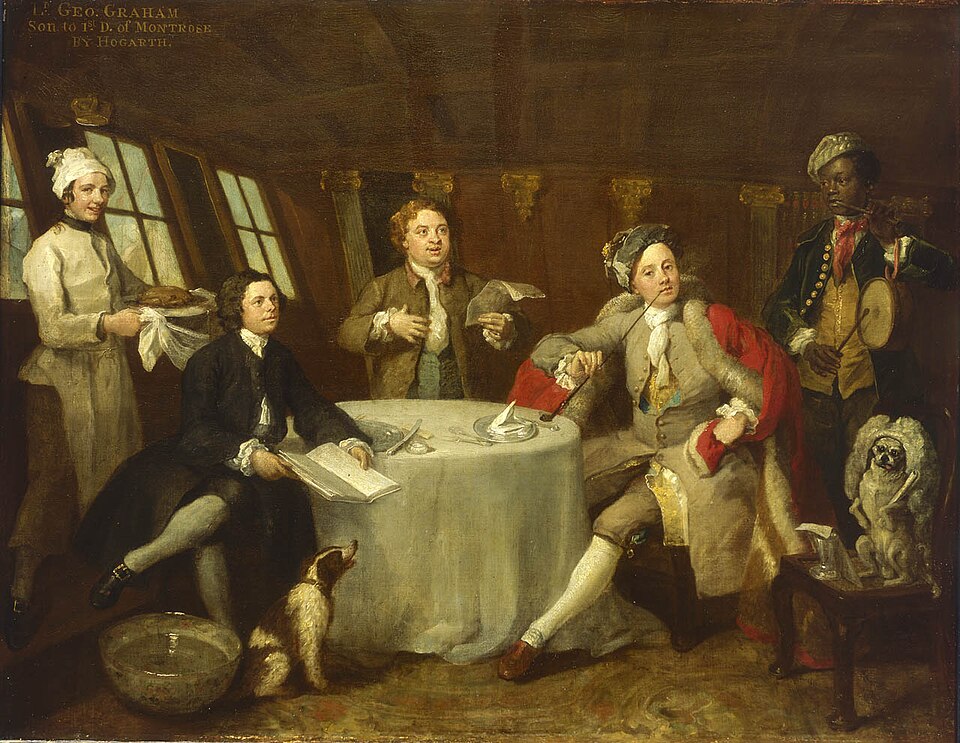
A naval captain relaxes with his pipe while a dog in his wig conducts the music and a grinning steward spills gravy down the chaplain's back. Hogarth turned a hero's portrait into a cabin full of jokes.
The story behind the painting
In July 1745 Lord George Graham, a younger son of the 1st Duke of Montrose, commanded the 24-gun HMS Bridgewater in the English Channel. Off Ostend, with HMS Sheerness and the armed vessel Ursula, he attacked three privateers from Dunkirk escorting seven captured prizes. After a fierce fight, the Royal and the Duchesse de Penthierre struck their colours to the Bridgewater, the prizes were taken, and only a small dogger escaped. Graham was rewarded with the 60-gun HMS Nottingham, and he probably commissioned this painting from Hogarth around that time to remember the victory.
What to look for
The table divides the cabin. Graham sits on the right in a fur-lined red velvet cape and a green velvet cap slightly askew, smoking a long pipe. The clerk stands in the centre singing from a sheet of music, and the chaplain sits on the left in a black coat. A black servant plays a pipe and tabor, while a steward carries a roast duck and smiles out at us as gravy drips down the chaplain's coat. Graham's own dog seems to sing, and Hogarth's pug Trump, wearing Graham's wig, sits on a chair reading his own music. Through the windows on the left you can glimpse the sails of ships.
Meaning and intent
The relaxed, slightly ridiculous scene is the opposite of the battle it celebrates, and that contrast is the joke. Trump, with lolling tongue, wig and a scroll held like a conductor's, mocks the formality of Graham's rank and stands in for Hogarth himself. A salt cellar sits between the chaplain and the captain, perhaps marking their social distance. The servant's pose and pipe echo Graham's, and later scholars have studied how Hogarth painted black subjects. The music historian Jeremy Barlow notes that the lively pipe and tabor would hardly suit a sentimental song, and suggests the picture combines several typical cabin pastimes into one moment.
Legacy
Graham did not enjoy his picture for long: he died in 1747. His family kept the portrait until 1932, when it passed to Sir James Caird, who gave it to the National Maritime Museum in Greenwich, where it remains today. Hogarth drew on his own experience of group conversation pieces, and he was probably influenced by an earlier cabin scene by Bartolomeo Nazari. The canvas measures about 68.5 by 88.9 cm. It remains one of the liveliest records of shipboard life in the eighteenth century, where a hero's portrait is shared with servants, dogs and a spilt dinner.
Did you know?
- Painted in 1745 by William Hogarth.
- Commemorates Graham's victory over Dunkirk privateers off Ostend in July 1745.
- Hogarth's own pug, Trump, sits in the scene wearing Graham's wig.
- Now at Royal Museums Greenwich, a gift of Sir James Caird.
About the artist
William Hogarth (1697-1764)
More by William Hogarth
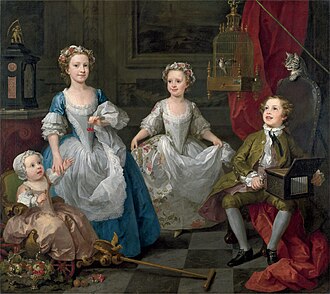 The Graham Children - William Hogarth (1742)
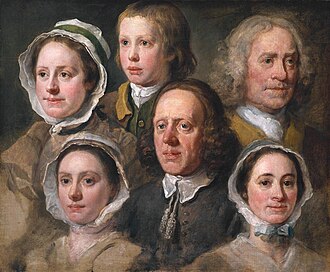 Hogarth's Servants - William Hogarth (1750s)
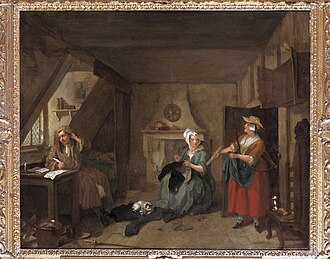 The Distrest Poet - William Hogarth (1730s)
 Marriage A-la-Mode: 2. The Tête à Tête - William Hogarth (1743)
 David Garrick as Richard III - William Hogarth (1745)
 The Orgy - William Hogarth (1735)
 Marriage A-la-Mode: 6. The Lady's Death - William Hogarth (1743)
The Lady's Last Stake - William Hogarth (1759)