The Orgy
William Hogarth · 1735
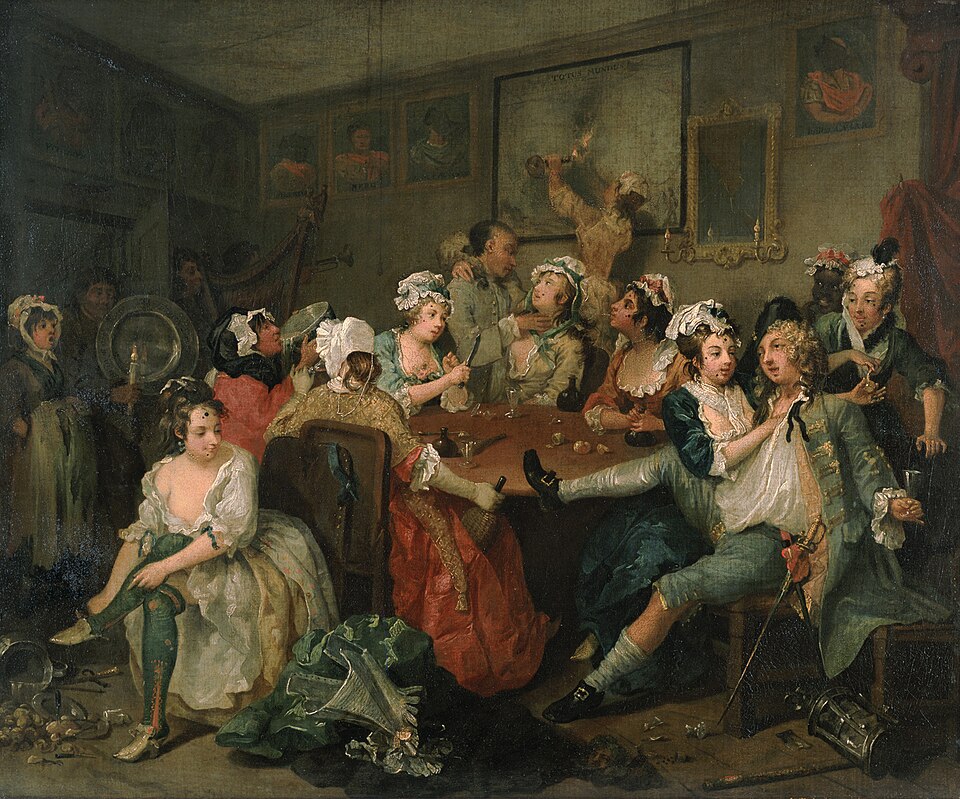
Three in the morning at the Rose Tavern: Tom Rakewell sprawls drunk in a chair, a foot on the table, while the women around him quietly lift his watch. Hogarth's third scene of A Rake's Progress is the night the fall begins.
The story behind the painting
A Rake's Progress is a series of eight oil paintings by William Hogarth, published as engravings from 1734. It tells the invented story of Tom Rakewell, the free-spending son and heir of a rich merchant, who comes to London and wastes his fortune on luxury, prostitutes and gambling, ending in Fleet Prison and finally in Bethlem Hospital, known as Bedlam. The Orgy, also called the Tavern Scene, is the third picture. The source dates the series to 1732 to 1733 but this scene to 1735, a difference it does not explain; Wikidata also gives 1735.
What to look for
The setting is the Rose Tavern in Drury Lane, Covent Garden, a brothel and restaurant in one. Tom, drunk, his sword at his side, lounges in a chair with one foot on a table, surrounded by prostitutes. Beside him lie a watchman's rod and lantern, stolen during his night wanderings in the streets. Look closely at the two women working on Tom's watch: they are stealing it. In the doorway a female street singer appears. On the walls hang a world map and framed prints of Roman emperors, among them Augustus, Titus, Otho, Vitellius and Vespasian.
Meaning and intent
The picture draws on the merry company tradition, scenes of revelry popular in earlier painting, but Hogarth turns it into a moral episode. This is the beginning of Tom's way down: the young heir who thinks he is enjoying himself is in fact being robbed while he sprawls. The stolen rod and lantern show how far the night has already gone. Within the eight-part story, the scene is the hinge between Tom's arrival in fashionable society and the debts, prison and madness that follow in the later canvases.
Legacy
The eight paintings were sold by William Beckford at Christie's in 1802 to the architect John Soane. They hung first at his country house, Pitzhanger Manor, and from 1810 in his town house in Lincoln's Inn Fields, now Sir John Soane's Museum, where the whole series is still shown in the picture gallery. The story found a second life in music: Igor Stravinsky saw Hogarth's pictures at an exhibition in Chicago in 1947, had the idea for an opera, and wrote The Rake's Progress with a libretto by W. H. Auden and Chester Kallman.
Did you know?
- Third of the eight paintings in A Rake's Progress.
- Set at the Rose Tavern in Drury Lane at three in the morning.
- Bought by John Soane in 1802; still in Sir John Soane's Museum.
- Inspired Stravinsky's opera The Rake's Progress.
About the artist
William Hogarth (1697-1764)
woman · man · genre art · group of humans
More by William Hogarth
 The Graham Children - William Hogarth (1742)
 Hogarth's Servants - William Hogarth (1750s)
 The Distrest Poet - William Hogarth (1730s)
 Marriage A-la-Mode: 2. The Tête à Tête - William Hogarth (1743)
 David Garrick as Richard III - William Hogarth (1745)
 Marriage A-la-Mode: 6. The Lady's Death - William Hogarth (1743)
The Lady's Last Stake - William Hogarth (1759)
 Marriage A-la-Mode: 1. The Marriage Settlement - William Hogarth (1743)