Bathing Men
Edvard Munch · 1908
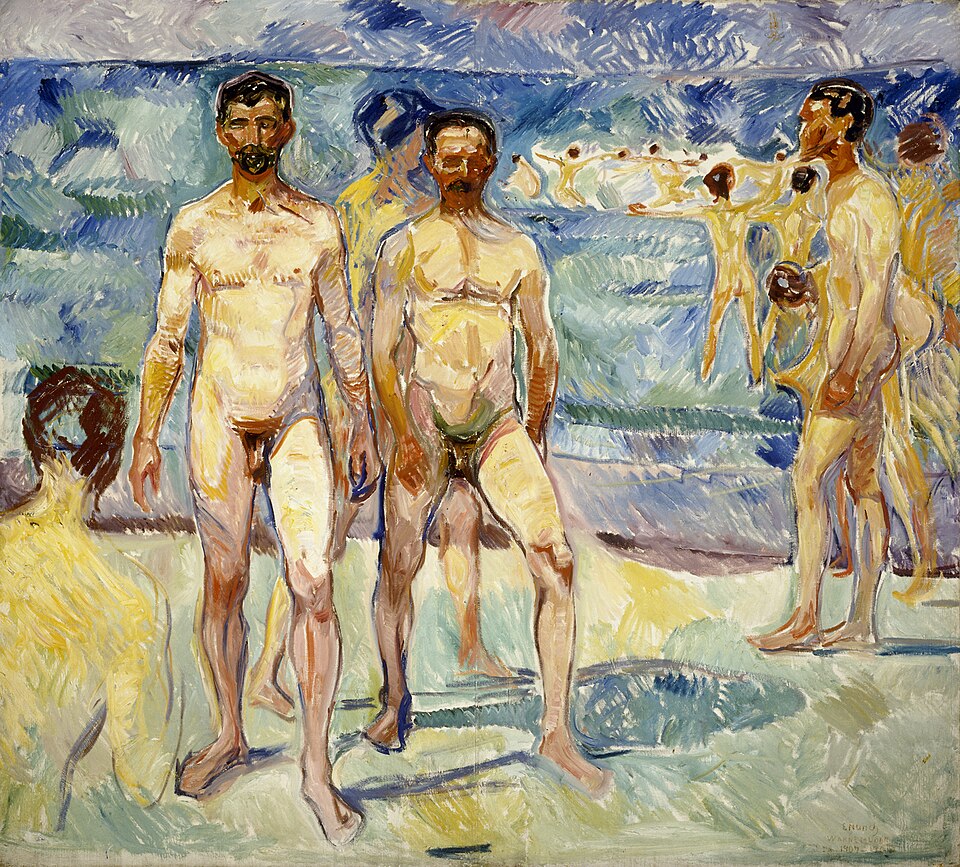
Naked men walk out of the sea into bright, almost Fauvist colour. Munch painted them at a German seaside resort while trying to recover from a breakdown, and the canvas changed the way he painted.
The story behind the painting
After his break with his fiancée Tulla Larsen, Munch went to the seaside resort of Warnemünde in northern Germany to recover from his nervous troubles. There, on the beach, he painted Bathing Men, using the local lifeguards as his models. The Spanish Wikipedia article dates the work 1907 to 1908, while Wikidata gives 1908. The stay brought him some recovery and a burst of productivity, but the following year he entered a nerve clinic in Copenhagen. The painting is a rare record of a hopeful moment in a difficult time.
What to look for
This is the most monumental of Munch's paintings on the theme, about 206 cm high and 227.5 cm wide. Look at the colours: lively, almost Fauvist, and an unusually cheerful, optimistic tone for Munch. Look too at the brushwork. Before, he had mostly worked with long strokes and even fields of colour inside clear outlines, still visible in his earlier bathers. Here the bodies are built with powerful, airy forms, sometimes shaped by rhythmically twisting lines. The male nudist beach is shown in full daylight, open and bright.
Meaning and intent
Female bathers were a common subject in Western painting, but male bathers were much rarer. In the early twentieth century, painting naked people bathing outdoors became popular as naturist ideas spread about nudity and the good effects of open air on body and soul. Munch painted many versions, varying men and women, adults and children, groups and single figures. In 1911 in Helsinki he showed Bathing Men as the centre of a triptych he called the Ages of Life, a parallel to his famous Frieze of Life. The centre stood for manhood, flanked by youth and old age.
Legacy
The exhibition in Helsinki was considered very controversial, yet the Ateneum bought the painting, and it remains in the collections of the Finnish National Gallery there. A similar work is in the Belvedere in Vienna, and two sketches are in the Munch Museum in Oslo. According to the source, Bathing Men and The Death of Marat, painted at the same time, marked a change in Munch's artistic expression. Other painters drawn to bathers include Paul Cézanne, Auguste Renoir, Eugène Jansson and Anders Zorn, so the canvas belongs to a wider story of the body in modern painting.
Did you know?
- Painted at Warnemünde, Germany, with local lifeguards as models.
- Dated 1907-1908 by Wikipedia and 1908 by Wikidata.
- About 206 x 227.5 cm, the largest of Munch's bather paintings.
- Bought by the Ateneum in Helsinki after a controversial 1911 show.
About the artist
Edvard Munch (1863-1944)
More by Edvard Munch
 The Scream - Edvard Munch (1893)
 Dance of Life - Edvard Munch
 The Kiss - Edvard Munch (1897)
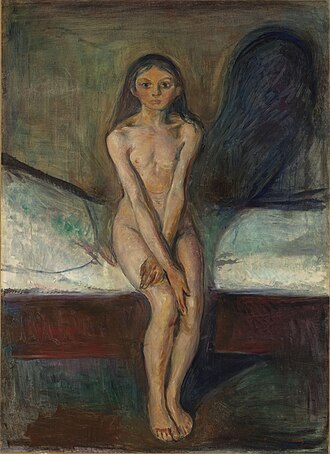 Puberty - Edvard Munch (1895)
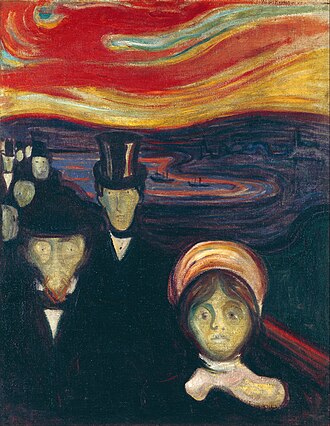 Anxiety - Edvard Munch (1894)
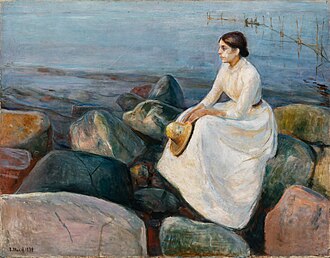 Inger on the Beach - Edvard Munch (1889)
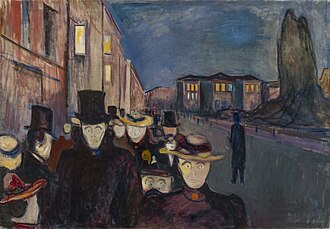 Evening on Karl Johan - Edvard Munch (1892)
 Night in Saint-Cloud - Edvard Munch (1890)