Bathers at Tahiti
Paul Gauguin · 1897
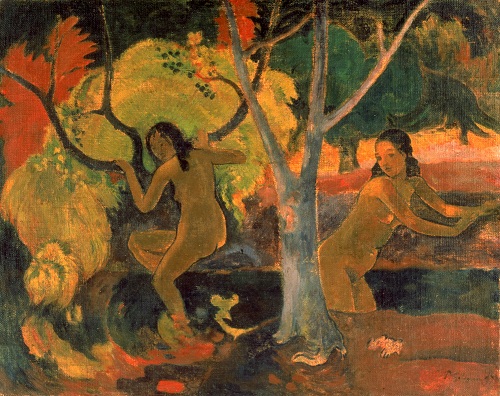
Two nude women stand in a Tahitian river, turned away from each other, yet both look out at us. Gauguin painted them in 1897 by enlarging a small detail of his great philosophical canvas, and critics liked them more than the big picture.
The story behind the painting
Gauguin painted this canvas in 1897 in Tahiti, during his last stay in French Polynesia. It grew out of his large painting Where Do We Come From? What Are We? Where Are We Going?: Gauguin took a small nude woman seen far off on the left of that work, from the part about destiny, and enlarged and developed her here. On 9 December 1897 it was one of nine canvases he sent to the dealer Ambroise Vollard, described as two little bathers against a background of yellow trees.
What to look for
The oil on canvas measures 73.3 by 91.8 cm. The bather on the left, seen from behind, seems to step out of the water while turning her head towards the viewer. The one on the right faces the other way, her body leaning slightly forward, arms reaching out. The two women seem to ignore each other, but both look at us. The landscape is built from broad, hazy brushstrokes in bright greens and reds, used for expressive effect. For the left figure, the Wildenstein catalogue points to the painting Fatata te Miti.
Meaning and intent
Gauguin wanted this canvas shown with seven others linked to Where Do We Come From?, as fragmentary replicas and preparatory studies for the big picture. They were exhibited together at Vollard's gallery in November and December 1898, and were received as one decorative ensemble with a defined programme. The large philosophical canvas was not well received there. This smaller picture, with its echoes of 18th and 19th century French painting, its tropical light and its light eroticism, pleased the critics much more.
Legacy
The painting is number W. 564 in the Wildenstein catalogue raisonné of Gauguin's work. Vollard sold it to Samuel Courtauld in 1924, and it then passed through several collections, including that of Wildenstein himself. In 1949 the Barber Institute of Fine Arts in Birmingham, England, acquired it, inventory number 49.9, and it remains there. A quiet offshoot of one of Gauguin's most ambitious works, it has found its own audience.
Did you know?
- Painted in Tahiti in 1897.
- Enlarges a detail of Where Do We Come From? What Are We? Where Are We Going?
- Shown with seven related canvases at Vollard's gallery in 1898.
- In the Barber Institute of Fine Arts, Birmingham, since 1949.
About the artist
Paul Gauguin (1848-1903)
Barber Institute of Fine Arts · Degas Collection
More by Paul Gauguin
 Where Do We Come From? What Are We? Where Are We Going? - Paul Gauguin (1897-1898)
 The Yellow Christ - Paul Gauguin (1889)
 When Will You Marry? - Paul Gauguin (1892)
 Tahitian Women on the Beach - Paul Gauguin (1890)
 Vision After the Sermon - Paul Gauguin (1888)
Manaò tupapaú - Paul Gauguin (1892)
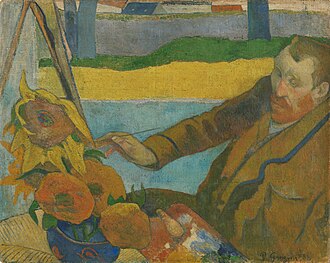 Vincent van Gogh Painting Sunflowers - Paul Gauguin (1888)
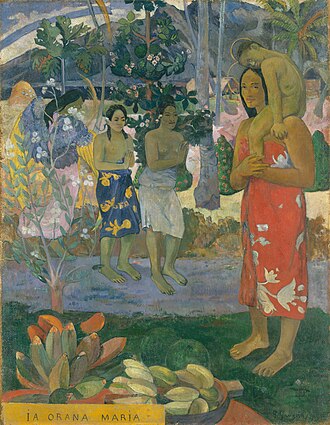 Ia Orana Maria - Paul Gauguin (1891)
Paintings by related artists
 The Starry Night - Vincent van Gogh (1889)
 Café Terrace at Night - Vincent van Gogh (1888)
 Walk on the mountain - Joaquín Sorolla (1909)
 Sad Inheritance - Joaquín Sorolla (1898)
 Les Grandes Baigneuses - Paul Cézanne (1900s)
 The Boy in the Red Vest - Paul Cézanne
 Dance at Le Moulin de la Galette - Pierre-Auguste Renoir (1876)
 Luncheon of the Boating Party - Pierre-Auguste Renoir (1881)
 At the Moulin Rouge - Henri de Toulouse-Lautrec (1892)
 La Toilette - Henri de Toulouse-Lautrec (1896)