Italienische Renaissance
Italian Renaissance painting is the story of about three centuries in which Italy reinvented how pictures could look and feel.
Fra Angelico · Leonardo da Vinci · Michelangelo · Piero della Francesca
 Mona Lisa - Leonardo da Vinci (1503-1519)
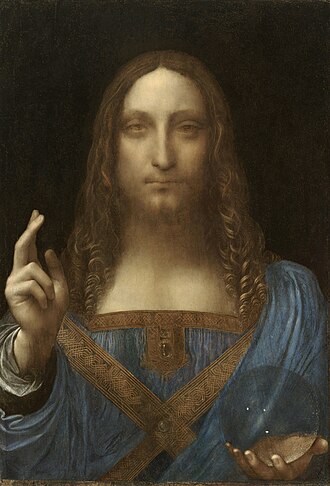 Salvator Mundi - Leonardo da Vinci (1490)
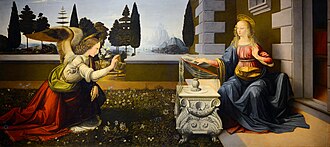 Die Verkündigung - Leonardo da Vinci (1472)
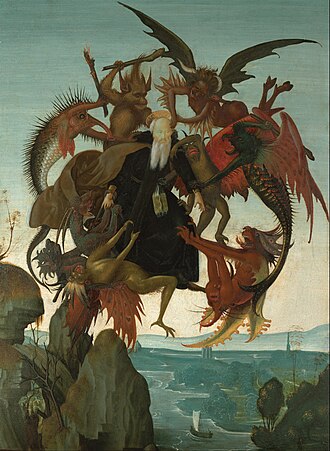 Die Versuchung des Hl. Antonius - Michelangelo (1487)
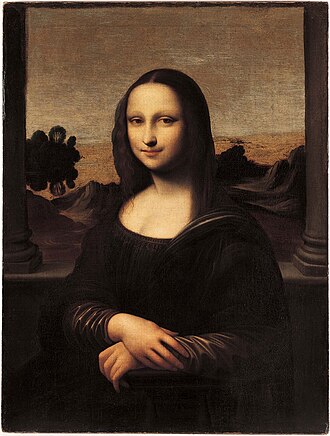 Isleworth Mona Lisa - Leonardo da Vinci (1500s)
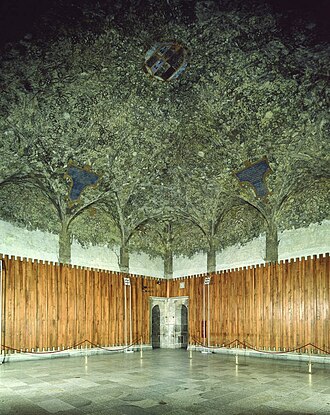 Sala delle Asse - Leonardo da Vinci (1498)
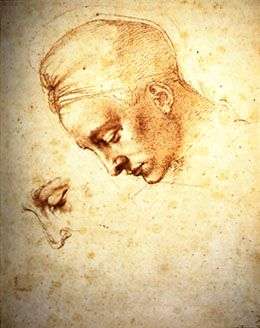 Leda - Michelangelo (1530)
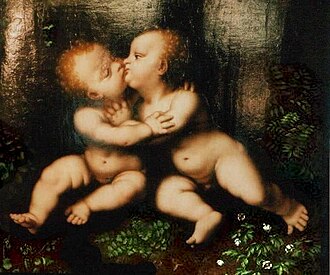 Christuskind und Johannesknabe - Leonardo da Vinci (1480s)
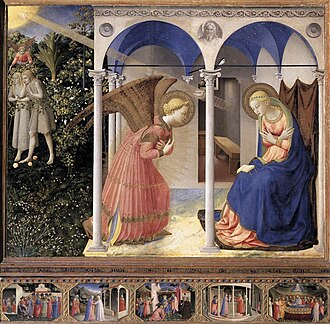 Verkündigung - Fra Angelico (1425)
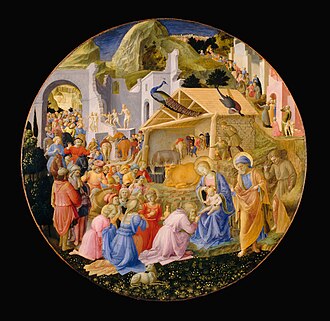 Die Anbetung der Könige, Tondo - Fra Angelico (1430)
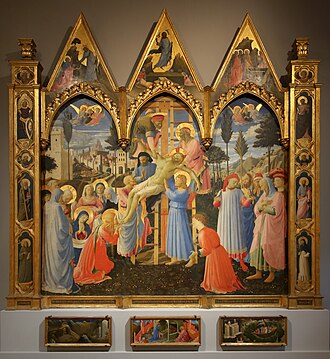 Kreuzabnahme - Fra Angelico (1432)
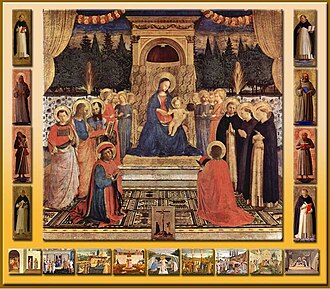 Altarbild von San Marco - Fra Angelico
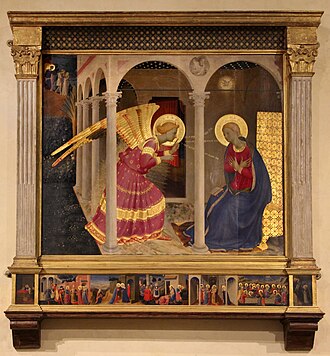 Verkündigung von Cortona - Fra Angelico (1430s)
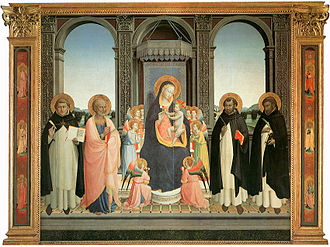 Fiesole Altar - Fra Angelico (1422)
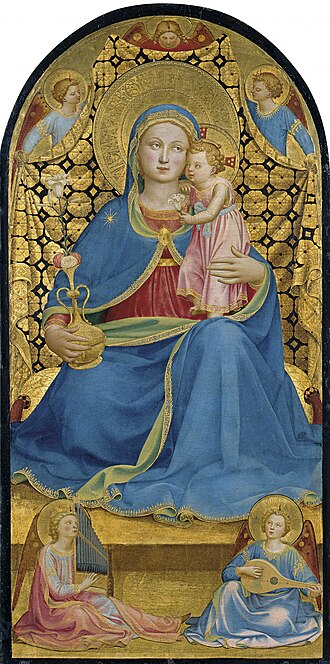 Demutsmadonna - Fra Angelico (1433)
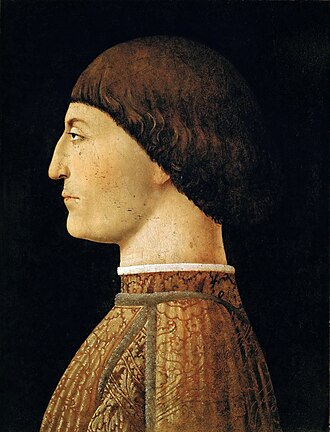 Porträt von Sigismondo Malatesta - Piero della Francesca (1450s)
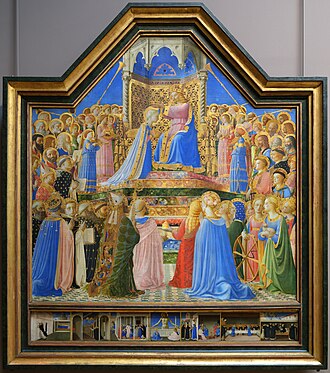 Marienkrönung - Fra Angelico
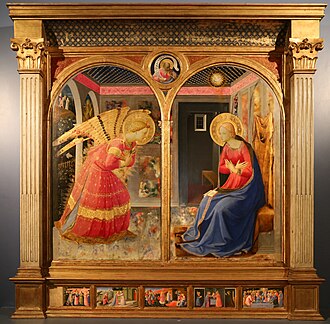 Verkündigung von San Giovanni Valdarno - Fra Angelico (1430)
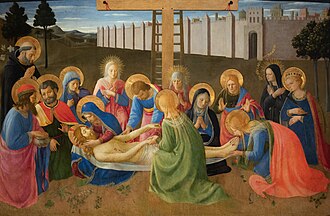 Die Kreuzabnahme - Fra Angelico (1436)
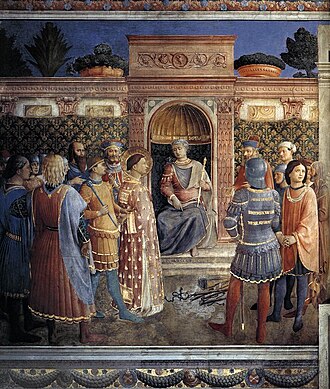 Verurteilung des hl. Laurentius durch Kaiser Valerian - Fra Angelico (1447)
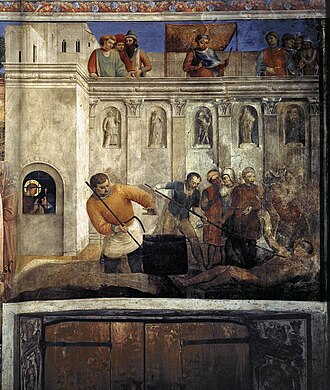 Martyrium des hl. Laurentius - Fra Angelico (1447)
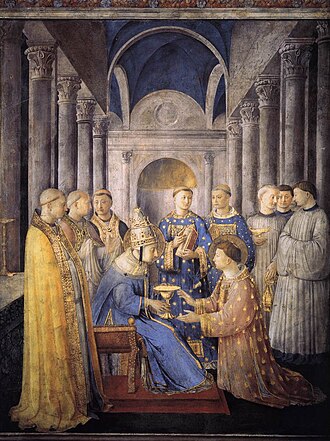 Der hl. Petrus weiht den hl. Laurentius zum Diakon - Fra Angelico (1447)
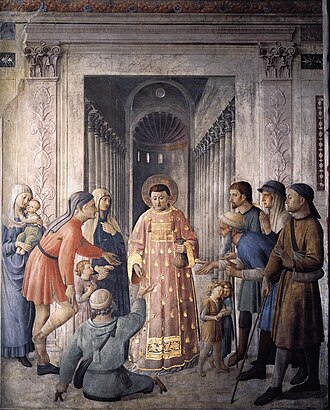 Der hl. Laurentius verteilt Almosen - Fra Angelico (1447)
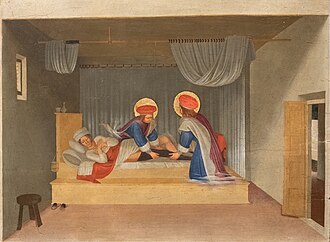 Heilung des Justinian durch die heiligen Cosmas und Damian - Fra Angelico
Neugierig auf Italienische Renaissance?
Italian Renaissance painting is the story of about three centuries in which Italy reinvented how pictures could look and feel. From Giotto's emotional figures to Leonardo, Michelangelo and Titian, it is one of the richest chapters in the whole history of art, and a wonderful place to start exploring.
What is Italian Renaissance painting, in simple words?
It is the painting made in Italy from the late 13th century, flourishing from the early 15th to the late 16th century. Italy was then split into many states, yet painters travelled widely, spreading artistic and philosophical ideas. Step by step they learned to observe nature, study anatomy, handle light and use perspective, turning painting into a convincing window onto a lifelike world.
Why is it called the Renaissance?
Renaissance means "rebirth". In this period, classical texts lost to Western European scholars for centuries became available again, and people grew newly interested in ancient Greece and Rome. The architect Brunelleschi and the sculptor Donatello even made the first archaeological study of Roman remains. This revival inspired a classical spirit in painting, visible as early as the 1420s in works by Masaccio and Paolo Uccello.
When and where did it start?
Florence in Tuscany is known as the birthplace of the Renaissance and of Renaissance painting in particular, though Rome and Venice became more important later. The story is usually split into four periods: the Proto-Renaissance (1300-1425), the Early Renaissance (1425-1495), the High Renaissance (1495-1527) and Mannerism (1527-1600). These dates show the general trend, since individual artists often overlapped them.
Who were the main painters?
The Proto-Renaissance begins with Giotto. The Early Renaissance was started by Masaccio and developed by Fra Angelico, Paolo Uccello, Piero della Francesca, Sandro Botticelli, Verrocchio, Domenico Ghirlandaio and Giovanni Bellini. The High Renaissance belonged to Leonardo da Vinci, Michelangelo, Raphael, Andrea del Sarto, Correggio, Giorgione and Titian. Later Mannerists included Pontormo, Parmigianino, Bronzino and Tintoretto.
What did these painters paint?
Much of it was made for the Catholic Church: large fresco cycles of the Life of Christ, the Virgin or saints such as St. Francis, plus altarpieces and countless small Madonna and Child pictures. Cities commissioned paintings for government buildings. Portraits became common during the 15th century. With Humanism, classical myths appeared too, like Botticelli's Birth of Venus for the Medici, along with scenes of daily and family life.
How can I recognise one?
Look for solid, three-dimensional figures with real emotions on their faces, a feeling of deep space created by linear perspective, and light that seems to come from a real source. Giotto's figures, for example, stand squarely on the ground and show joy, rage, despair and love. Later works add softer blending of tones, rich oil colours, and, in Venice, colour rather than line as the main tool.
How is it different from the medieval painting before it?
Before Giotto, Tuscan painting followed the Italo-Byzantine style of Cimabue and Duccio. It was highly formal and based on icon painting, with details like the position of the Madonna's hands fixed by tradition and repeated in countless pictures. Giotto based his figures on observing life instead. In the Uffizi in Florence his Ognissanti Madonna hangs in the same room as Madonnas by Cimabue and Duccio, so you can compare them directly.
Which famous works should I see first?
A good first tour: Giotto's frescoes in the Scrovegni Chapel in Padua, Masaccio's Brancacci Chapel in Florence, Piero della Francesca's Flagellation of Christ, Botticelli's Birth of Venus, Mantegna's Camera degli Sposi in Mantua, Leonardo's The Last Supper and Mona Lisa, Michelangelo's Sistine Chapel ceiling, Raphael's The School of Athens, Giorgione's The Tempest and Titian's Assumption of the Virgin.
Where can I see these paintings today?
Many remain in Italian churches and palaces, such as the Scrovegni Chapel in Padua, the Brancacci Chapel in Florence and the Sistine Chapel in the Vatican. The Uffizi Gallery in Florence holds great early Madonnas, and the Louvre has Raphael's La Belle Jardinière. Some of the world's best known collections, including the National Gallery in London, were formed specifically to collect Italian Renaissance works.
Why does it still matter?
Its influence is enormous. Leonardo and Raphael shaped generations of artists, including Poussin and classical painters of the 18th and 19th centuries. Michelangelo's style can be traced through El Greco, Caravaggio, Rubens and on to Jacques-Louis David and Delacroix. Rembrandt knew Titian and Raphael's work, and modern academies of art, such as the Royal Academy, were founded under its influence. Titian is even considered by some the founder of modern painting.