Yard with Lunatics
Francisco Goya · 1790s
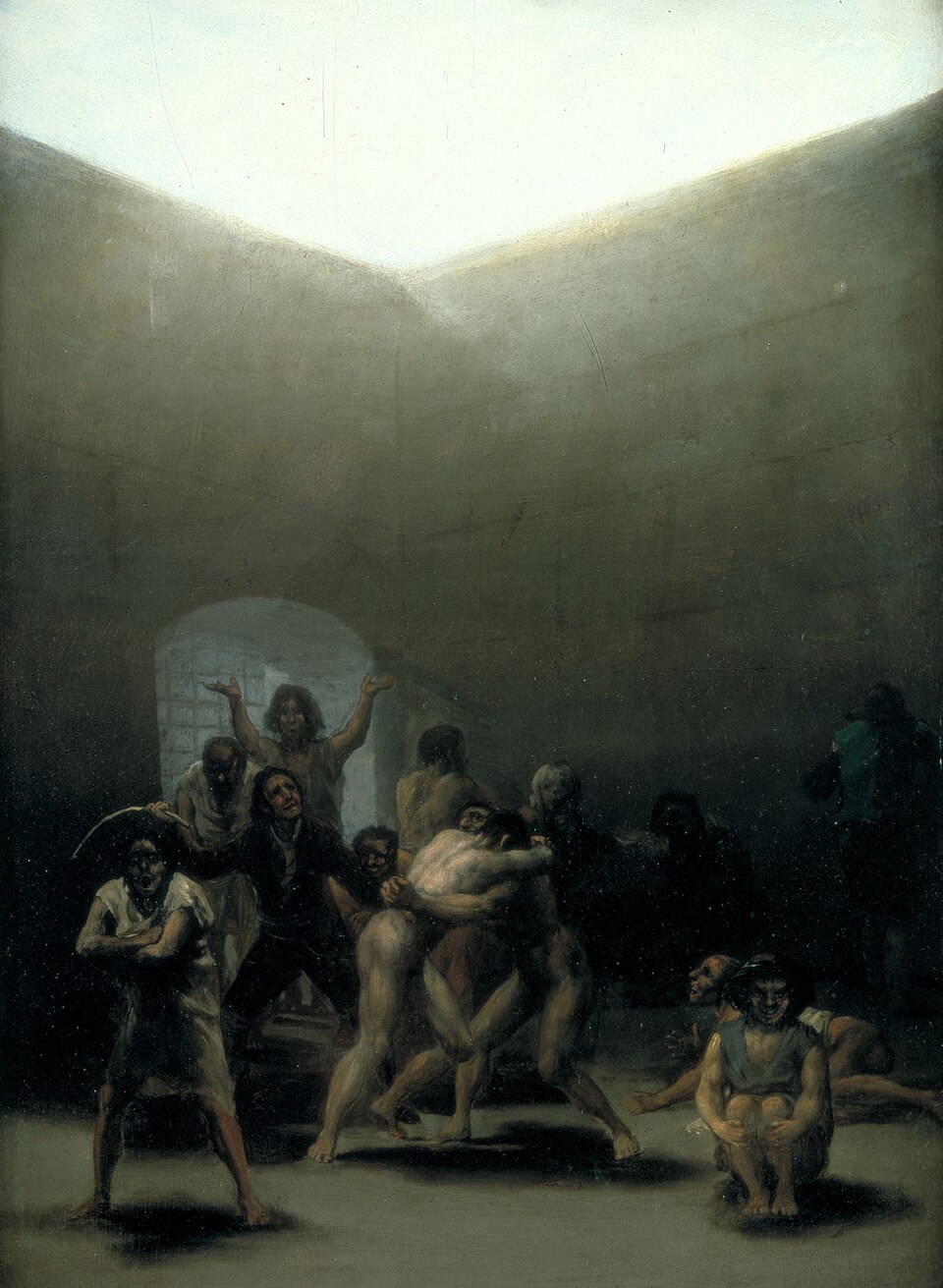
Shackled men fight and huddle in a stone yard under a grey-green light while a guard raises his whip. Goya painted this small nightmare from memory, at a time when he feared he was losing his own mind.
The story behind the painting
Goya painted Yard with Lunatics, a small oil on tinplate, in 1793 to 1794, while his deafness was developing and he complained ever more about his health. A diagnosis of the time noted the noises in his head and his deafness were not improving. Until then he had been busy with commissioned portraits of royalty and nobles. This work was one of about a dozen small, dark pictures he made on his own. He wrote that they served to occupy his imagination, tormented by contemplating his sufferings, and showed things that normally find no place in commissioned works.
What to look for
The yard is stark. High walls and a heavy stone arch enclose shackled inmates. Some fight, some grin, some huddle in despair, all bathed in an oppressive grey and green light and watched by a single guard. In a 1794 letter to his friend Bernardo de Yriarte, Goya described two of them fighting completely naked while their warder beats them, and others in sacks, a scene he said he witnessed at Zaragoza. The top of the picture dissolves into sunlight, which makes the scene below feel even more like a nightmare. It is small, about 44 by 32 cm.
Meaning and intent
The painting is usually read as an indictment of how the insane were treated, locked up with criminals, put in iron manacles and routinely beaten. The critic Robert Hughes called such places holes in the social surface. Arthur Danto saw in it Goya's move from a world with no shadows to one with no light. Goya admitted the series reflected his own self-doubt and fear of madness. Historians have suggested encephalitis or Ménière's disease, but these posthumous diagnoses are only speculation, and his illness remains unknown.
Legacy
Uncommissioned, this was one of the first of Goya's cabinet paintings of the mid-1790s, where his search for ideal beauty gave way to an exploration of naturalism and fantasy that would occupy him for the rest of his life. It is often compared with his later and equally bleak Madhouse of 1812 to 1819, and condemning brutality toward prisoners became a theme of many later works. Out of public view after a private sale in 1922, it was donated by Algur H. Meadows in 1967 to the Meadows Museum in Dallas.
Schon gewusst?
- Oil on tinplate, painted 1793-1794.
- Goya said he saw the scene at Zaragoza.
- Made independently, not on commission.
- In the Meadows Museum, Dallas, since 1967.
Über den Künstler
Francisco Goya (1746-1828)
Mehr von Francisco Goya
 Die Erschießung der Aufständischen - Francisco Goya (1814)
 Die nackte Maja - Francisco Goya (1800)
 Saturn verschlingt seinen Sohn - Francisco Goya (1819)
 Die Familie Karls IV. - Francisco Goya (1800)
 Die Bekleidete Maja - Francisco Goya (1800)
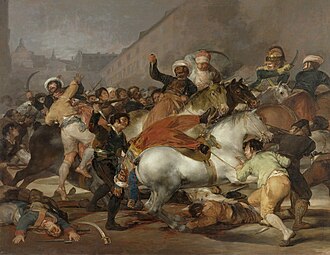 Kampf mit den Mamelucken am 2. Mai 1808 in Madrid - Francisco Goya (1814)
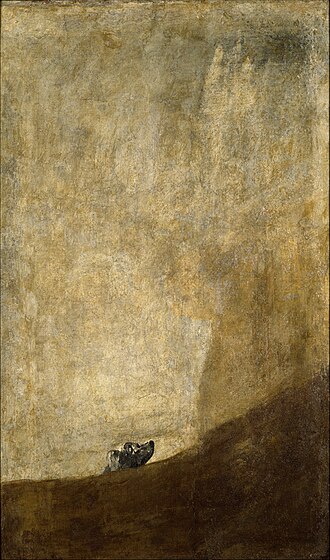 Hund - Francisco Goya (1819)
 Hexensabbat - Francisco Goya (1820s)
Werke verwandter Künstler
 Der Wanderer über dem Nebelmeer - Caspar David Friedrich (c. 1818)
 Abtei im Eichwald - Caspar David Friedrich (1800s)
 Die Freiheit führt das Volk - Eugène Delacroix (1830)
 Der Tod des Sardanapal - Eugène Delacroix (1827)
 Die letzte Fahrt der Temeraire - J. M. W. Turner (1839)
 Rain, Steam and Speed - The Great Western Railway - J. M. W. Turner (1844)
 Knabe in Blau - Thomas Gainsborough (1770)
 Mr. und Mrs. Andrews - Thomas Gainsborough (1748)