Kampf mit den Mamelucken am 2. Mai 1808 in Madrid
Francisco Goya · 1814
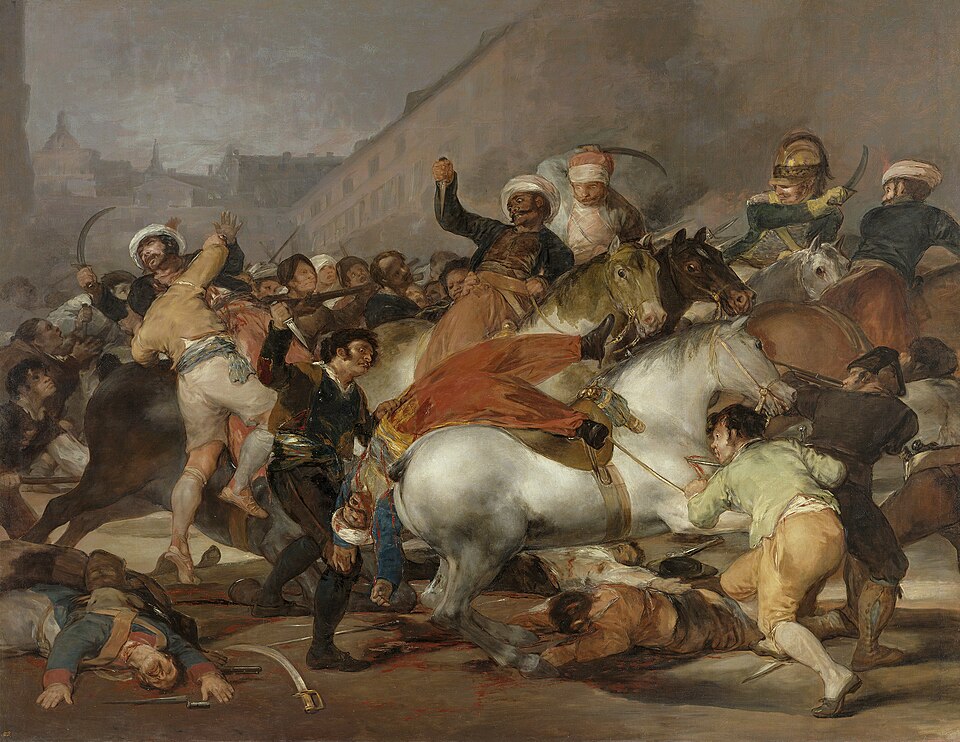
No hero, no centre, no calm: only a street in Madrid exploding as ordinary people hurl themselves with knives at the horsemen of an empire.
The story behind the painting
In 1808 Napoleon used the pretext of reinforcing his army in Portugal to seize the Spanish throne and install his brother Joseph. When attempts were made to remove members of the Spanish royal family from Madrid, the city rose up on the second of May, and the revolt was crushed under Marshal Joachim Murat. Goya lived through the occupation, though he was probably not present at this particular clash. Six years later, in 1814, after the French had been driven out, the council governing Spain before Ferdinand VII's return commissioned the work. Goya completed it, together with its companion The Third of May 1808, within about two months. The scene is set in the Calle de Alcalá near the Puerta del Sol, where the Egyptian Mamelukes of Napoleon's Imperial Guard were ordered to charge the crowd.
What to look for
Stand back from this vast canvas, more than two and a half metres high and nearly three and a half wide, and try to find where to rest your eye. You cannot, and that is the point. Goya deliberately refused a single action or focal point, so the struggle spills in every direction. Horses rear and twist, riders in exotic dress swing curved scimitars, and townspeople leap up to drag them from their saddles. Look for the knives: the citizens fight with the crudest weapons against a professional army. Blood, saddles and tangled bodies fill the foreground in a melee that seems to have no beginning or end. The sheer press of figures, packed edge to edge, makes the viewer feel caught inside the chaos rather than watching it from a safe distance.
Meaning and intent
Goya chose to show the people of Madrid as unnamed heroes, not generals or kings. The crowd, seeing the Mamelukes as Moors, turned on them in fury instead of scattering, and Goya captures that ferocity without polishing it into glory. There is no noble commander on a white horse here, only anger, fear and improvised violence. This choice was pointed. Ferdinand VII, on his return, was not pleased by a picture celebrating the common people rather than the crown, and the paintings were not hung publicly until many years, and several governments, later. Scholars have debated how much Goya drew on Rubens's tumultuous battle and hunting scenes; Kenneth Clark even called the painting an artistic failure haunted by such models. Others see in its chaos an honest refusal of heroic convention.
Legacy
Today The Second of May 1808 hangs with its companion in the Museo del Prado in Madrid, where the two form one of the most powerful pairs in the history of painting: revolt, then reprisal. The work itself survived a war of its own. In 1936, during the Spanish Civil War, the republican government evacuated the Prado's paintings as Madrid was bombed. A truck carrying Goya's canvases had an accident, and this picture was badly damaged, with tears and even missing pieces. It was first restored in 1941, when the paintings returned to Madrid, and again between 2007 and 2008. That a scene of violence should itself bear the scars of later conflict gives it a strange, moving resonance for visitors who stand before it today.
Schon gewusst?
- It is also known as The Charge of the Mamelukes.
- Goya painted it and The Third of May 1808 within about two months in 1814.
- The canvas was torn in a truck accident while being evacuated during the Spanish Civil War.
- It was restored in 1941 and again in 2007-2008.
Über den Künstler
Francisco Goya (1746-1828)
Museo del Prado · Historienmalerei · Hauspferd
Mehr von Francisco Goya
 Die Erschießung der Aufständischen - Francisco Goya (1814)
.jpg) Die nackte Maja - Francisco Goya (1800)
Die nackte Maja - Francisco Goya (1800).jpg) Saturn verschlingt seinen Sohn - Francisco Goya (1819)
Saturn verschlingt seinen Sohn - Francisco Goya (1819) Die Familie Karls IV. - Francisco Goya (1800)
 Die Bekleidete Maja - Francisco Goya (1800)
 Hund - Francisco Goya (1819)
 Hexensabbat - Francisco Goya (1820s)
 Porträt der Doña Isabel de Porcel - Francisco Goya (1800s)