Die Frau im Spiegel
Tizian · 1515
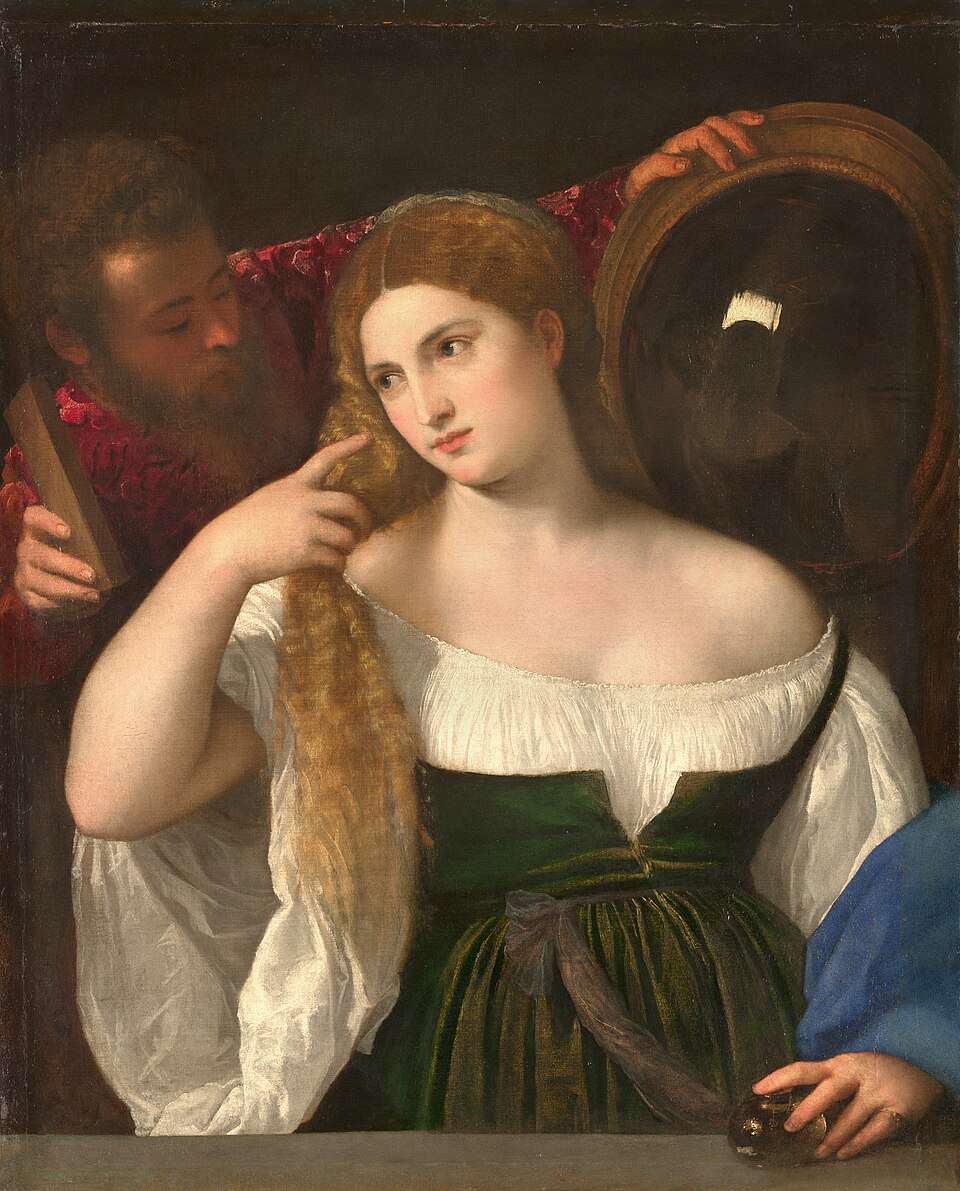
A young woman gathers her loose hair and gazes into a mirror, while a man behind her holds up a second glass. With two mirrors, Titian shows us the same figure from more than one side.
The story behind the painting
Titian painted Woman with a Mirror, also called Woman at Her Toilet, around 1515, in oil on canvas. It is first known in the collection of the Gonzaga family in Mantua, from which it was bought by Charles I of England. After Charles was executed his collection was sold off, and Louis XIV of France purchased the painting for the Palace of Versailles. Today it is in the Louvre in Paris. Many versions of the work are known, equal in quality but smaller; the best are in the MNAC in Barcelona, the gallery of Prague Castle and the National Gallery of Art in Washington, a reminder that Titian's workshop often made variations from the same studies.
What to look for
A woman of idealised beauty leans over a parapet, one hand touching a small bottle that may hold perfume or ointment, her right hand lifting her reddish blonde hair. Behind her a man raises a mirror that shows her from behind, along with the window that lights the room. He also holds a second mirror, seen in profile, in which she studies herself as she dresses. Follow the reflections and you see the woman from the front, from the back and in her own eyes. The warm harmony of colour and the balanced composition are typical of the young Titian.
Meaning and intent
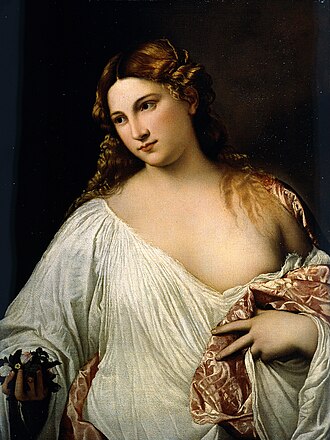
Who was she? Suggestions include Titian's own lover, Laura Dianti, the companion of Alfonso I d'Este, and Isabella Boschetti, Federico Gonzaga's lover, as Wikidata records. None fits the style-based date of 1512-15, and she is probably a model who appears in other Titian paintings of these years, such as Flora in the Uffizi. The mirrors connect to the Renaissance Paragone debate: painting, like sculpture, should show its subject from many sides. Because women of the time wore their hair loose only in the privacy of the home, the scene feels intimate, its sensuality outweighing the vanitas hints of the ointment bottle and the play of mirrors.
Legacy
The painting's journey through great collections, from the Gonzaga in Mantua to Charles I in London and Louis XIV at Versailles, tells of how highly it was prized. Its many surviving versions show how popular the composition became, and how Titian's workshop could repeat a successful design. The same reddish blonde woman links it to a whole family of his early pictures, including the Vanity in Munich, the Salome in the Galleria Doria Pamphilj and the clothed figure in Sacred and Profane Love. In the Louvre today, it remains one of the clearest examples of Titian's early gift for beauty, light and reflection.
Schon gewusst?
- It was owned by the Gonzaga, then Charles I of England, then Louis XIV.
- Proposed sitters include Laura Dianti and Isabella Boschetti, but none fits the date of 1512-15.
- Good versions exist in Barcelona, Prague Castle and Washington.
- The double mirrors relate to the Renaissance Paragone debate between painting and sculpture.
Über den Künstler
Tizian (1488-1576)
Porträt · Mann · Hochrenaissance · Gemäldeabteilung des Louvre · Spiegel
Mehr von Tizian
.jpg) Venus von Urbino - Titian (1538)
Venus von Urbino - Titian (1538) Mariä Himmelfahrt - Titian (1510s)
FXD.jpg) Himmlische und Irdische Liebe - Titian (1510s)
Himmlische und Irdische Liebe - Titian (1510s) Kaiser Karl V. nach der Schlacht bei Mühlberg - Titian (1548)
 Flora - Titian (1517)
 Allegorie der von der Klugheit beherrschten Zeit - Titian (1550)
 Bacchus und Ariadne - Titian (1520s)
%20nave%20left%20-%20Altar%20of%20Madona%20di%20Ca'Pesaro.jpg) Pesaro Madonna - Titian
Pesaro Madonna - Titian
Werke verwandter Künstler
 Mona Lisa - Leonardo da Vinci (1503-1519)
 Dame mit dem Hermelin - Leonardo da Vinci (1490)
 Selbstbildnis im Pelzrock - Albrecht Dürer (1500)
 Anbetung der Könige - Albrecht Dürer (1504)
 Die Geburt der Venus - Sandro Botticelli (c. 1485)
 Primavera - Sandro Botticelli (1480s)