Venus und Cupido
Artemisia Gentileschi · 1620s
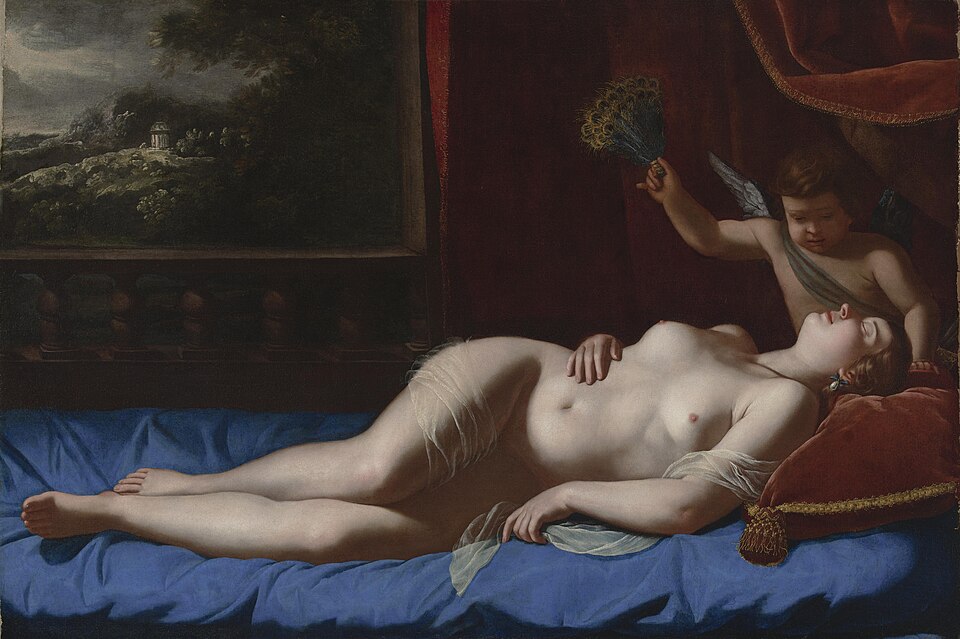
Venus drifts into sleep on a deep blue bed while her son fans her with peacock feathers, gazing at her in rapture. Artemisia Gentileschi gave the goddess features of her own face, in a rare sleeping nude painted by a woman.
The story behind the painting
Artemisia Gentileschi painted Venus and Cupid, also called Sleeping Venus, around 1626; Wikidata dates it simply to the 1620s. It was probably commissioned by an important and wealthy patron. The clue is in the bed: Gentileschi painted the blue sheets with two layers of lapis lazuli, an expensive material for artists to obtain. Because the picture shows a slumbering, vulnerable woman, unlike her earlier works, it is thought to show her willingness to adapt her style to what patrons wanted. A second artist may have been commissioned to paint the landscape at the top left.
What to look for
The canvas is about 96.5 by 143.8 cm. Venus reclines on a blue bed covering, her head on a rich crimson and gold tasselled pillow. She wears only a thin wisp of transparent linen around her thigh. Cupid fans her with richly coloured peacock feathers, gazing at her with an adoring, rapturous expression. Through a window you see a moonlit landscape with a temple to the goddess. Look at her face: full cheeks, heavy lids, a prominent nose and a small protruding chin, all features of Gentileschi's own face. Her hand rests lightly on her side and her legs lie gently together.
Meaning and intent
The art historian Udo Kultermann places the work in a long tradition of sleeping female nudes, from antiquity through the Renaissance, and notes that it is a rare example of a woman artist taking up the motif. He argues that the composition heightens the intimacy and voyeurism typical of the subject, making the viewer aware of the indiscretion of looking at a vulnerable, sleeping goddess. More recent scholarship stresses a balance between erotic display and a sacred, protective space. Addison Cucchiaro calls her a goddess at rest, framed as divine by the costly ultramarine and the temple behind her.
Legacy
The painting blends realism and classicism, both in its imagery and in Gentileschi's style. Its modern history is recent: it was first documented in a private collection in Rome in the 1980s. It was then acquired by the Barbara Piasecka Foundation in Princeton, New Jersey, and later by the Adolph D. and Wilkins C. Williams Foundation, which gave it to the Virginia Museum of Fine Arts. There it now invites visitors to reconsider a familiar theme of European art, seen this time through the eyes of a woman painter who gave the goddess her own face.
Schon gewusst?
- Painted by Artemisia Gentileschi around 1626.
- The blue sheets use two layers of costly lapis lazuli.
- Venus has features of the painter's own face.
- Gifted to the Virginia Museum of Fine Arts.
Über den Künstler
Artemisia Gentileschi (1593-1653)
mythologische Malerei · Akt · Venus · Amor · Virginia Museum of Fine Arts
Mehr von Artemisia Gentileschi
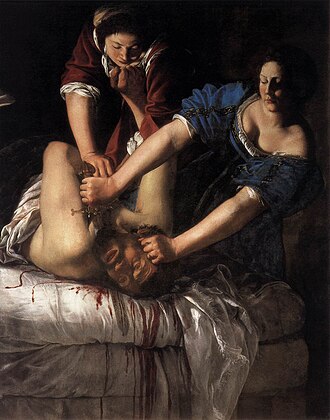 Judith enthauptet Holofernes - Artemisia Gentileschi (1613)
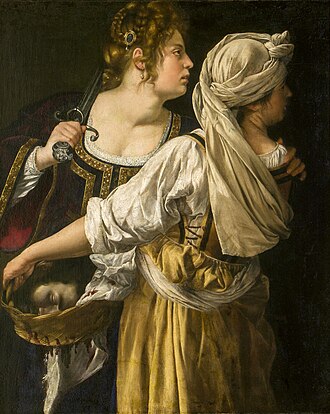 Judith mit ihrer Magd - Artemisia Gentileschi (1618)
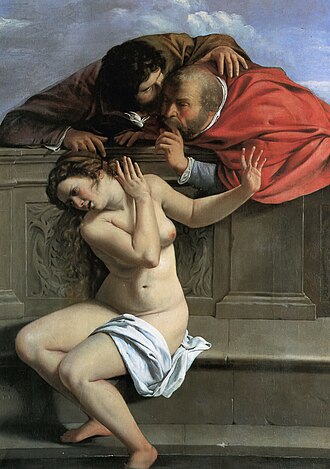 Susanna und die Ältesten - Artemisia Gentileschi (1610)
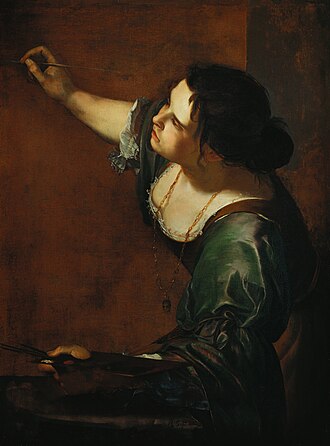 Selbstporträt als Allegorie der Malerei - Artemisia Gentileschi (1638)
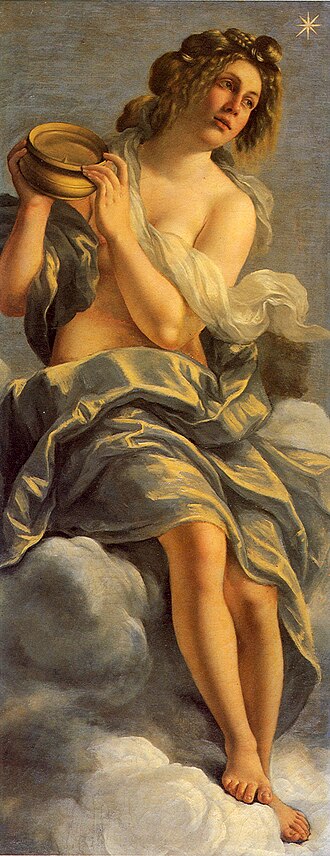 Das natürliche Talent - Artemisia Gentileschi (1615)
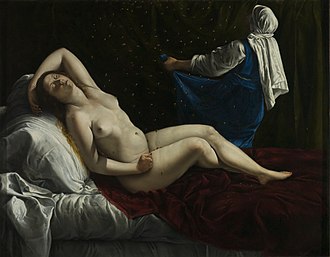 Danaë - Artemisia Gentileschi (1612)
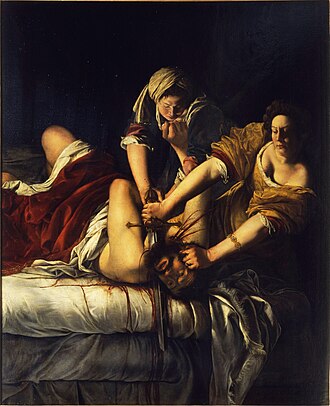 Judith enthauptet Holofernes - Artemisia Gentileschi (1620)
 Esther vor Ashaver - Artemisia Gentileschi (1620s)
Werke verwandter Künstler
 Das Abendmahl in Emmaus - Caravaggio (1601)
 Die Berufung des Hl. Matthäus - Caravaggio (1609)
 Las Meninas - Diego Velázquez (1656)
 Die Übergabe von Breda - Diego Velázquez (1635)
 Saint Francis in Meditation - Francisco de Zurbarán (1639)
 The Immaculate Conception - Francisco de Zurbarán (1661)
 Dreifachporträt von Karl I. - Anthony van Dyck (1635)
 Karl I mit M. de St. Antoine - Anthony van Dyck (1636)
 Die Aufrichtung des Kreuzes - Peter Paul Rubens (1609)
 Der Raub der Töchter des Leukippos - Peter Paul Rubens (1618)
 Die Nachtwache - Rembrandt van Rijn (1642)
 Selbstbildnis - Rembrandt van Rijn (1659)