the tobacco guards
Francisco Goya · 1779
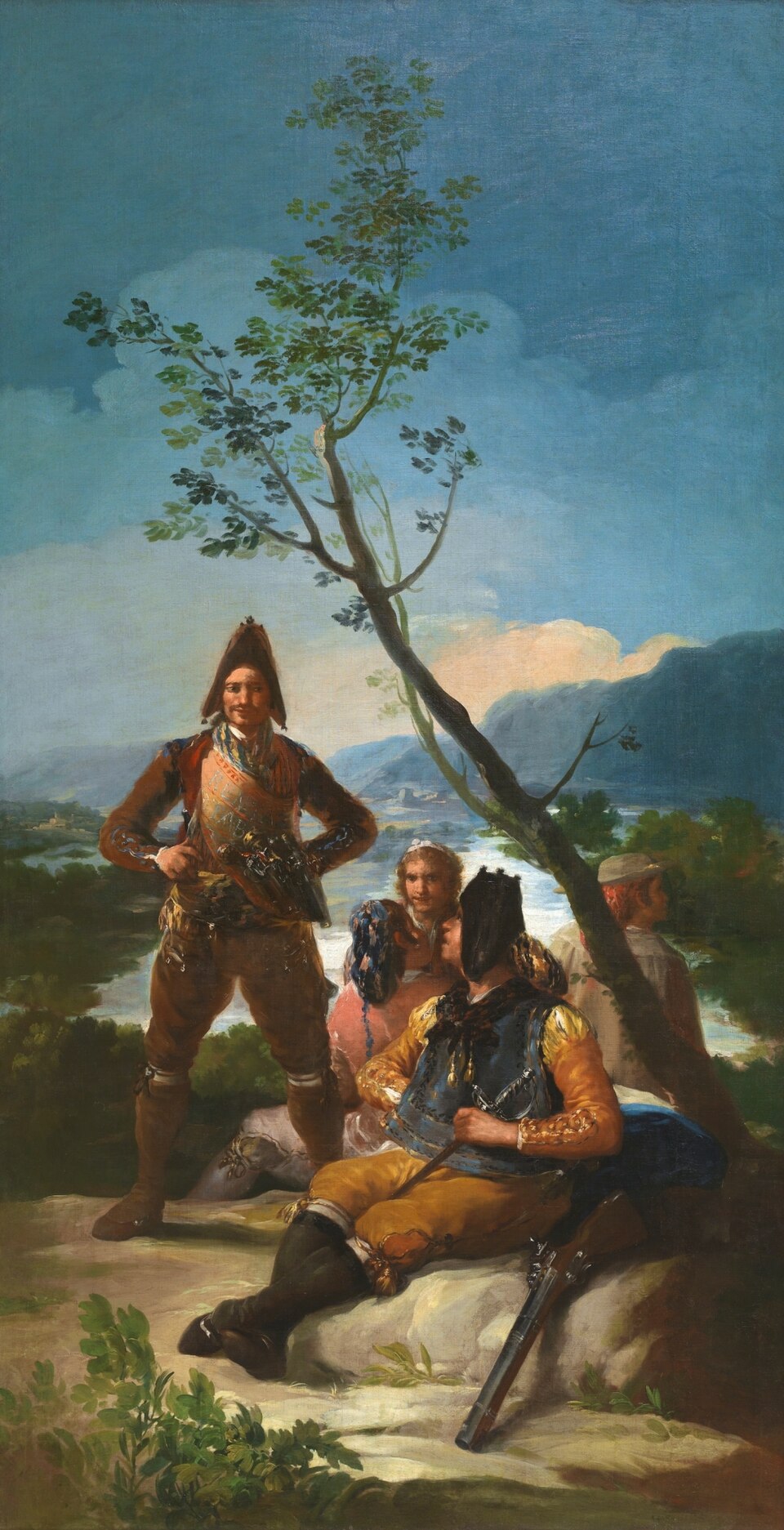
Armed men rest by a river, one standing to scan the land as if on patrol. Goya designed this tall scene as a tapestry cartoon for a royal antechamber, then it vanished into a palace basement for nearly ninety years.
The story behind the painting
El resguardo de tabacos belongs to Goya's fourth series of tapestry cartoons, all made for the antechamber of the Prince of Asturias, the future Charles IV, and his wife Maria Luisa of Parma at the Palace of El Pardo. The painting was delivered to the Royal Tapestry Factory on 24 January 1780. A document dated 2 October 1777, of unknown origin, says the tapestry was to hang on the south wall of the antechamber beside another one, La Novillada. The French Wikipedia article dates the painting 1780, while Wikidata gives 1779. The series also included The Blind Guitarist, The Swing, The Washerwomen, The Boy with a Bird, The Tree Boy, The Woodcutters and others, plus two lost cartoons.
What to look for
Goya described it himself: five tobacco guards, two seated and one standing not far from a river, looking around as if on reconnaissance, and two of them well armed. Look at the standing figure keeping watch while the others rest, and at the weapons, which carry much of the scene's meaning. In the background landscape, the source notes the influence of Diego Velázquez. The canvas is tall and narrow in feeling, 262 by 137 cm, made to be translated into a woven wall hanging. The subject was well known at the time: tobacco smuggling and the guards who fought it.
Meaning and intent
In such episodes the heroes were usually the smugglers. According to Gregorio Cruzada Villaamil, Goya instead chose to stage the defenders of national interests. Although Goya called the men guards, the scholar Janis Tomlinson suggests they may be ruffians rather than guardians, and the source leaves both readings open. The article also points to an obvious sexual symbolism, completed by La Novillada in the same series. The painting has deep roots in the literature of the Spanish Golden Age, where the sword as a bastion of masculinity was idealised by the Count of Villamediana and by Francisco de Quevedo, both authors of famous sonnets on the subject.
Legacy
For a long time the cartoon was thought lost. In 1869 Gregorio Cruzada Villaamil found the canvas in the basement of the Royal Palace of Madrid, and it was handed to the Museo del Prado in 1870 by orders of 19 January and 9 February that year. It first appears in the Prado catalogue in 1876, as number 24 of Appendix I, and the source places it in room 91. What began as a design for weavers, meant to disappear behind a finished tapestry, is now looked at as a painting in its own right, alongside the other cartoons of the same royal series.
Schon gewusst?
- Part of Goya's fourth tapestry-cartoon series for El Pardo.
- Delivered to the Royal Tapestry Factory on 24 January 1780.
- Rediscovered in a Royal Palace basement in 1869.
- In the Museo del Prado since 1870.
Über den Künstler
Francisco Goya (1746-1828)
Genreszene · Museo del Prado · Feuerwaffe
Mehr von Francisco Goya
 Die Erschießung der Aufständischen - Francisco Goya (1814)
 Die nackte Maja - Francisco Goya (1800)
 Saturn verschlingt seinen Sohn - Francisco Goya (1819)
 Die Familie Karls IV. - Francisco Goya (1800)
 Die Bekleidete Maja - Francisco Goya (1800)
 Kampf mit den Mamelucken am 2. Mai 1808 in Madrid - Francisco Goya (1814)
 Hund - Francisco Goya (1819)
 Hexensabbat - Francisco Goya (1820s)
Werke verwandter Künstler
 Der Wanderer über dem Nebelmeer - Caspar David Friedrich (c. 1818)
 Abtei im Eichwald - Caspar David Friedrich (1800s)
 Die Freiheit führt das Volk - Eugène Delacroix (1830)
 Der Tod des Sardanapal - Eugène Delacroix (1827)
 Die letzte Fahrt der Temeraire - J. M. W. Turner (1839)
 Rain, Steam and Speed - The Great Western Railway - J. M. W. Turner (1844)
 Knabe in Blau - Thomas Gainsborough (1770)
 Mr. und Mrs. Andrews - Thomas Gainsborough (1748)