Einst und jetzt
Francisco Goya · 1810s
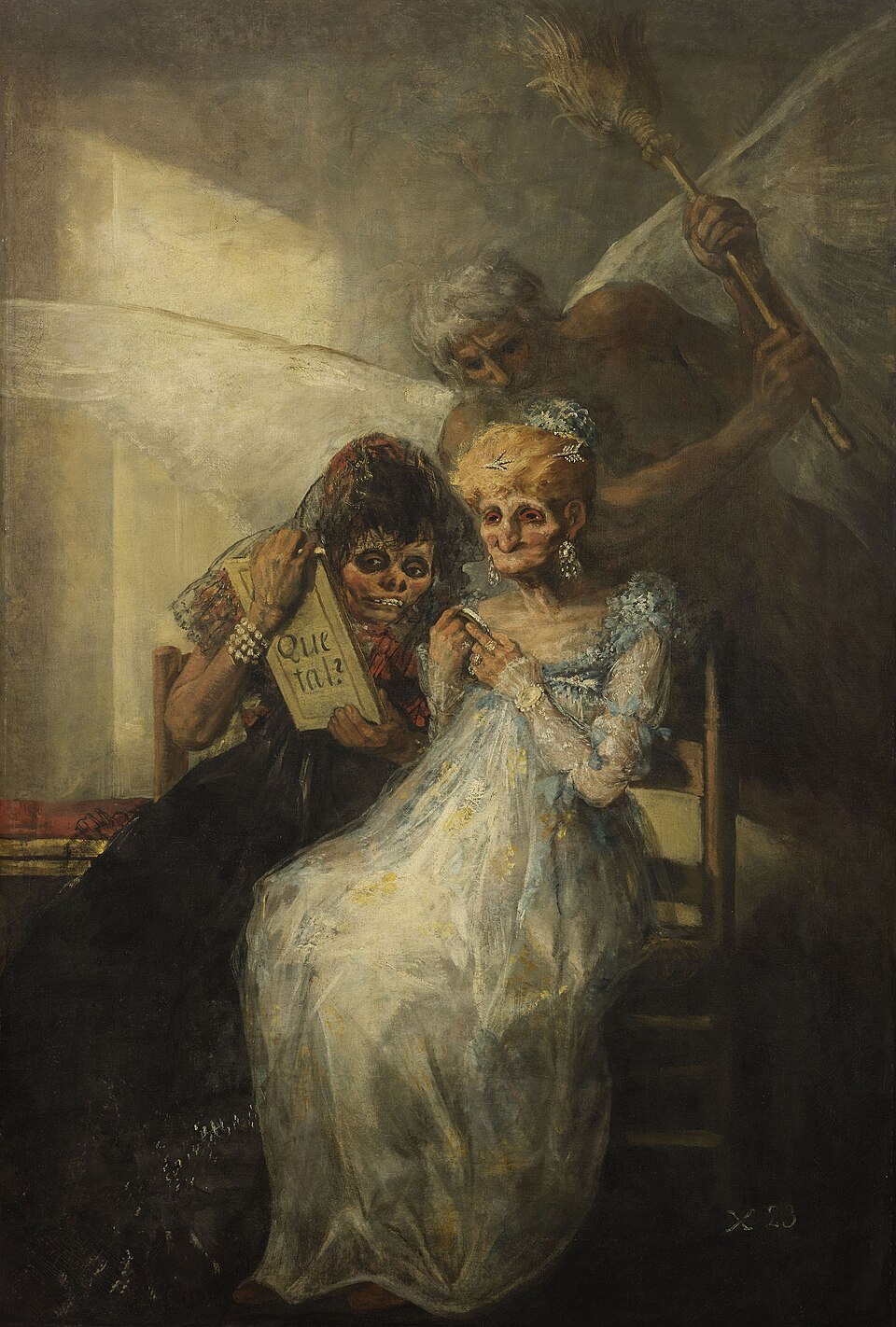
Two ancient women primp before a mirror that asks, How goes it? Behind them, winged Time raises his broom to sweep them away. Goya painted this dark joke during the war, when the nobility had fled and the commissions had stopped.
The story behind the painting
Goya painted this canvas during the Spanish War of Independence, when the nobility had fled and he had no more commissions. Wikidata dates it to the 1810s. The Palais des Beaux-Arts in Lille describes it as made in a very melancholy moment, when the painter was prey to nightmarish visions after Napoleonic France went to war with Spain. In the inventory of Goya's goods drawn up in 1812, after the death of his wife Josefa, it is number 23. Number 24 lists two pictures of young women on a balcony, painted at the same time and of similar size.
What to look for
In a chiaroscuro setting, two cadaverous old women sit in front, one seated, the other whispering in her ear, while behind them a bare-chested winged man is about to sweep them away with a broom. The seated woman, dressed in white and very carefully groomed, studies a miniature portrait of herself. The other holds up a mirror whose back reads Que tal?, How goes it?, like a speech balloon, a device Goya had already used in Los Caprichos. The museum points out how the two are set in opposition: short blond hair against long dark hair, white against black.
Meaning and intent
The work can be read as a vanity painting, a reminder that old age and death will come, or as a satire on the hypocrisy of the old, part of a series of critiques of manners. The two women are probably a noblewoman, the museum suggests the Queen, and her servant, obsessed with appearances to the edge of death while Chronos, god of time, is ready to sweep them off. The woman in white wears a diamond Cupid's arrow in her hair like the one worn by Queen Maria Luisa in The Family of Charles IV. The other has been read as the Duchess of Alba, a close friend of Goya and a rival of the queen.
Legacy
X-rays show that this picture and the two balcony scenes were painted over three older works by another painter of the early 17th century, allegories of the four elements after engravings by Adriaen Collaert. The Old Women was painted over the allegory of air. The canvas was sold together with The Young Ones, though the two are not a pair. It belongs to a path in Goya's work, after his illness and deafness, from the Caprichos toward the Black Paintings, leaving bright Rococo colour behind for darker tones. It is now in the Palais des Beaux-Arts de Lille.
Schon gewusst?
- Painted during the Spanish War of Independence.
- Number 23 in the 1812 inventory of Goya's goods.
- The mirror's back reads Que tal?
- Painted over an older allegory of air.
Über den Künstler
Francisco Goya (1746-1828)
Frau · Sitzen · Romantik · Allegorie · Spiegel · Palais des Beaux-Arts de Lille
Mehr von Francisco Goya
 Die Erschießung der Aufständischen - Francisco Goya (1814)
.jpg) Die nackte Maja - Francisco Goya (1800)
Die nackte Maja - Francisco Goya (1800).jpg) Saturn verschlingt seinen Sohn - Francisco Goya (1819)
Saturn verschlingt seinen Sohn - Francisco Goya (1819) Die Familie Karls IV. - Francisco Goya (1800)
 Die Bekleidete Maja - Francisco Goya (1800)
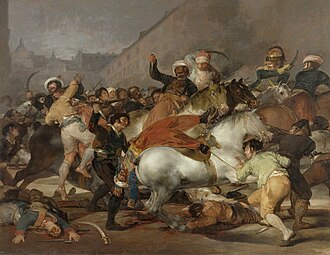 Kampf mit den Mamelucken am 2. Mai 1808 in Madrid - Francisco Goya (1814)
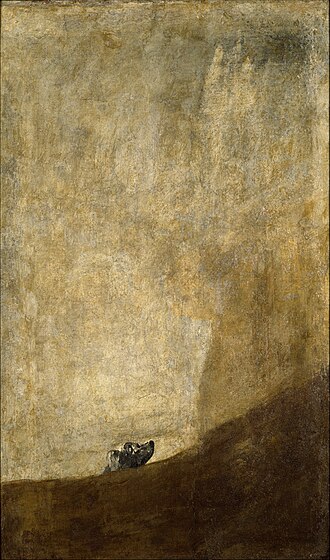 Hund - Francisco Goya (1819)
 Hexensabbat - Francisco Goya (1820s)
Werke verwandter Künstler
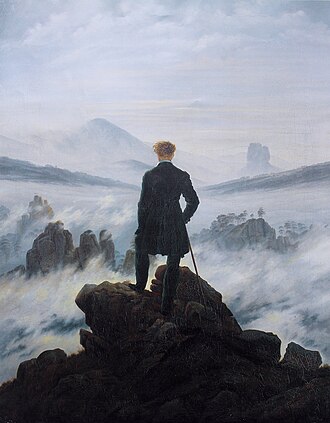 Der Wanderer über dem Nebelmeer - Caspar David Friedrich (c. 1818)
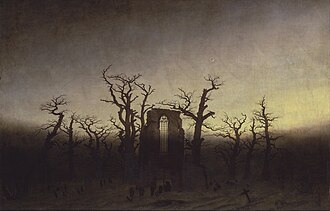 Abtei im Eichwald - Caspar David Friedrich (1800s)
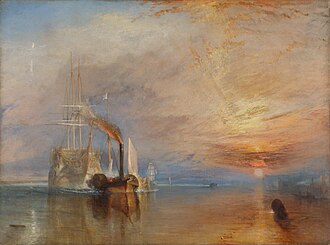 Die letzte Fahrt der Temeraire - J. M. W. Turner (1839)
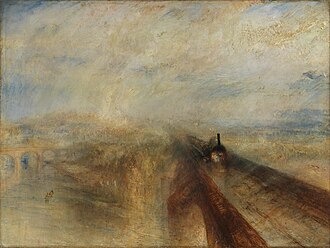 Rain, Steam and Speed - The Great Western Railway - J. M. W. Turner (1844)