El Pelele
Francisco Goya · 1791
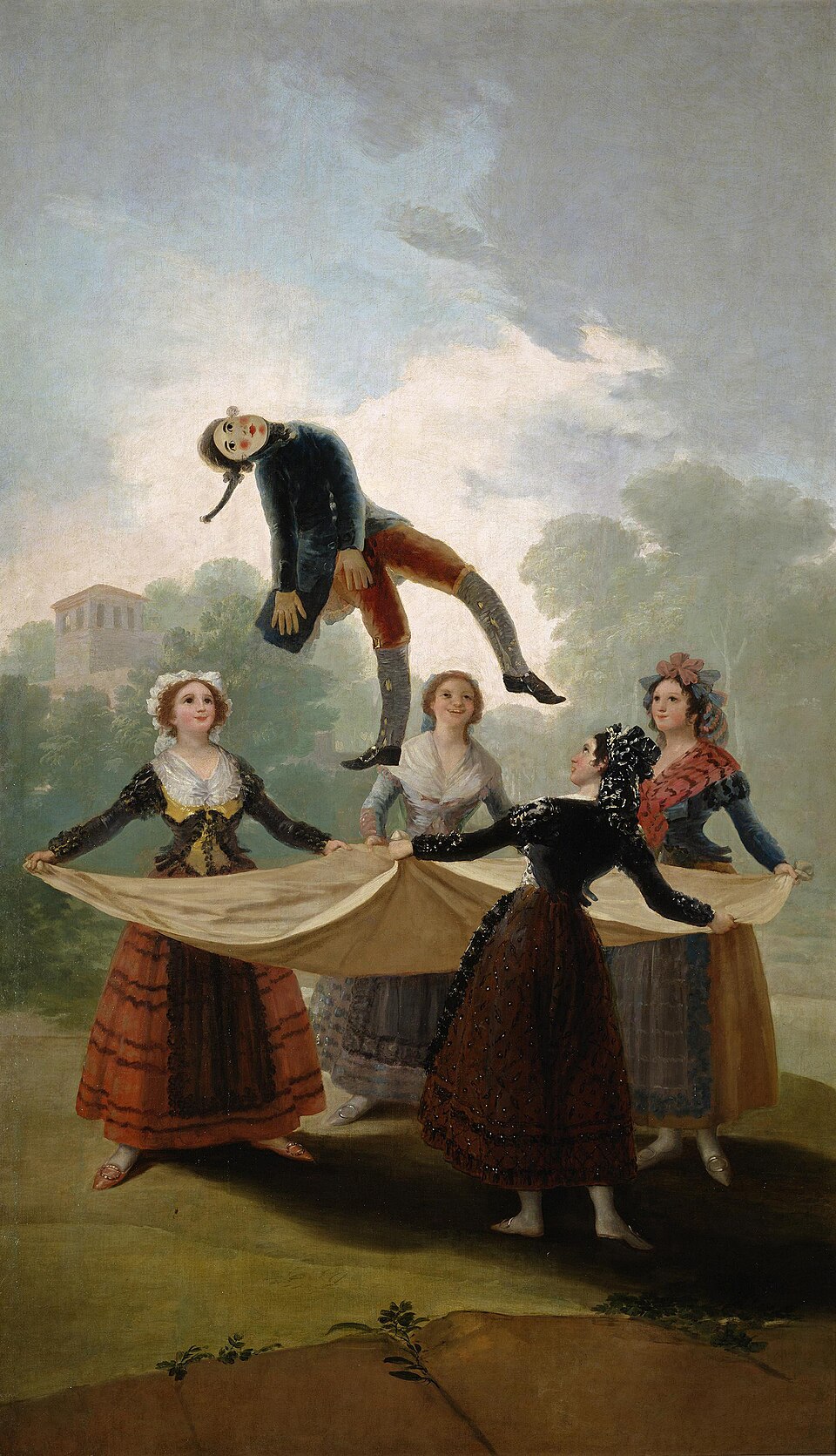
Four laughing young women toss a straw puppet into the air from a blanket. Goya painted this popular game as a design for a royal tapestry, and it can be read as a joke about men, or about politics.
The story behind the painting
El pelele, The Straw Manikin, was painted by Goya between late 1791 and early 1792. It belongs to the seventh series of tapestry cartoons, full size designs for tapestries meant for the study of King Charles IV in the palace of El Escorial. The king, earlier Prince of Asturias, had already been the destination of the six previous series. The seventh series was made up of The Wedding, The Stilts, The Seesaw, Las gigantillas, Boys Climbing a Tree, The Straw Manikin and Girls with Jugs. A small oil study, 35 by 23 cm, survives in the Hammer Museum in Los Angeles, with a fortified wall as its background.
What to look for
The scene shows a popular game, the pelele. Four young women dressed as majas hold a blanket stretched between them and bounce a puppet into the air, laughing as it flies. The puppet hangs limp, its arms and legs loose, while the women stand firm around it. The painting is large, 267 by 160 cm, and tall rather than wide. It was done with quick brushstrokes and lively colours. The overall style is elegant and light, typical of the eighteenth century. Compare the women's easy poise with the floppy figure above them: the whole picture turns on that contrast between the ones who play and the one being played with.
Meaning and intent
The puppet is read as a male symbol, and the scene as women making fun of men. In that reading the man is a toy, thrown about by female whim. The painting may also allude, with irony, to the political instability of the time, when several first ministers followed one another in 1792. Both readings rest on the same simple image: a figure with no will of its own, tossed up and down by others. Made for a royal study, the cartoon presents a light game of the people, yet it leaves room for a sharper smile underneath, one that Goya's later work would make much more explicit.
Legacy
The cartoon was considered lost until 1869, when Gregorio Cruzada Villaamil found the canvas in the basement of the Royal Palace in Madrid. It was handed to the Museo del Prado in 1870 by orders of 19 January and 9 February that year, and it is shown in room 93. It first appears in the Prado catalogue in 1876. The image went on to inspire other works, notably several scenes of the opera Goyescas by Enrique Granados. On Wikidata the work is dated 1791, the year it was begun, while the French Wikipedia article places it between late 1791 and early 1792.
Schon gewusst?
- A tapestry cartoon from Goya's seventh series, for Charles IV's study at El Escorial.
- Painted between late 1791 and early 1792.
- Rediscovered in 1869 in the basement of the Royal Palace in Madrid.
- Inspired scenes of Granados's opera Goyescas.
Über den Künstler
Francisco Goya (1746-1828)
Frau · Genreszene · Museo del Prado
Mehr von Francisco Goya
 Die Erschießung der Aufständischen - Francisco Goya (1814)
 Die nackte Maja - Francisco Goya (1800)
 Saturn verschlingt seinen Sohn - Francisco Goya (1819)
 Die Familie Karls IV. - Francisco Goya (1800)
 Die Bekleidete Maja - Francisco Goya (1800)
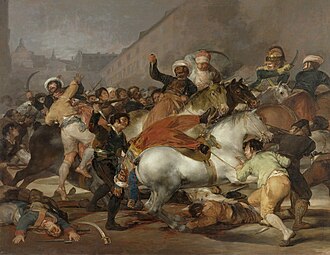 Kampf mit den Mamelucken am 2. Mai 1808 in Madrid - Francisco Goya (1814)
 Hund - Francisco Goya (1819)
 Hexensabbat - Francisco Goya (1820s)
Werke verwandter Künstler
 Der Wanderer über dem Nebelmeer - Caspar David Friedrich (c. 1818)
 Abtei im Eichwald - Caspar David Friedrich (1800s)
 Die Freiheit führt das Volk - Eugène Delacroix (1830)
 Der Tod des Sardanapal - Eugène Delacroix (1827)
 Die letzte Fahrt der Temeraire - J. M. W. Turner (1839)
 Rain, Steam and Speed - The Great Western Railway - J. M. W. Turner (1844)
 Knabe in Blau - Thomas Gainsborough (1770)
 Mr. und Mrs. Andrews - Thomas Gainsborough (1748)