The Snowstorm
Francisco Goya · 1787
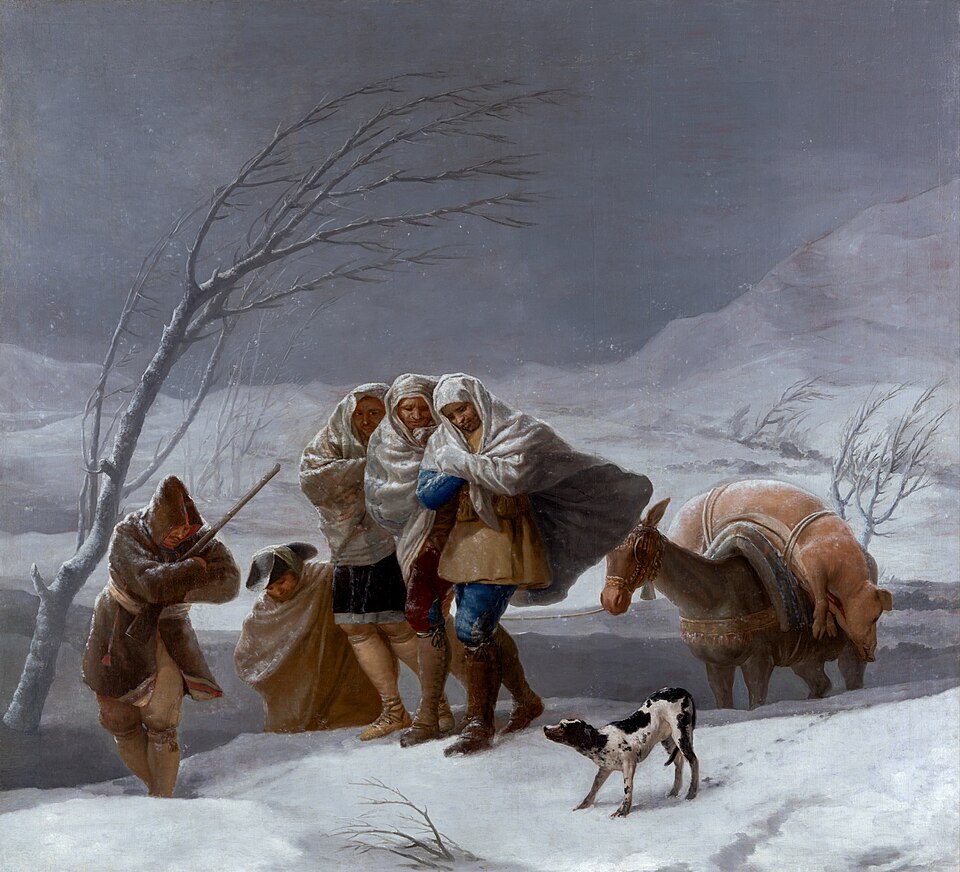
Bent against the wind, a few men trudge through the snow with a donkey and a frozen dog. Goya's Winter is no pleasant seasonal allegory but the cold, hard face of a Spanish winter.
The story behind the painting
Goya painted this canvas as a cartoon, a full-size model for a tapestry, in the fifth series he made for the dining room of the Prince of Asturias, the future Charles IV, and his wife Maria Luisa of Parma, at the Palace of El Pardo. It is one of four seasons, with The Flower Girls for spring, The Threshing Floor for summer and The Grape Harvest for autumn. French Wikipedia says it was painted in the autumn of 1786, while Wikidata gives 1787. The series also included scenes such as The Injured Mason and Poor People at the Fountain.
What to look for
The figures walk through a storm, suffering under the hard wind and the snow. Behind them a donkey carries the gutted carcass of a pig, since pigs were slaughtered in winter. Everyone is cold, down to the dog shivering on its legs. The wind bends the bare trees, and the flakes blur the men's view. With white, Goya conveys the cold, the snow and the storm, set against the dark tones of the rest of the composition. The large canvas measures about 275 by 293 cm according to Wikidata.
Meaning and intent
The four seasons were a long tradition in Western art and a favourite Rococo theme for tapestries in dining rooms. Goya left his own mark by turning the allegories into scenes of everyday Spanish life. His winter is raw and harsh, without idealisation, in a cold, dark and sad atmosphere. It is described as the first realistic depiction of the season, without the romanticism that had made winter a game and a pleasant time. His treatment of the theme was a novelty among his contemporaries.
Legacy
The painting was thought lost until 1869, when Gregorio Cruzada Villaamil found the canvas in the basement of the Royal Palace in Madrid. By orders of 19 January and 9 February 1870 it was handed to the Museo del Prado, and it appeared in the museum's catalogue for the first time in 1876. It is shown in room 94. What was made as a model for a palace weaving now hangs as a painting in its own right, one of the earliest glimpses of the unsentimental eye that Goya would later turn on Spanish life.
Schon gewusst?
- A tapestry cartoon for the Prince of Asturias's dining room at El Pardo.
- One of four seasons; this is winter.
- Dated 1786 by French Wikipedia, 1787 by Wikidata.
- Rediscovered in a palace basement in 1869.
Über den Künstler
Francisco Goya (1746-1828)
Museo del Prado · Romantik · Schnee · Wind
Mehr von Francisco Goya
 Die Erschießung der Aufständischen - Francisco Goya (1814)
 Die nackte Maja - Francisco Goya (1800)
 Saturn verschlingt seinen Sohn - Francisco Goya (1819)
 Die Familie Karls IV. - Francisco Goya (1800)
 Die Bekleidete Maja - Francisco Goya (1800)
 Kampf mit den Mamelucken am 2. Mai 1808 in Madrid - Francisco Goya (1814)
 Hund - Francisco Goya (1819)
 Hexensabbat - Francisco Goya (1820s)
Werke verwandter Künstler
 Der Wanderer über dem Nebelmeer - Caspar David Friedrich (c. 1818)
 Abtei im Eichwald - Caspar David Friedrich (1800s)
 Die Freiheit führt das Volk - Eugène Delacroix (1830)
 Der Tod des Sardanapal - Eugène Delacroix (1827)
 Die letzte Fahrt der Temeraire - J. M. W. Turner (1839)
 Rain, Steam and Speed - The Great Western Railway - J. M. W. Turner (1844)
 Knabe in Blau - Thomas Gainsborough (1770)
 Mr. und Mrs. Andrews - Thomas Gainsborough (1748)