The Quail Shoot
Francisco Goya · 1775
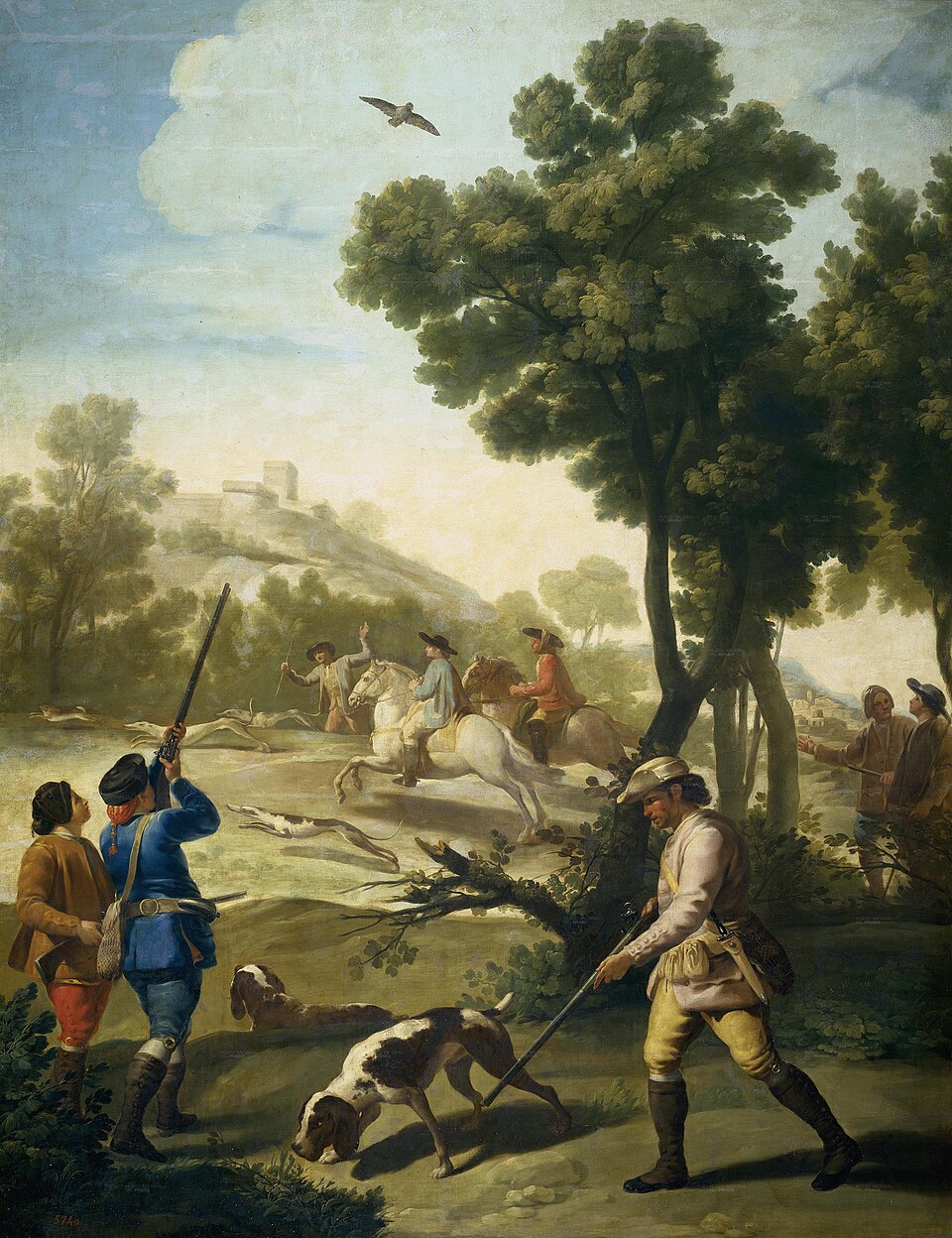
A hunter strides forward with his dog, a shot rings out further back, riders and hounds chase the prey into the distance. This large cartoon from 1775 is among Goya's very first works for the royal tapestry factory, made while he was still learning the trade.
The story behind the painting
The Quail Shoot is a cartoon, a full-size painted model for a tapestry, delivered by Goya to the Royal Tapestry Factory with the rest of its series on 24 May 1775. The tapestries were meant for the dining room of the Prince of Asturias, the future Charles IV, and his wife Maria Luisa of Parma, at the Escorial. It was Goya's first year in this work, and he was closely supervised by his brother-in-law Francisco Bayeu, who sketched the drafts Goya then painted. The series also included hunting dogs and tools, a boar hunt, a fisherman and boys hunting with an owl.
What to look for
The canvas, about 290 by 226 cm, shows several moments of a quail hunt at once. In the right foreground a hunter walks with his dog following. Further back on the left a shot is fired while a dog waits crouching. Along a diagonal into the distance, two men appear on the right and, further left, a group of riders and dogs catching up with the prey. Goya separated the groups with slopes so they would not blur together. The style recalls other court cartoon painters, notably José del Castillo and Ramón Bayeu, Francisco's brother.
Meaning and intent
The aim was to give variety to a single theme by showing every typical, picturesque moment of the hunt. The French Wikipedia article argues that Goya did not yet solve the hard part, linking these separate motifs: keeping the groups apart isolates them and breaks the unity of the scene. The picture could be read as a strip of vignettes in time order, but Goya did not choose that kind of fragmentation. Seen this way, the painting is a record of a young artist at the start of his learning curve, honest about its own difficulties.
Legacy
The cartoon was considered lost until 1869, when Gregorio Cruzada Villaamil found it in the basement of the Royal Palace in Madrid. Orders of 19 January and 9 February 1870 sent it to the Prado, which first listed it in its catalogue in 1876 and hangs it as a pair with Hunting with a Decoy. Only two years after this work, in 1777, Goya would find more natural solutions for scenes with many figures, as in El paseo de Andalucía, where every glance and movement belongs to one tense moment.
Schon gewusst?
- Tapestry cartoon delivered on 24 May 1775.
- Part of Goya's first series, for the princes' dining room at the Escorial.
- Rediscovered in 1869 in the Royal Palace basement in Madrid.
- Held by the Museo del Prado since 1870.
Über den Künstler
Francisco Goya (1746-1828)
Mehr von Francisco Goya
 Die Erschießung der Aufständischen - Francisco Goya (1814)
.jpg) Die nackte Maja - Francisco Goya (1800)
Die nackte Maja - Francisco Goya (1800).jpg) Saturn verschlingt seinen Sohn - Francisco Goya (1819)
Saturn verschlingt seinen Sohn - Francisco Goya (1819) Die Familie Karls IV. - Francisco Goya (1800)
 Die Bekleidete Maja - Francisco Goya (1800)
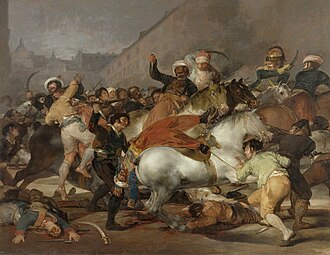 Kampf mit den Mamelucken am 2. Mai 1808 in Madrid - Francisco Goya (1814)
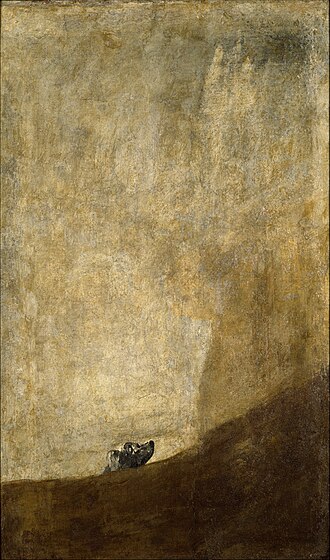 Hund - Francisco Goya (1819)
 Hexensabbat - Francisco Goya (1820s)
Werke verwandter Künstler
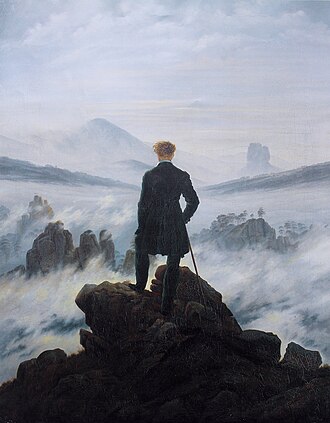 Der Wanderer über dem Nebelmeer - Caspar David Friedrich (c. 1818)
 Abtei im Eichwald - Caspar David Friedrich (1800s)
 Die letzte Fahrt der Temeraire - J. M. W. Turner (1839)
 Rain, Steam and Speed - The Great Western Railway - J. M. W. Turner (1844)
 Die Freiheit führt das Volk - Eugène Delacroix (1830)
 Der Tod des Sardanapal - Eugène Delacroix (1827)