Der Sonnenschirm
Francisco Goya · 1770s
.jpg)
A young woman rests on the ground with a little dog in her lap while a young man holds a parasol over her face. Behind them the trees bend in the wind. Goya painted it as a design for a royal tapestry.
The story behind the painting
The Parasol is one of Goya's cartoons, full-size oil paintings made to be woven into tapestries for the Royal Palace of El Pardo in Madrid. These tapestries were meant for the dining room of the Prince and Princess of Asturias, the future King Charles IV and Maria Luisa of Parma. The princess wanted the room decorated with cheerful scenes from everyday life, and The Parasol was part of Goya's answer. He painted such cartoons from 1775 to 1792. Wikidata places the work in the 1770s and gives its size as 104 by 152 cm.
What to look for
The woman sits on the ground, perhaps resting after a long walk, dressed in the French fashion of the day. She holds a fan in her right hand and a small dog is curled in her lap. The young man beside her is dressed in the so-called majo style, which the source explains as dressing like a poor person of the time, his hair gathered in a net and a colourful silk sash at his waist. He stands with one foot on a rock, holding the parasol to shade her face. Behind them dark clouds gather and the trees sway in a strong wind, as if a storm were coming.
Meaning and intent
Goya often mixed French and Spanish fashion, and here the two meet in one couple: a lady in French dress and a young man in majo clothes. The scene radiates calm warmth, but the wind in the trees and the clouds overhead add a note of unease. The way the young man stands makes him look almost triumphant, protecting her from the sun and perhaps from the coming storm. The painting is counted as classicism for its link to everyday life, in a period when Neoclassicism was gaining favour over the Rococo.
Legacy
The tapestry cartoons were Goya's first genre of painting and perhaps the most important period of his development. They trained him to observe human behaviour closely, a skill visible in his later work. In the same years he began painting portraits for the Spanish royal family, his first popular success. He was elected to the Royal Academy of San Fernando in 1780, named painter to the king in 1786 and court painter in 1789. The Parasol is now in the Museo del Prado in Madrid, as is Blind Man's Bluff from the same series.
Schon gewusst?
- A cartoon for a tapestry at the Royal Palace of El Pardo.
- Made for the dining room of the future Charles IV and Maria Luisa of Parma.
- Goya painted tapestry cartoons from 1775 to 1792.
- Now in the Museo del Prado.
Über den Künstler
Francisco Goya (1746-1828)
Porträt · Museo del Prado · Fächer
Mehr von Francisco Goya
 Die Erschießung der Aufständischen - Francisco Goya (1814)
.jpg) Die nackte Maja - Francisco Goya (1800)
Die nackte Maja - Francisco Goya (1800).jpg) Saturn verschlingt seinen Sohn - Francisco Goya (1819)
Saturn verschlingt seinen Sohn - Francisco Goya (1819) Die Familie Karls IV. - Francisco Goya (1800)
 Die Bekleidete Maja - Francisco Goya (1800)
 Kampf mit den Mamelucken am 2. Mai 1808 in Madrid - Francisco Goya (1814)
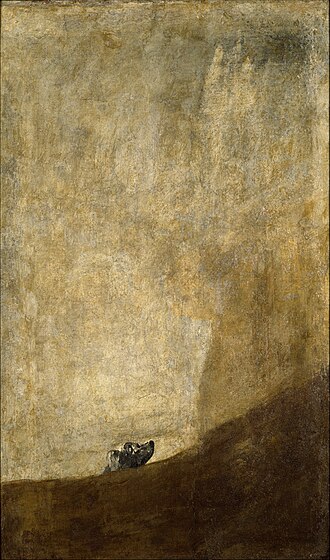 Hund - Francisco Goya (1819)
 Hexensabbat - Francisco Goya (1820s)
Werke verwandter Künstler
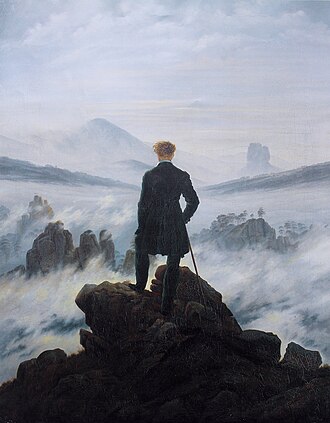 Der Wanderer über dem Nebelmeer - Caspar David Friedrich (c. 1818)
 Abtei im Eichwald - Caspar David Friedrich (1800s)
 Die letzte Fahrt der Temeraire - J. M. W. Turner (1839)
 Rain, Steam and Speed - The Great Western Railway - J. M. W. Turner (1844)
 Die Freiheit führt das Volk - Eugène Delacroix (1830)
 Der Tod des Sardanapal - Eugène Delacroix (1827)