Martyrium des Hl. Laurenzius
Tizian · 1550s
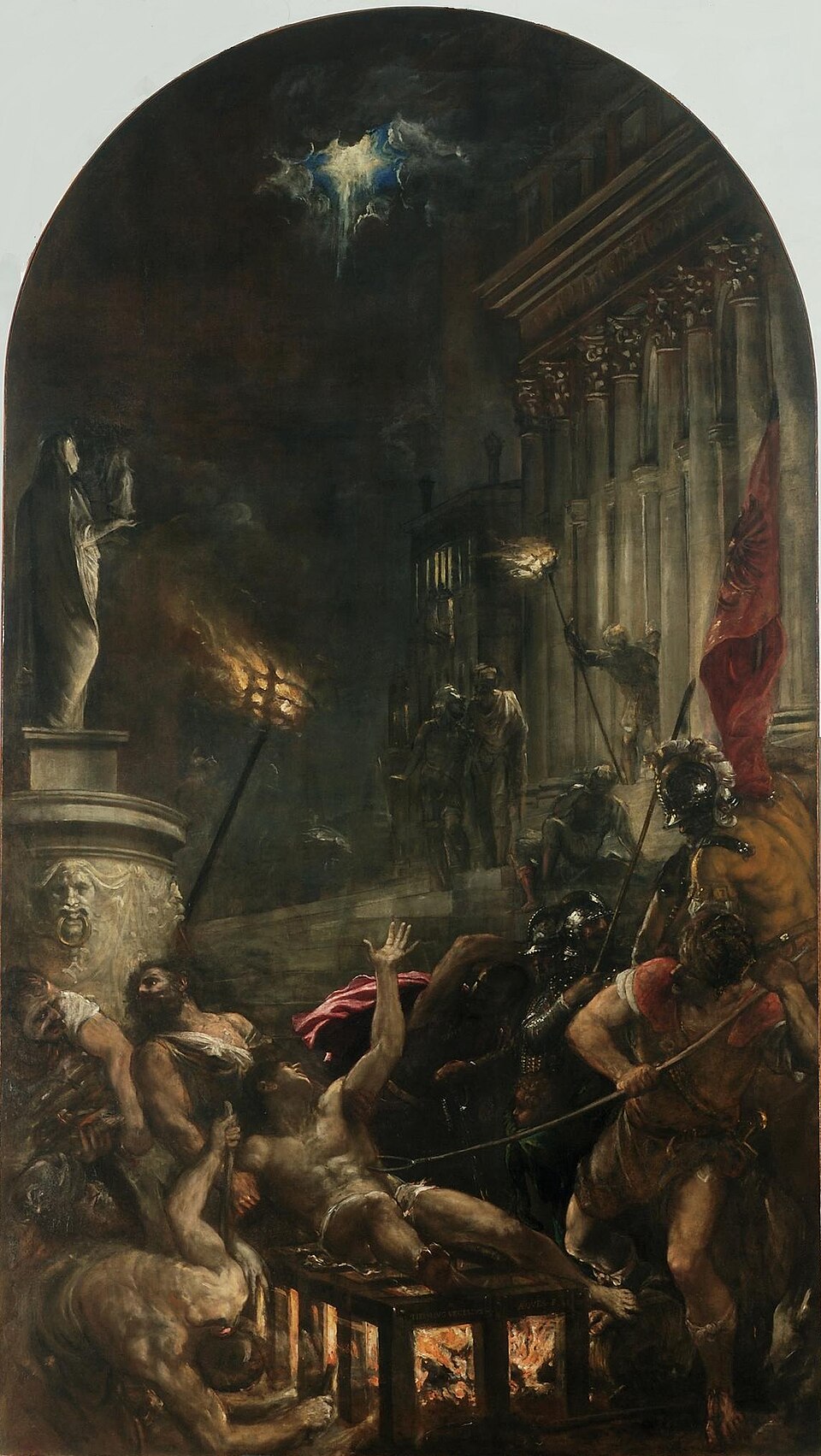
In a night of smoke and armour, a nearly naked man on a gridiron stretches one arm toward a beam of light breaking through the clouds. Titian's Saint Lawrence turns a scene of torture into a moment frozen between violence and grace.
The story behind the painting
Saint Lawrence was appointed archdeacon of Rome in 257 by Pope Sixtus II. A year later, in 258, he, six other deacons and the pope were martyred in a purge of Christians ordered by the emperor Valerian, long before the Edict of Milan decreed tolerance of Christianity in 313. According to legend, Lawrence was burned alive on a gridiron, an image that later portrayals made famous. Titian's altarpiece was commissioned by a wealthy, well-connected Venetian couple, Lorenzo Massolo and Elisabetta Querini, for the church of Santa Maria Assunta dei Crociferi. Wikipedia dates it from 1558; Wikidata gives only the 1550s.
What to look for
The moment of death unfolds in chaotic darkness. Two sources of light fight the night: the fire at the bottom of the picture and the light shining through the clouds above. The armour and bodies of the figures catch their glow, while the rest of the tall canvas, about 493 by 277 cm, stays shrouded in shadow. That contrast picks out Lawrence's mostly naked body and his outstretched arm reaching upward. He seems frozen in time, surrounded by a turbulent mass of darkness and moving figures. Follow his hand: it points straight to the opening in the sky.
Meaning and intent
Titian's source was the Golden Legend, and the painting closely mirrors its account. There Lawrence, tortured by the Romans, refuses their demand that he renounce Christianity by speaking of the holy light that protects him. That light is the beam breaking through the clouds, and his reaching arm is the answer to it. By wrapping a well-lit, still figure in confused, violent darkness, Titian conveys the mix of tragic violence and sublime sacrifice that accompanies martyrdom: the horror of the fire below and, at the same moment, a calm certainty turned toward heaven.
Legacy
The church of the Crociferi was destroyed during a suppression of that religious order, and in the early eighteenth century the painting was moved to the new church of I Gesuiti in Venice, where it remains. The picture made a deep impression beyond Venice. It so impressed Philip II of Spain that in 1567 he commissioned a second version from Titian for the basilica at El Escorial. The Venetian altarpiece thus became the model for a royal commission, and it is still seen today in a church, the setting it was painted for, rather than in a museum gallery.
Schon gewusst?
- Commissioned by Lorenzo Massolo and Elisabetta Querini for a Venetian church.
- Wikipedia dates it 1558; Wikidata says the 1550s.
- Based on the Golden Legend's account of Lawrence's death.
- Philip II ordered a second version for El Escorial in 1567.
Über den Künstler
Tizian (1488-1576)
religiöse Kunst · Venezianische Schule · Laurentius von Rom
Mehr von Tizian
 Venus von Urbino - Titian (1538)
 Mariä Himmelfahrt - Titian (1510s)
 Himmlische und Irdische Liebe - Titian (1510s)
 Kaiser Karl V. nach der Schlacht bei Mühlberg - Titian (1548)
 Flora - Titian (1517)
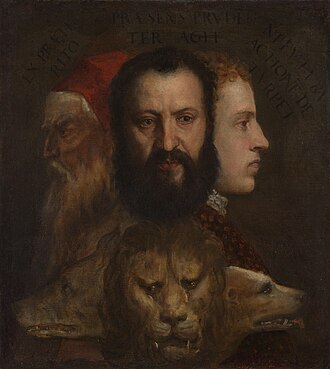 Allegorie der von der Klugheit beherrschten Zeit - Titian (1550)
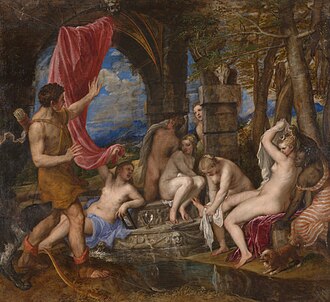 Diana und Actaeon - Titian (1550s)
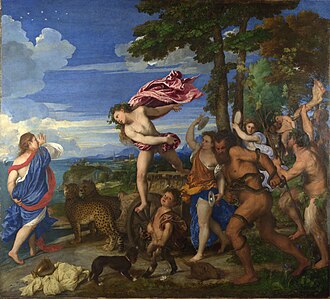 Bacchus und Ariadne - Titian (1520s)
Werke verwandter Künstler
 Das letzte Abendmahl - Jacopo Tintoretto (1563)
 Der heilige Markus befreit den gefesselten Sklaven - Jacopo Tintoretto (1540s)
 Die Hochzeit zu Kana - Paolo Veronese (1560s)
 Das Gastmahl im Hause des Levi - Paolo Veronese (1573)