The Immaculate Conception
Francisco de Zurbarán · 1645
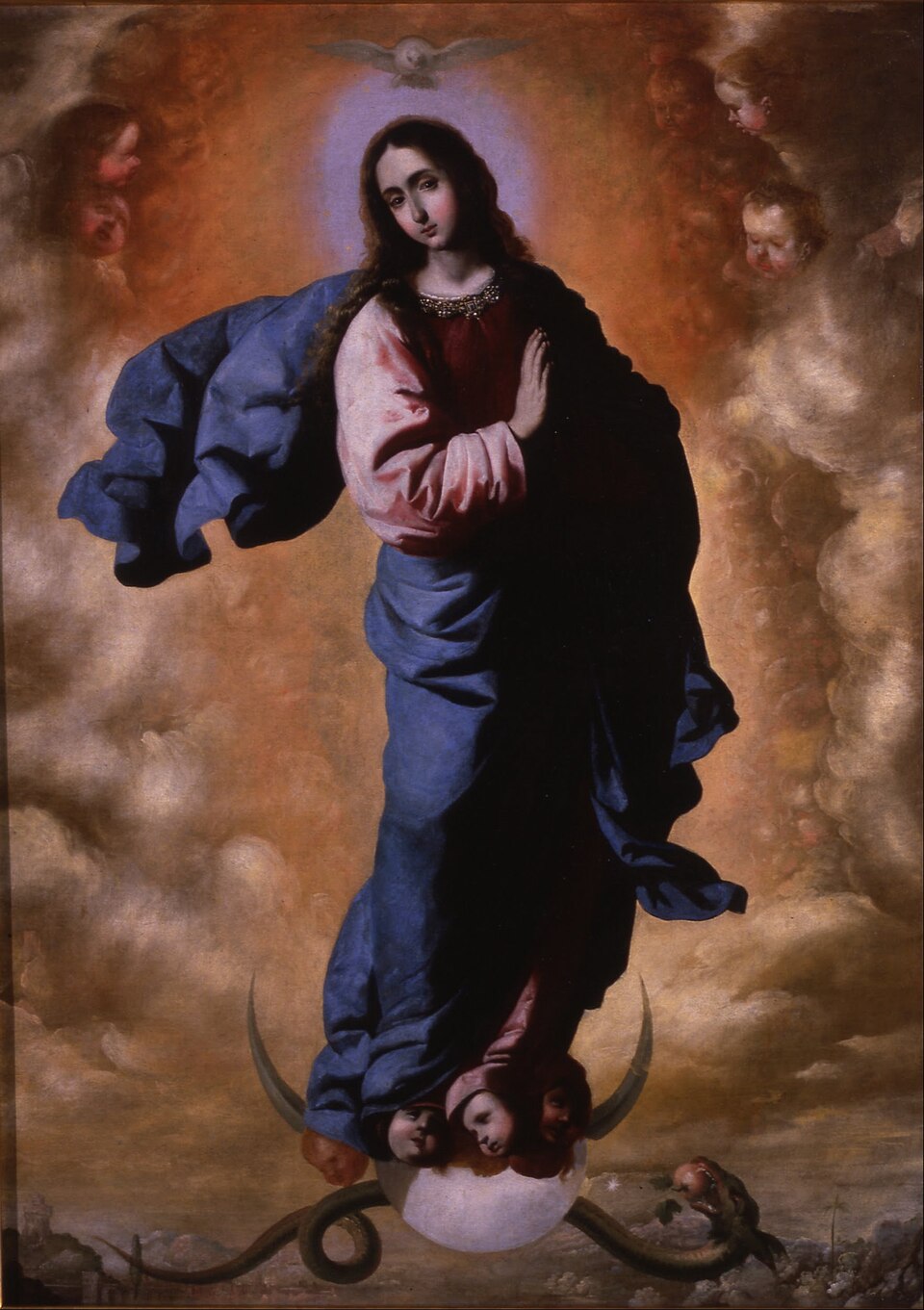
A serpent with an apple coils at Mary's feet, a dove hovers above her head, and the moon's horns point upward. This Immaculate Conception from the 1640s breaks several of Zurbarán's own habits, perhaps because a patron asked for something special.
The story behind the painting
In Spain the doctrine of the Immaculate Conception mattered greatly from the early Middle Ages, even though the Council of Trent did not officially back it. Writers such as Luis del Alcázar in 1618, and the painter Francisco Pacheco in his Art of Painting, shaped how it should be painted, especially in Seville. Pacheco's rules were never followed strictly, and he was the first to break them. Zurbarán broke them too, here and in a closely related canvas now at the Fundación Focus in Seville. This painting, about 201 by 145 cm, is dated about 1640 to 1645 and is number 194 in Odile Delenda's catalogue.
What to look for
Several Zurbarán Immaculate Conceptions of the 1640s show bold variations. The Marian symbols of the litany have vanished from around Mary and are replaced by angel heads; a few remain, lightly painted, in a misty golden landscape below. Mary seems to float in a golden sky. Her figure sways gently, she is much more elongated than in earlier versions, and the clouds around her are lighter. She wears a pink tunic and a deep blue mantle that billows gracefully. At her feet a sinuous serpent bites an apple, a reference to Eve. The moon's points turn upward, and the Holy Spirit appears as a dove above her head.
Meaning and intent
These details are unusual for Zurbarán. The serpent, the upturned moon and the dove all appeared in some prints and paintings of the late sixteenth century, and the source suggests they may result from a special commission. It also raises a puzzle: perhaps the waning moon was added later, because under the base of cherub heads there is a round white globe that could also be the moon. The upturned horns may have been meant to avoid confusion with the body of the snake. The painting shows a mature painter willing to bend the established formula he had helped create.
Legacy
The work may have belonged in the seventeenth century to the Marquis of Leganés, though the source marks this with a question mark. It later belonged to the Marquis of Salamanca, whose seal is on the stretcher, and went through his Paris sales in 1867, when it did not sell, and in 1875. In 1884 it was bought with other works from the Palacio de Vista Alegre by Enrique de Aguilera y Gamboa, Marquis of Cerralbo, who bequeathed his collection to the Spanish state in 1922. It now hangs in the Cerralbo Museum in Madrid.
Schon gewusst?
- Dated about 1640 to 1645, 201 by 145 cm.
- Number 194 in Odile Delenda's catalogue.
- Includes a serpent with an apple and the dove of the Holy Spirit, rare for Zurbarán.
- Bequeathed to the Spanish state with the Cerralbo collection in 1922.
Über den Künstler
Francisco de Zurbarán (1598-1664)
religiöse Kunst · Maria · Barock
Mehr von Francisco de Zurbarán
 Saint Francis in Meditation - Francisco de Zurbarán (1639)
 The Immaculate Conception - Francisco de Zurbarán (1661)
 Saint Francis - Francisco de Zurbarán (1635)
 The Immaculate Conception - Francisco de Zurbarán (1635)
 The Immaculate Conception - Francisco de Zurbarán (1661)
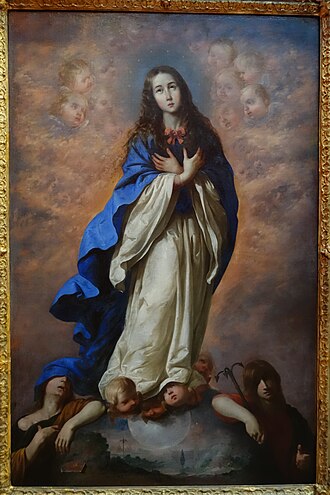 The Immaculate Conception - Francisco de Zurbarán (1658)
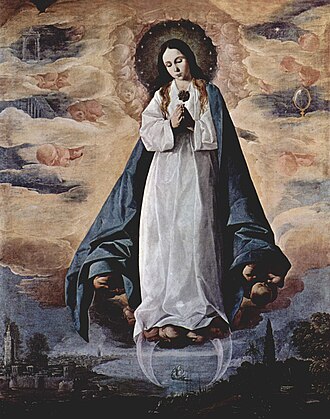 Unbefleckte Empfängnis - Francisco de Zurbarán (1630)
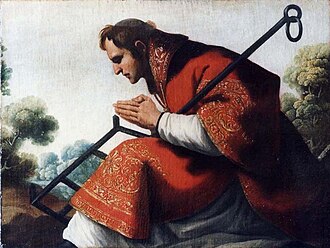 Heiliger Laurentius - Francisco de Zurbarán (1630s)
Werke verwandter Künstler
 Das Abendmahl in Emmaus - Caravaggio (1601)
 Die Berufung des Hl. Matthäus - Caravaggio (1609)
 Las Meninas - Diego Velázquez (1656)
 Die Übergabe von Breda - Diego Velázquez (1635)
 Dreifachporträt von Karl I. - Anthony van Dyck (1635)
 Karl I mit M. de St. Antoine - Anthony van Dyck (1636)
 Die Aufrichtung des Kreuzes - Peter Paul Rubens (1609)
 Der Raub der Töchter des Leukippos - Peter Paul Rubens (1618)
 Die Nachtwache - Rembrandt van Rijn (1642)
 Selbstbildnis - Rembrandt van Rijn (1659)
 Ein Schütze einen Berkemeyer haltend, bekannt als „Der fröhliche Trinker" - Frans Hals (1620s)
 Der lachende Kavalier - Frans Hals (1624)