The Honourable Mrs Graham
Thomas Gainsborough · 1775
%20-%20Google%20Art%20Project.jpg)
A young bride stands full length, life size, the face that became an icon of Georgian beauty. Her husband loved her so much that after her death he could not bear to look at Gainsborough's portrait.
The story behind the painting
The sitter was born the Honourable Mary Cathcart on 1 March 1757, daughter of Charles Cathcart, 9th Lord Cathcart, who had served as British ambassador at the court of Catherine the Great. At 17 she married Thomas Graham, later Lord Lynedoch, on 26 December 1774, in a double wedding with her older sister Jane. Thomas Gainsborough painted her shortly afterwards. He made three portraits of her in all. A more conventional half length, now in the National Gallery of Art in Washington, is believed to be the one first commissioned. Wikipedia dates this full length to 1777, while Wikidata gives 1775.
What to look for
This is a large, full length canvas, about 237 by 154 cm, and has become an icon of the Scottish National Gallery. It is counted among Gainsborough's finest portraits. Mary is shown standing, life size, in the grand manner of a society portrait, and it was her looks above all that people noticed. A third, more informal portrait of her, known as the Housemaid, was rejected by her family and never finished; after Gainsborough's death it was sold to the 5th Earl of Carlisle, hung at Castle Howard, and was given to the Tate in 1913. Comparing the versions shows how carefully the public image was chosen.
Meaning and intent
When Gainsborough showed the portrait at the Royal Academy in 1777, Mary's beauty caused a stir. The painting made her an icon of contemporary beauty and helped her quickly become a figure in the fashionable society of Georgian London. She won many admirers and friends, from the poet Robert Burns to Georgiana, Duchess of Devonshire, who remembered her goodness, her sense and her sweetness. The portrait is therefore more than a likeness: it shaped how a young woman was seen by her world, and how she is still remembered, while her family connections, including her uncle Sir William Hamilton, placed her at the centre of society.
Legacy
Mary soon fell ill with tuberculosis. Her husband nursed her devotedly, taking her first to Brighton and then, as she grew worse, through revolutionary Paris to the Mediterranean in search of warmth. She died near Hyères on 26 June 1792, aged 35. Thomas Graham lived 50 more years, never remarried, and was so grief stricken that he could not look at her portrait. It was stored away and almost forgotten until it was exhibited in Manchester in 1857. Two years later his cousin and heir Robert Graham bequeathed it to the newly opened Scottish National Gallery in Edinburgh, one of its first works.
Schon gewusst?
- Painted shortly after Mary Cathcart married Thomas Graham in 1774.
- Shown at the Royal Academy in 1777; Wikidata dates it 1775.
- Her grieving husband had the portrait put away after her death.
- Bequeathed to the Scottish National Gallery in 1859.
Über den Künstler
Thomas Gainsborough (1727-1788)
Frau · Porträt · Schottische Nationalgalerien
Mehr von Thomas Gainsborough
.jpg) Knabe in Blau - Thomas Gainsborough (1770)
Knabe in Blau - Thomas Gainsborough (1770).jpg) Mr. und Mrs. Andrews - Thomas Gainsborough (1748)
Mr. und Mrs. Andrews - Thomas Gainsborough (1748)%20-%20WGA8418.jpg) Der Morgenspaziergang - Thomas Gainsborough (1785)
Der Morgenspaziergang - Thomas Gainsborough (1785)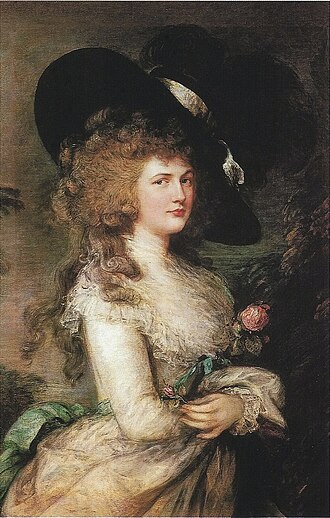 Portrait of Georgiana, Duchess of Devonshire - Thomas Gainsborough (1780s)
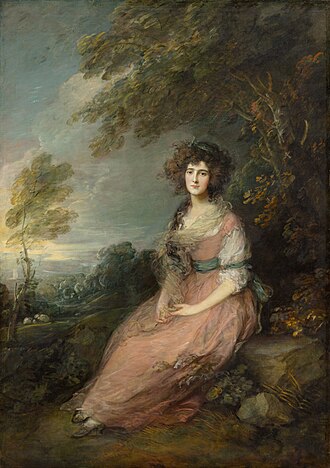 Mrs. Richard Brinsley Sheridan - Thomas Gainsborough (1785)
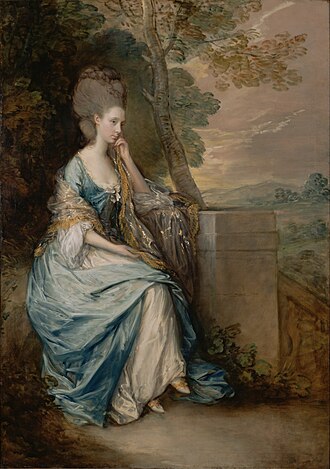 Portrait of Anne, Countess of Chesterfield - Thomas Gainsborough (1770s)
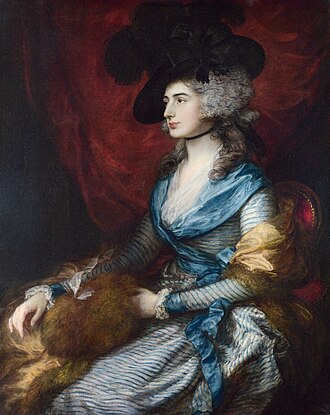 Mrs Siddons - Thomas Gainsborough (1785)
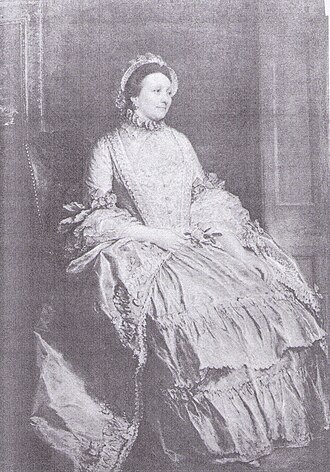 The Wife of William St Quintin - Thomas Gainsborough (1767)
Werke verwandter Künstler
 Die Erschießung der Aufständischen - Francisco Goya (1814)
.jpg) Die nackte Maja - Francisco Goya (1800)
Die nackte Maja - Francisco Goya (1800) Der Wanderer über dem Nebelmeer - Caspar David Friedrich (c. 1818)
 Abtei im Eichwald - Caspar David Friedrich (1800s)
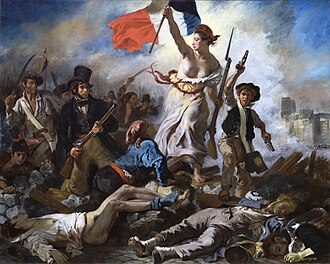 Die Freiheit führt das Volk - Eugène Delacroix (1830)
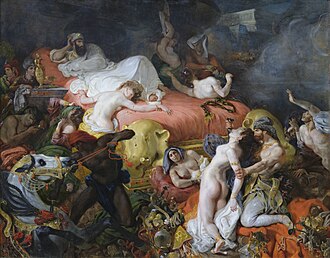 Der Tod des Sardanapal - Eugène Delacroix (1827)
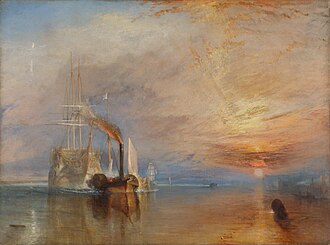 Die letzte Fahrt der Temeraire - J. M. W. Turner (1839)
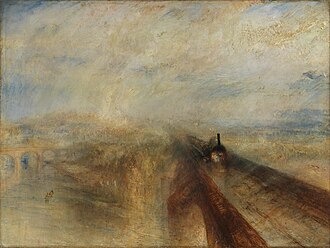 Rain, Steam and Speed - The Great Western Railway - J. M. W. Turner (1844)