Thomas Gainsborough
1727-1788
Thomas Gainsborough painted the fashionable faces of Georgian England, yet his heart was in the countryside. Quick, light and poetic, his brushwork moved John Constable to say that looking at his pictures brings tears to our eyes without knowing why.
Origins
Thomas Gainsborough was baptised on 14 May 1727 in Sudbury, Suffolk, the youngest son of John Gainsborough, a weaver and maker of woollen goods, and his wife Mary. One of his brothers, Humphrey, is said to have invented a method of condensing steam that proved of great service to James Watt; another, John, was nicknamed Scheming Jack for his love of designing curiosities. Thomas spent his childhood in the house on Gainsborough Street that is now a museum to his life and art. By the age of ten he was painting heads and small landscapes, including a miniature self-portrait. In 1740 he left home to study art in London under the engraver Hubert Gravelot.
Life and turning points
In 1746 he married Margaret Burr, and returned to Sudbury to concentrate on portraits because his landscapes were not selling well. In 1752 the family, now with daughters Mary and Margaret, moved to Ipswich, and in 1759 to Bath, where he studied van Dyck and won a fashionable clientele. He was invited to be a founding member of the Royal Academy in 1769, though the relationship was not easy and he stopped exhibiting there in 1773. In 1774 he moved to Schomberg House in Pall Mall, London. In 1780 he painted King George III and Queen Charlotte, and he remained the royal family's favourite painter. He died of cancer on 2 August 1788 and was buried at Kew.
Style and technique
The art historian Michael Rosenthal called Gainsborough one of the most technically proficient and most experimental artists of his time. He painted quickly and worked more from observation of nature than from academic rules. Though famous for portraits, he took more pleasure in landscapes, and with Richard Wilson he is credited as an originator of the 18th century British landscape school. In the 1770s and 1780s he developed portraits that merge the sitter into the landscape, as in his Mrs John Douglas, where clouds and drapery share the same silvery violet tones. His landscapes were often painted at night by candlelight, using a tabletop model of stones, mirror pieces and broccoli. His later works have a light palette and easy, economical strokes.
Stories and anecdotes
Gainsborough was frank about his frustrations. In the 1760s he wrote to a friend that he was sick of portraits and longed to take his viola da gamba and walk off to some sweet village to paint landscapes. He loved the instrument so much that he owned five. In 1776 he painted Johann Christian Bach, youngest son of Johann Sebastian Bach, for a collection of musicians' portraits. In the 1780s he used a device he called a Showbox to display landscapes backlit on glass; the original is in the Victoria and Albert Museum. His rival Joshua Reynolds wrote that Girl with Pigs was the best picture he ever painted. According to his daughter Peggy, his last words were van Dyck.
Legacy
With Reynolds, Gainsborough was one of the most important British artists of the 18th century and a dominant portraitist of its second half. His best known works include The Blue Boy, Mr and Mrs Andrews and The Morning Walk. A friend wrote that to those close to him he was sincere and honest, and his letters were praised as being as original and beautiful as his paintings. He asked to be buried near his friend Joshua Kirby at St Anne's Church, Kew, and his tomb was restored in 2012. His works became highly sought after by collectors from the 1850s. His portraits still breathe the open air, with people and landscape painted as one living scene.
Schon gewusst?
- Gainsborough's only known assistant was his nephew, Gainsborough Dupont.
- In London he experimented with aquatint and soft ground etching.
- In Bath he lived at 17 The Circus.
- Stanley Kubrick drew on his paintings for the look of Barry Lyndon.
Romantik · romantische Malerei · Rococo painting
Verwandte Künstler
Francisco Goya · Caspar David Friedrich · Eugène Delacroix · J. M. W. Turner
Gemälde von Thomas Gainsborough
.jpg) Knabe in Blau - Thomas Gainsborough (1770)
Knabe in Blau - Thomas Gainsborough (1770).jpg) Mr. und Mrs. Andrews - Thomas Gainsborough (1748)
Mr. und Mrs. Andrews - Thomas Gainsborough (1748)%20-%20WGA8418.jpg) Der Morgenspaziergang - Thomas Gainsborough (1785)
Der Morgenspaziergang - Thomas Gainsborough (1785)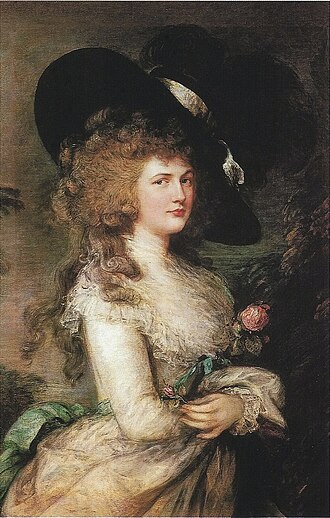 Portrait of Georgiana, Duchess of Devonshire - Thomas Gainsborough (1780s)
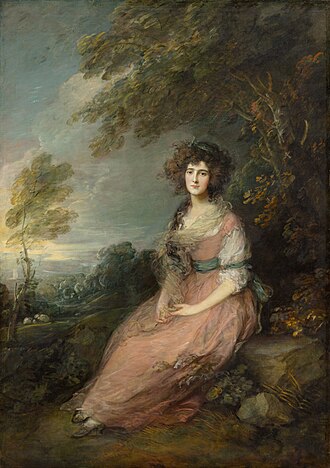 Mrs. Richard Brinsley Sheridan - Thomas Gainsborough (1785)
%20-%20Google%20Art%20Project.jpg) The Honourable Mrs Graham - Thomas Gainsborough (1775)
The Honourable Mrs Graham - Thomas Gainsborough (1775)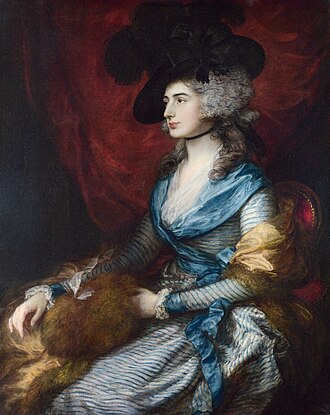 Mrs Siddons - Thomas Gainsborough (1785)
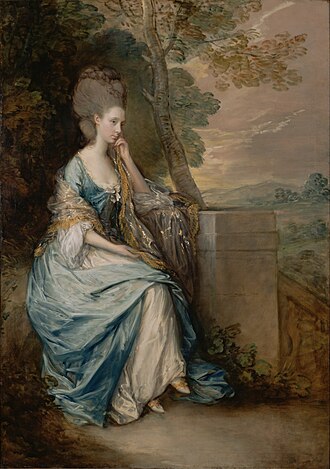 Portrait of Anne, Countess of Chesterfield - Thomas Gainsborough (1770s)
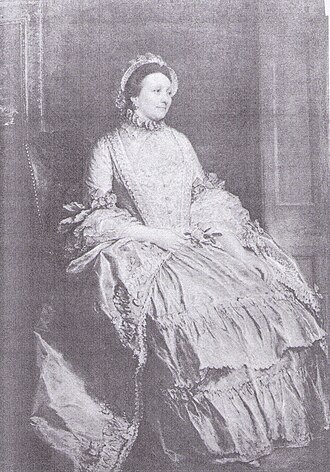 The Wife of William St Quintin - Thomas Gainsborough (1767)
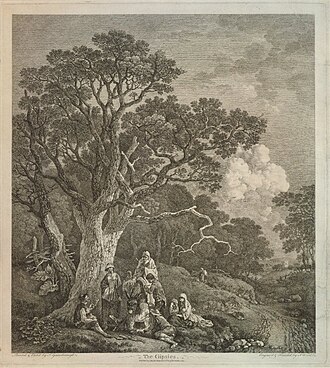 Waldlandschaft mit Zigeunern um ein Lagerfeuer - Thomas Gainsborough (1753)