Las gigantillas
Francisco Goya · 1791
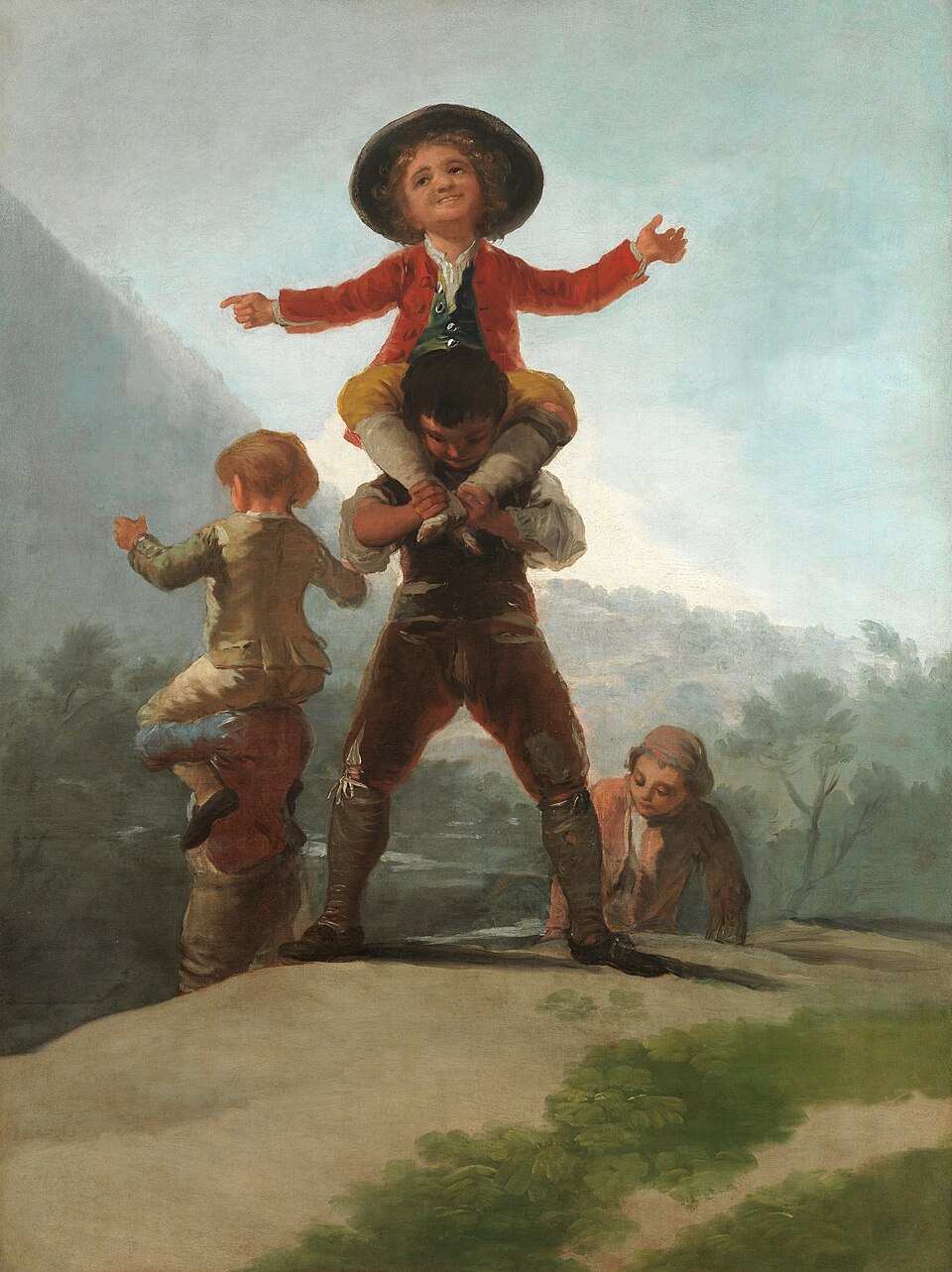
A rich boy wobbles, all smiles, on the back of a sweating peasant boy while their friends play around them. Goya painted this children's game for a royal tapestry, and it may hide a sly joke about Spanish politics.
The story behind the painting
Las gigantillas belongs to Goya's seventh series of tapestry cartoons, intended for the study of Charles IV at the palace of El Escorial. The painting was made between late 1791 and early 1792; Wikidata gives 1791, while the French Wikipedia article gives 1792. The title borrows the nickname of the parades of giants in Santander. According to the Prado's official site, the tapestry was meant for the bedroom of the infantas at the Pardo palace, although most critics prefer to link it to the seventh series for El Escorial.
What to look for
Five children play the popular game of gigantillas, sitting on one another's shoulders, in a landscape of hills and trees. The social contrast is sharp: a rich, noble child balances, all smiles, on the back of a playmate who clearly comes from a peasant family and sweats with effort. The tapestry was meant to hang above a door, so the triangular shape found in other designs of the series is stretched upward. Goya's airy, vibrant brushstrokes recall Velazquez, and the light of the canvas has been said to anticipate Impressionism.
Meaning and intent
The scene may be an allegory of the political instability of Spain at the time, with ministers rising and falling in quick succession, a theme Goya would treat again later in Up and Down. It also shows his mastery of the world of children, as in Boys Blowing Up a Balloon. Under the cheerful game lies a quiet question about who carries whom, and how long the one on top can keep his balance.
Legacy
Like many of the cartoons, the painting was moved to the basement of the Royal Palace of Madrid around 1856 to 1857. When Gregorio Cruzada Villaamil found the cartoons stored there, this one was missing. Only in 1913 did the Spanish government trace it, identifying it at an auction in Paris of the gallery of Marczell von Nemes of Budapest. Its buyer, Baron Herzog, gave it to King Alfonso XIII, who placed it in the Prado. The same source also says it was first listed in the Prado catalogue in 1876, which does not fit with a recovery in 1913.
Schon gewusst?
- Part of Goya's seventh series of tapestry cartoons, for El Escorial.
- Painted late 1791 to early 1792.
- Missing from the palace store, then found at a Paris auction in 1913.
- Given by Baron Herzog to King Alfonso XIII, now in the Prado.
Über den Künstler
Francisco Goya (1746-1828)
Mehr von Francisco Goya
 Die Erschießung der Aufständischen - Francisco Goya (1814)
 Die nackte Maja - Francisco Goya (1800)
 Saturn verschlingt seinen Sohn - Francisco Goya (1819)
 Die Familie Karls IV. - Francisco Goya (1800)
 Die Bekleidete Maja - Francisco Goya (1800)
 Kampf mit den Mamelucken am 2. Mai 1808 in Madrid - Francisco Goya (1814)
 Hund - Francisco Goya (1819)
 Hexensabbat - Francisco Goya (1820s)
Werke verwandter Künstler
 Der Wanderer über dem Nebelmeer - Caspar David Friedrich (c. 1818)
 Abtei im Eichwald - Caspar David Friedrich (1800s)
 Die Freiheit führt das Volk - Eugène Delacroix (1830)
 Der Tod des Sardanapal - Eugène Delacroix (1827)
 Die letzte Fahrt der Temeraire - J. M. W. Turner (1839)
 Rain, Steam and Speed - The Great Western Railway - J. M. W. Turner (1844)
 Knabe in Blau - Thomas Gainsborough (1770)
 Mr. und Mrs. Andrews - Thomas Gainsborough (1748)