Die Herzogin von Alba
Francisco Goya · 1797
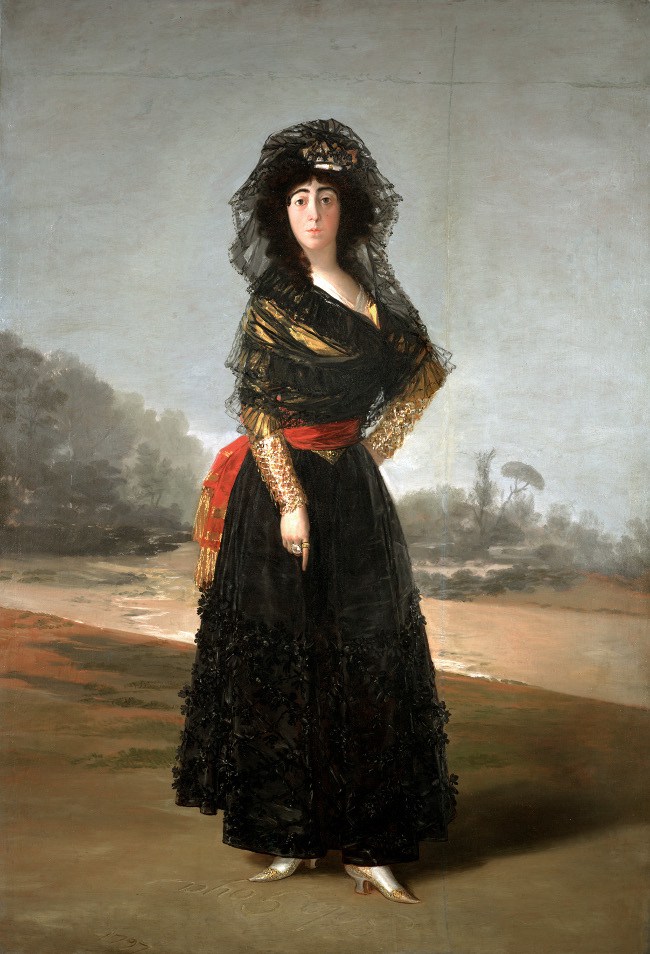
The Duchess of Alba, in black mourning lace, points to the ground. Only after restoration could people read what is written there: solo Goya, only Goya.
The story behind the painting
María Cayetana de Silva, 13th Duchess of Alba, lost her husband José in 1796. She withdrew to one of her estates in Andalusia for a period of mourning, and Goya followed, making many paintings and sketches of her during her stay. This portrait dates from 1797, when she was thirty five. It is one of several works in which Goya portrayed her, and a companion to The White Duchess, completed two years earlier and described as more chaste. An anecdote says the duchess once came into Goya's studio and asked him to do her makeup, then paint her, which he did.
What to look for
On a large canvas of some 210 by 149 cm, the duchess appears in a black mantilla and black skirt, the colours of her mourning. She is dressed in the maja style associated with the lower classes, yet behind her stretches what appears to be one of the Alba estates. Look at her hands. She wears two rings, one engraved Alba and the other Goya. With one finger she points to the ground at her feet, where the words solo Goya are lightly inscribed. The word solo was hidden for a long time and came to light only when the painting was restored.
Meaning and intent
The portrait mixes grief, status and a private message. The maja costume may have been chosen so that she would appear as a woman of the people, while the landscape quietly reminds us that she owned the land. The rings and the inscription bind the sitter and the painter together, and the words only Goya invite every viewer to wonder what they meant. Many, including the director Carlos Saura, have assumed that Goya and the duchess were lovers. The source treats that as an assumption, and notes that the idea she posed for La maja desnuda is a minority view.
Legacy
Although the picture may have been painted at the duchess's request, it was still in Goya's possession when she died. His son Javier sold it, and after several owners Archer Milton Huntington bought it in 1906, took it to the United States and gave it to the Hispanic Society of America in New York in 1907. While the Society renovated its buildings, highlights from its collection travelled, and in 2023 the painting was shown at the Royal Academy in London. Carlos Saura's 1999 film Goya en Burdeos restages the pose, with Maribel Verdú as the duchess in a black mantilla.
Schon gewusst?
- Painted in 1797, when the duchess was 35 and in mourning.
- Her rings read Alba and Goya.
- The words solo Goya at her feet reappeared during restoration.
- In the Hispanic Society of America, New York, since 1907.
Über den Künstler
Francisco Goya (1746-1828)
Frau · Porträt · Kleid · 1795-1820 in westlicher Mode · Schuh · Maria del Pilar Teresa Cayetana de Silva y Álvarez de Toledo · Hispanic Society of America · Mantilla
Mehr von Francisco Goya
 Die Erschießung der Aufständischen - Francisco Goya (1814)
 Die nackte Maja - Francisco Goya (1800)
 Saturn verschlingt seinen Sohn - Francisco Goya (1819)
 Die Familie Karls IV. - Francisco Goya (1800)
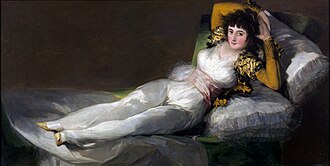 Die Bekleidete Maja - Francisco Goya (1800)
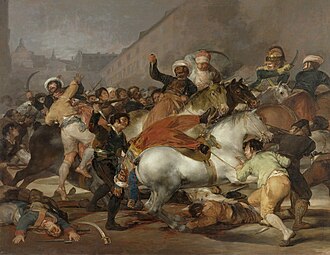 Kampf mit den Mamelucken am 2. Mai 1808 in Madrid - Francisco Goya (1814)
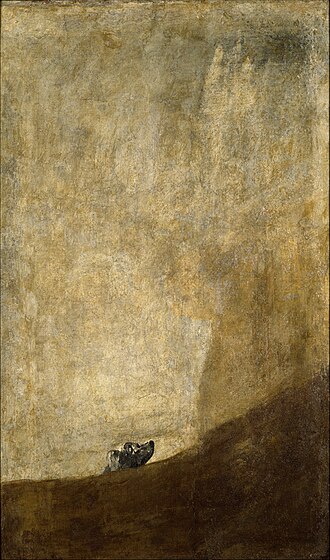 Hund - Francisco Goya (1819)
 Hexensabbat - Francisco Goya (1820s)
Werke verwandter Künstler
 Der Wanderer über dem Nebelmeer - Caspar David Friedrich (c. 1818)
 Abtei im Eichwald - Caspar David Friedrich (1800s)
 Die Freiheit führt das Volk - Eugène Delacroix (1830)
 Der Tod des Sardanapal - Eugène Delacroix (1827)
 Die letzte Fahrt der Temeraire - J. M. W. Turner (1839)
 Rain, Steam and Speed - The Great Western Railway - J. M. W. Turner (1844)
 Knabe in Blau - Thomas Gainsborough (1770)
 Mr. und Mrs. Andrews - Thomas Gainsborough (1748)