The Ancestors of Christ: Zerubbabel, Abiud and Eliakim
Michelangelo · 1508
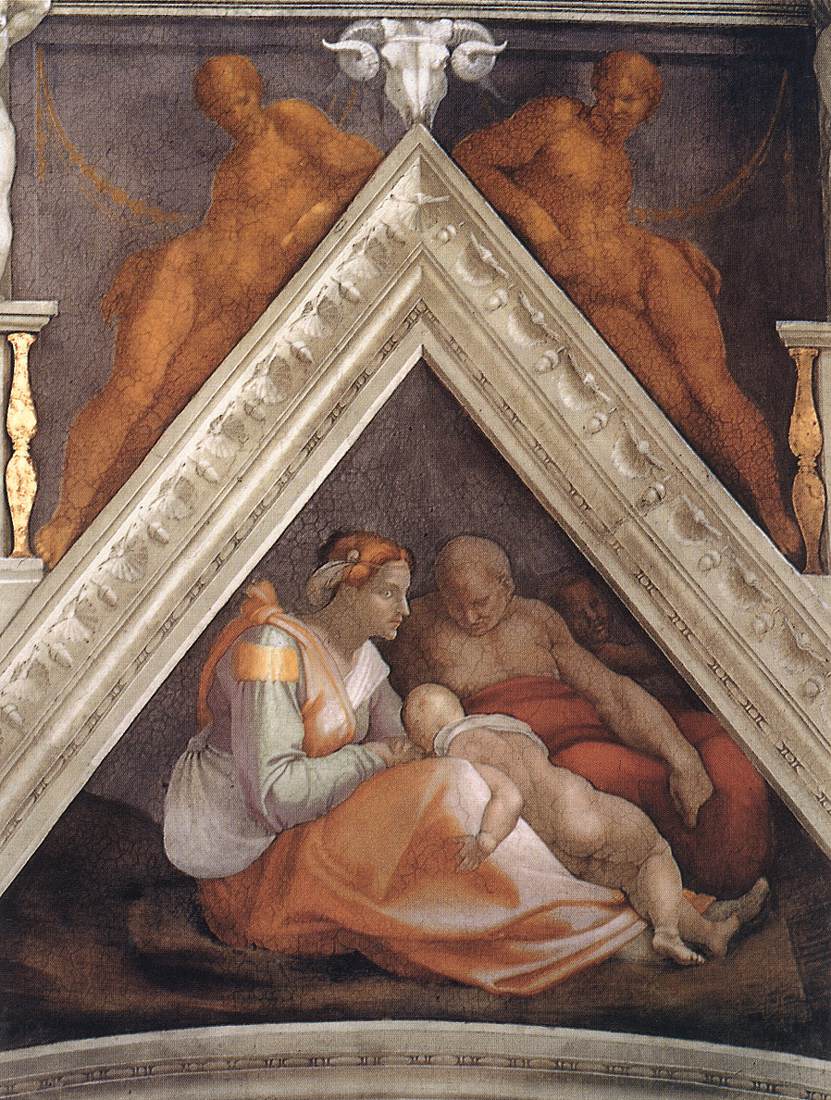
A family sits on bare ground, a mother in iridescent orange in front, a half-naked child lying between her legs. Among the first vaults painted on the Sistine Chapel ceiling, it recalls a Flight into Egypt.
The story behind the painting
Above the lunettes of the Sistine Chapel, Michelangelo painted a row of curved triangular vaults, part of the ceiling commissioned by Pope Julius II. Together with the lunettes below, they hold the series of the Ancestors of Christ, drawn from the genealogy of Jesus in the Gospel of Matthew. The ceiling was frescoed in two phases, starting from the wall opposite the altar, so the latest episodes of the story were painted first. By summer 1511 the first half was done, the scaffolding was taken down and rebuilt, and the second phase, begun in October 1511, ended a year later, in time for the unveiling on the eve of All Saints' Day 1512. This vault, above the lunette of Zerubbabel, Abiud and Eliakim and near the scene of the Flood, was among the first to be painted. The sources give slightly different dates: the French Wikipedia article says around 1510 in its opening and 1508 to 1510 later, while Wikidata gives 1508.
What to look for
The identity of the figures in the lunette below is not certain, but the vault is generally read as the family of Zerubbabel, the governor shown with his parents and his brother. They sit on bare ground in a composition that recalls scenes of the Flight into Egypt. In front, turned in profile to the right, the mother is well lit, in an iridescent orange dress, a blue shirt with a yellow patch on the shoulder and a white bag slung across her body. A half-naked child lies between her legs. Behind, roughly sketched, a man is dressed only in a red sheet from the waist down, and a second child stays in the half-light. Three days of fresco were needed.
Meaning and intent
The vaults differ from the lunettes in style and form: dark backgrounds instead of light ones, and families seated on the ground rather than on steps, to fit the triangular space. The figures are identified only through the names written on the plaques in the lunettes below, and a lunette crowned by a vault usually carries three names instead of two. Scholars do not agree on who is who. Michelangelo gave the figures no iconographic attributes, and he may not have wanted a direct, certain identification at all, concentrating instead on showing different human types and attitudes. That uncertainty is part of what makes these quiet family groups so open to the viewer. Here, separating near and far by light and sharpness of detail is close to Michelangelo's sculptural practice, where the unfinished is kept for more distant details, as in the Pitti Tondo and the Taddei Tondo.
Legacy
In the triangular spaces above each vault sit the so-called bronze nudes, monochrome figures imitating bronze, placed symmetrically against dark violet backgrounds and separated by a ram's skull hung with golden ribbons. Above this vault the two nudes lie in mirror positions, their chests turned toward the viewer. They were made from the same cartoon reversed, with slight differences that avoid a rigid symmetry. As one of the earliest vaults, this scene shows the series near its start, before the scaffolding moved and the second half of the ceiling began. The fresco measures about 245 by 340 cm and remains in the Sistine Chapel, in the Vatican Museums.
Schon gewusst?
- Among the first vaults painted, near the Flood scene.
- Dated around 1510 or 1508-1510 by Wikipedia, 1508 by Wikidata.
- Painted in three days of fresco.
- Measures about 245 x 340 cm.
Über den Künstler
Michelangelo (1475-1564)
religiöse Kunst · Hochrenaissance · Sixtinische Kapelle
Mehr von Michelangelo
 Tondo Doni - Michelangelo (1500s)
 Die Versuchung des Hl. Antonius - Michelangelo (1487)
 Die Grablegung Christi - Michelangelo (1500s)
 Madonna Manchester - Michelangelo (1494)
 Leda - Michelangelo (1530)
 Die Sintflut - Michelangelo (1508)
 The Sacrifice of Noah - Michelangelo (1508)
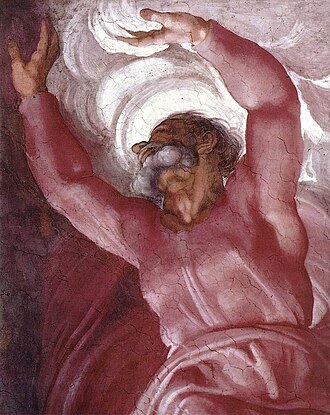 Trennung von Licht und Dunkelheit - Michelangelo (1512)
Werke verwandter Künstler
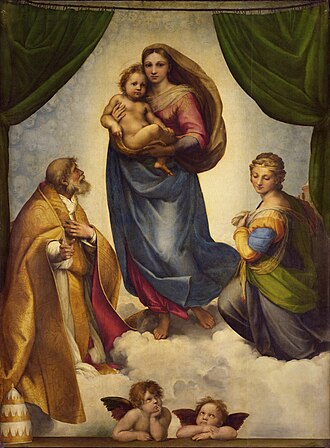 Sixtinische Madonna - Raphael (1510s)
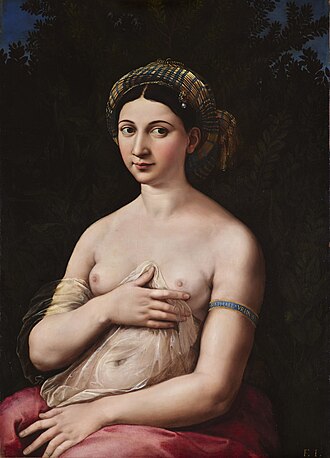 La Fornarina - Raphael
 Venus von Urbino - Titian (1538)
 Mariä Himmelfahrt - Titian (1510s)
 Mona Lisa - Leonardo da Vinci (1503-1519)
 Dame mit dem Hermelin - Leonardo da Vinci (1490)
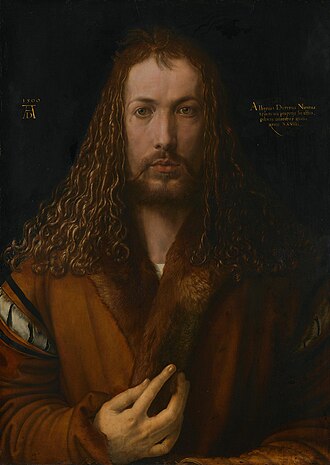 Selbstbildnis im Pelzrock - Albrecht Dürer (1500)
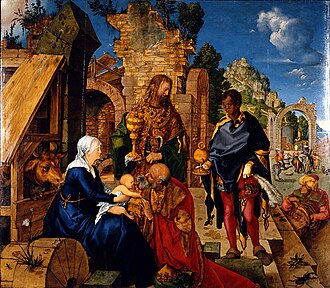 Anbetung der Könige - Albrecht Dürer (1504)
 Die Geburt der Venus - Sandro Botticelli (c. 1485)
 Primavera - Sandro Botticelli (1480s)
 Der Garten der Lüste - Hieronymus Bosch
 Das Narrenschiff - Hieronymus Bosch (1500s)