Die Grablegung Christi
Michelangelo · 1500s
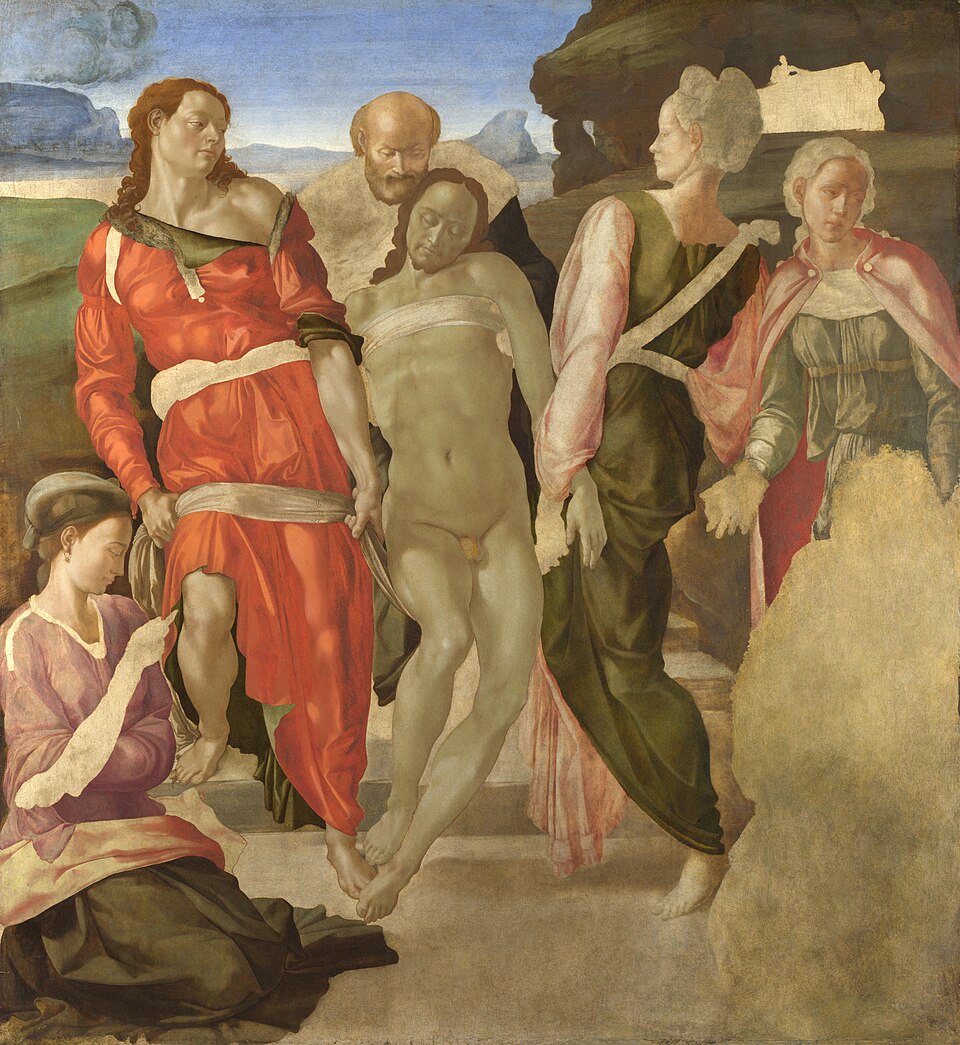
The body of Christ is carried upright up a flight of steps toward a tomb that was never painted in. Unfinished and mysterious, this panel lets us watch Michelangelo at work.
The story behind the painting
The Entombment is an unfinished oil painting on panel, now generally attributed to Michelangelo and dated to around 1500 or 1501. Documents found in 1981 show that in 1500 he was commissioned to paint a panel for a funerary chapel in the church of Sant'Agostino in Rome, but he later gave back the money. This is probably that work, left incomplete when he returned to Florence in 1501; the National Gallery's catalogue suggests he left to secure the marble block that became his David. The panel was in the Farnese collection by the 1650s, and the National Gallery in London bought it in 1868 from the Scottish photographer Robert Macpherson.
What to look for
At the centre, the naked body of the dead Christ is carried up a flight of steps toward the sepulchre, which was meant to fill the blank area in the rocks at upper right. Michelangelo's figures are typically androgynous, which makes them hard to identify. The bearded man behind Christ may be Joseph of Arimathea or Nicodemus; the long-haired figure in orange-red on the left is probably Saint John; the kneeling woman may be Mary Magdalene. Now look at the empty patch at lower right: it was intended for a kneeling Virgin Mary. Notice also the places where paint was scratched away, such as in the rocks, and how areas were finished one by one.
Meaning and intent
Usually in paintings of the Entombment, Christ's body is held horizontally. Here it is upright, a rare choice that had precedents in works by Fra Angelico and Domenico Ghirlandaio. The upright posture may point to his coming resurrection, and to the raising of the bread at the Eucharist. The painting was likely meant to be seen from below and lit from the left, as the chapel would have been. Its unfinished state becomes a gift: it reveals that Michelangelo completed sections in turn, as in fresco or tempera, rather than sketching the whole and adding details, as Raphael or Leonardo did. One theory links the gaps to a shortage of costly ultramarine, though that cannot explain every unfinished part.
Legacy
Questions of authorship have followed the work. The German painters Peter von Cornelius and Friedrich Overbeck attributed it to Michelangelo in 1864, but the attribution was first rejected and the panel was given to the so-called Master of the Manchester Madonna, a figure later identified with Michelangelo himself. Some authorities still believe it may be by a pupil working from his drawing. Accounts of how Macpherson acquired it also conflict. Today it is counted among the handful of paintings attributed to Michelangelo, alongside the Manchester Madonna and the Doni Tondo. In London, its empty spaces continue to draw visitors closer, inviting them to imagine the picture that was never completed.
Schon gewusst?
- Generally attributed to Michelangelo and dated c. 1500-1501; some think a pupil made it.
- Bought by the National Gallery, London, in 1868 from Robert Macpherson.
- The blank lower right was meant for a kneeling Virgin Mary.
Über den Künstler
Michelangelo (1475-1564)
religiöse Kunst · Mann · Hochrenaissance · Jesus Christus · National Gallery
Mehr von Michelangelo
 Tondo Doni - Michelangelo (1500s)
 Die Versuchung des Hl. Antonius - Michelangelo (1487)
 Leda - Michelangelo (1530)
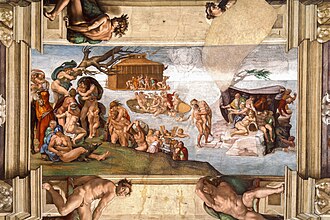 Die Sintflut - Michelangelo (1508)
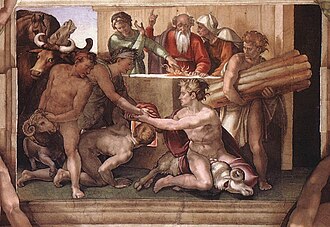 The Sacrifice of Noah - Michelangelo (1508)
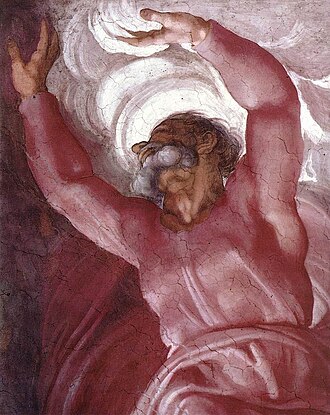 Trennung von Licht und Dunkelheit - Michelangelo (1512)
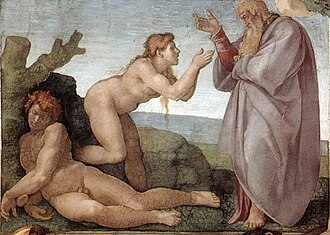 Die Erschaffung Evas - Michelangelo (1511)
 Die Trennung von Erde und Wasser - Michelangelo (1511)
Werke verwandter Künstler
.jpg) Venus von Urbino - Titian (1538)
Venus von Urbino - Titian (1538) Mariä Himmelfahrt - Titian (1510s)
 Sixtinische Madonna - Raphael (1510s)
.jpg) La Fornarina - Raphael
La Fornarina - Raphael Mona Lisa - Leonardo da Vinci (1503-1519)
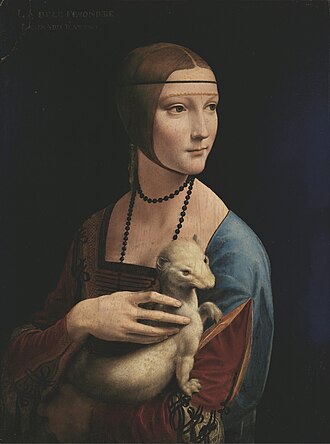 Dame mit dem Hermelin - Leonardo da Vinci (1490)
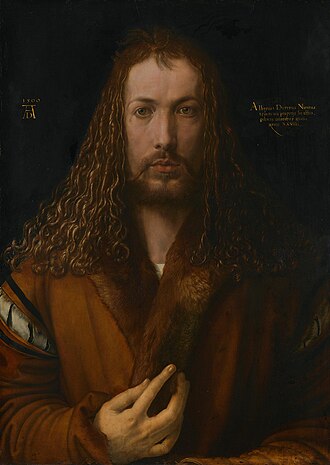 Selbstbildnis im Pelzrock - Albrecht Dürer (1500)
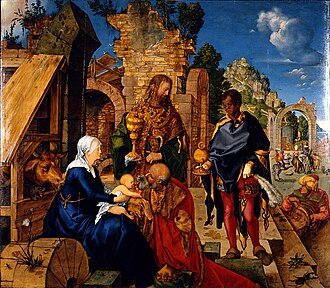 Anbetung der Könige - Albrecht Dürer (1504)
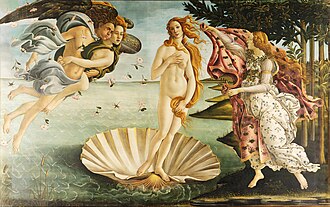 Die Geburt der Venus - Sandro Botticelli (c. 1485)
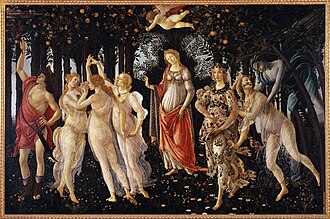 Primavera - Sandro Botticelli (1480s)
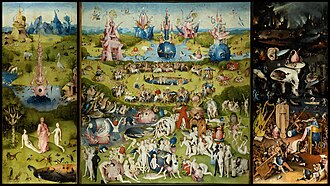 Der Garten der Lüste - Hieronymus Bosch
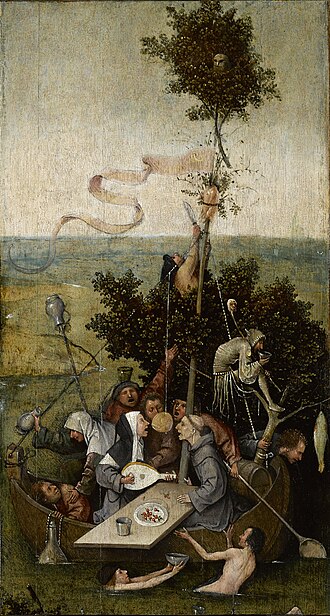 Das Narrenschiff - Hieronymus Bosch (1500s)