Büßender Hieronymus
Albrecht Dürer · 1496
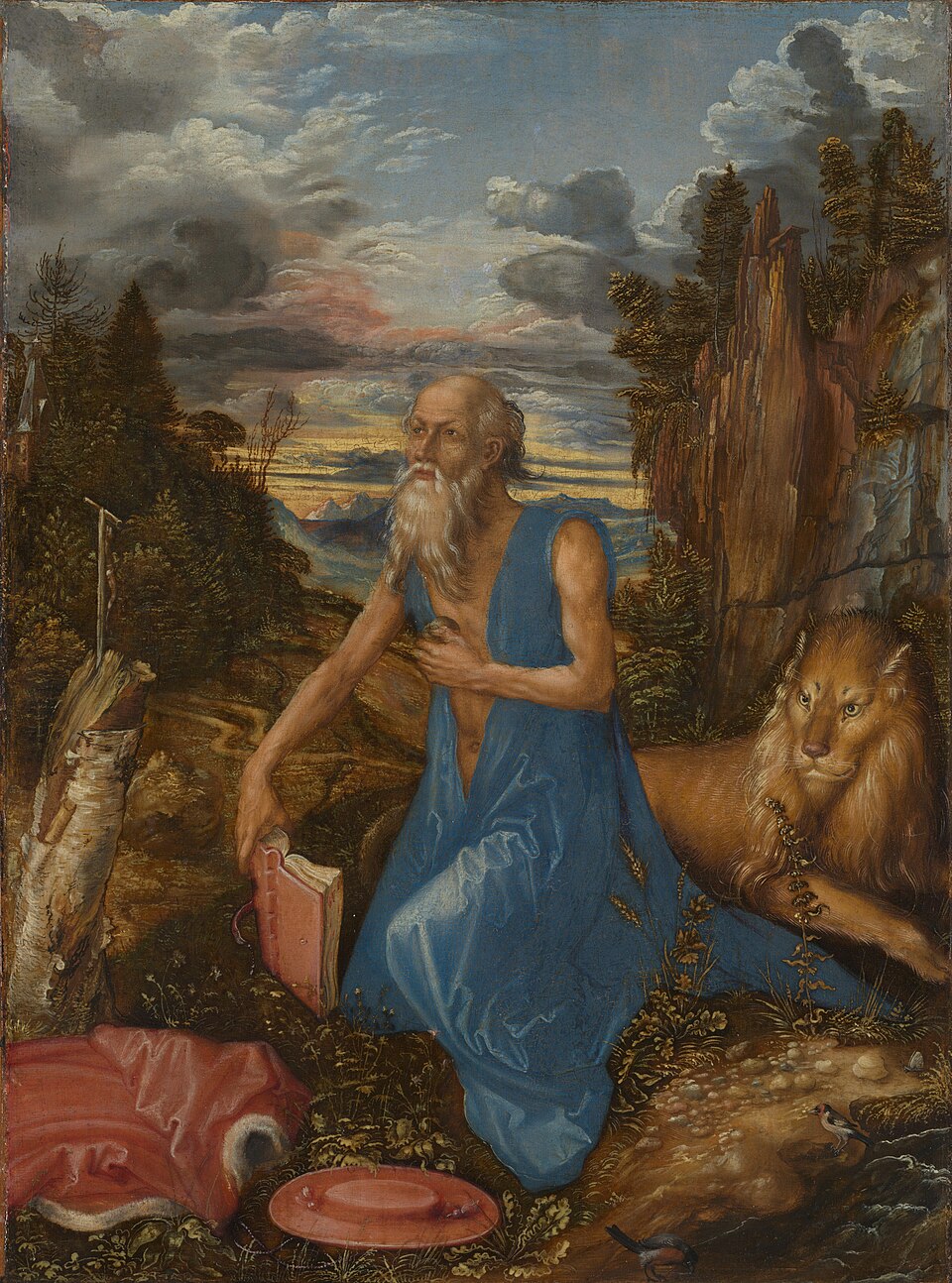
On one side, a saint kneels in the wild with his lion. Turn the panel over and a blazing light streaks across a dark sky. Dürer's little Saint Jerome may record a real event in the heavens.
The story behind the painting
This small double-sided oil painting on panel was made by Albrecht Dürer around 1496 and is now in the National Gallery in London, where both sides are on display. It was only attributed to Dürer in 1957, on the strength of the lion, which resembles an animal in a drawing on membrane from Dürer's second trip to Venice, now in the Hamburger Kunsthalle; the lion was almost surely drawn from the lions of Saint Mark in that city. The painting was previously in the Fitzwilliam Museum in Cambridge before the London museum bought it. Saint Jerome was a common subject at the time, and Dürer was probably inspired by Giovanni Bellini or artists influenced by Mantegna.
What to look for
Jerome is shown during his life as a hermit, surrounded by his traditional symbols: the tamed lion, his cardinal's hat and garments on the ground, the book, the stone he used to strike himself, and the crucifix for prayer. The panel is tiny, about 23 by 17 centimetres, so lean in. The nature is painted in the Northern European way, full of detail: small birds, a white butterfly near the bottom, the bark of a tree trunk, grass rendered blade by blade. The sky behind is similar to Dürer's watercolour Pool in the Wood in the British Museum. On the back is a fiery object in a dark sky, a meteor or a comet.
Meaning and intent
Each symbol tells part of Jerome's story. The discarded cardinal's robes mean a rejection of earthly honours. The book recalls that Jerome translated the Bible into the Latin Vulgate. The stone speaks of penance, the crucifix of prayer, and the lion of the creature he tamed. Dürer joins this religious meaning to a fresh study of the living world, as if holiness and close observation belonged together. The reverse adds another kind of attention. Unlike the stylised comets of the Nuremberg Chronicle of 1493, Dürer's image has the feel of something actually seen, like the blazing star in his engraving Melencolia I.
Legacy
If the image on the back records a real sky event, there are three candidates: the comet of 1491, whose orbit is very uncertain; the Ensisheim meteorite, which fell in Alsace on 7 November 1492, as Ursula B. Marvin suggested in relation to Melencolia I; and the comet of 1493, noted in Sir David Brewster's Edinburgh Encyclopaedia. The question remains open. That is part of the joy of this panel. Front and back, it shows a young Dürer looking hard at the world, at butterflies, bark and grass, and perhaps at a light falling from the sky, and recording it with wonder.
Schon gewusst?
- Double-sided oil on panel, about 1496; size 23.1 × 17.4 cm
- Attributed to Dürer in 1957
- Formerly in the Fitzwilliam Museum, Cambridge; now in the National Gallery, London
- Reverse shows a meteor or comet
Über den Künstler
Albrecht Dürer (1471-1528)
religiöse Kunst · Mann · National Gallery · Deutsche Renaissance · Hieronymus
Mehr von Albrecht Dürer
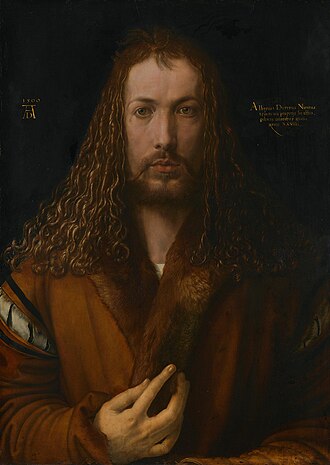 Selbstbildnis im Pelzrock - Albrecht Dürer (1500)
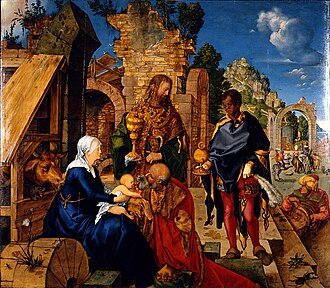 Anbetung der Könige - Albrecht Dürer (1504)
.jpg) Das Rosenkranzfest - Albrecht Dürer (1506)
Das Rosenkranzfest - Albrecht Dürer (1506)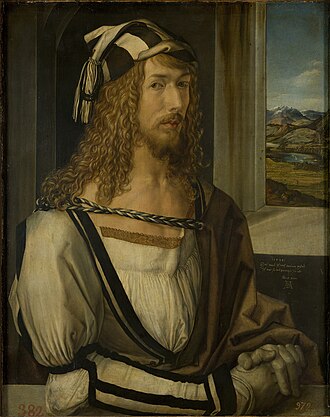 Selbstporträt im Alter von 26 Jahren - Albrecht Dürer (1498)
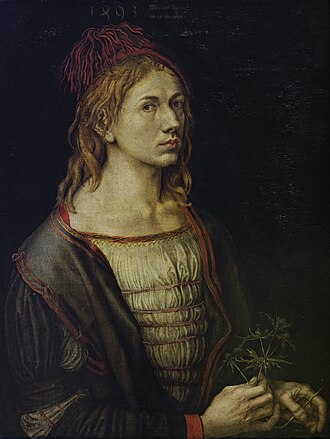 Selbstporträt mit einer Distel - Albrecht Dürer (1493)
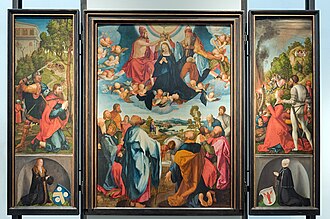 Heller-Altar - Albrecht Dürer (1500s)
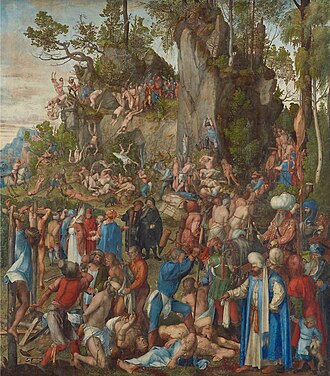 Marter der zehntausend Christen - Albrecht Dürer (1508)
%20-%20Google%20Art%20Project.jpg) Allerheiligenbild - Albrecht Dürer (1511)
Allerheiligenbild - Albrecht Dürer (1511)