Sleeping woman
Francisco Goya · 1790
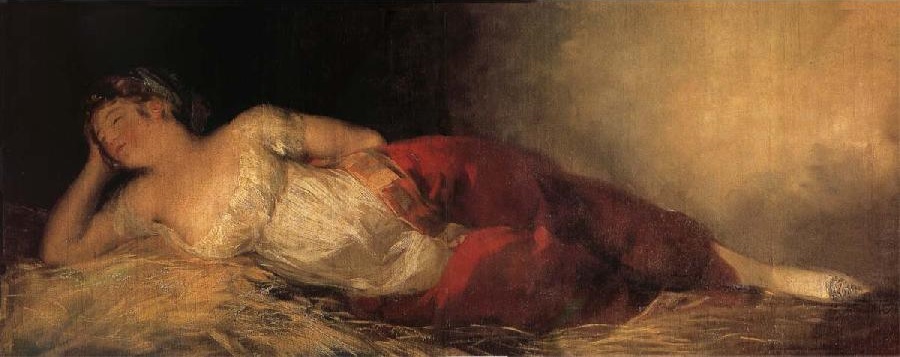
A woman sleeps on her side, her head resting on her hand, a blanket over her legs. Goya painted this quiet moment for a friend, in the years when he was reluctant to return to tapestry work for the king.
The story behind the painting
Goya painted Sleeping Woman between 1790 and 1793 as part of a commission for Sebastián Martínez y Pérez, a merchant, a man of the Enlightenment and a friend of the painter. It belonged with Women Conversing and El Sueño. In 1789 Goya had become painter of the king's chamber, and when Charles IV asked in 1790 for rustic and comic scenes for tapestries at El Escorial, Goya at first refused, finding such cartoons too much like craftwork. The success of this private commission, especially of Women Conversing, is said to have pushed him to start the seventh series of cartoons after all.
What to look for
A woman lies on her side and sleeps, her head propped on her right hand, her left hand hidden behind her body. She wears a light, low-cut dress, a sign that Goya wanted to draw the eye to her face and chest. A blanket seems to cover her legs up to the hips. The canvas is long and low, 59 by 145 cm, which suits a figure stretched across the picture. Light falls on the face and chest and leaves the rest in softer shade.
Meaning and intent
The light is used to set up a parallel with Women Conversing, as if Goya were offering a new view of a sleeping woman in dialogue with the other picture. For both pose and clothing, the historian Gudiol compared the painting with Goya's Portrait of the Marchioness of Santa Cruz and with his majas. There are also echoes of Mary Magdalene by Gaspar Becerra, which Goya may have drawn on for the pose and the lighting.
Legacy
The French Wikipedia account places this small private picture at a turning point: by pleasing a friend, it helped bring Goya back to the royal tapestry cartoons he had resisted. Wikidata dates the work to 1790, the start of the 1790 to 1793 range given in the article. Today it is a rare intimate scene in which nothing happens except sleep, and Goya lets light do the storytelling. It sits beside Women Conversing as a pair of quiet glimpses into private life.
Schon gewusst?
- Painted between 1790 and 1793 for Sebastián Martínez y Pérez.
- Part of a group with Women Conversing and El Sueño.
- Measures 59 by 145 cm.
- Gudiol linked the pose to Goya's majas.
Über den Künstler
Francisco Goya (1746-1828)
Mehr von Francisco Goya
 Die Erschießung der Aufständischen - Francisco Goya (1814)
 Die nackte Maja - Francisco Goya (1800)
 Saturn verschlingt seinen Sohn - Francisco Goya (1819)
 Die Familie Karls IV. - Francisco Goya (1800)
 Die Bekleidete Maja - Francisco Goya (1800)
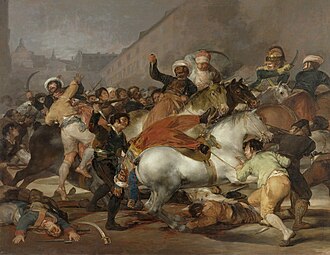 Kampf mit den Mamelucken am 2. Mai 1808 in Madrid - Francisco Goya (1814)
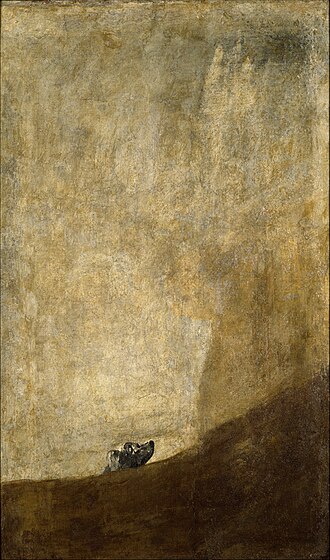 Hund - Francisco Goya (1819)
 Hexensabbat - Francisco Goya (1820s)
Werke verwandter Künstler
 Der Wanderer über dem Nebelmeer - Caspar David Friedrich (c. 1818)
 Abtei im Eichwald - Caspar David Friedrich (1800s)
 Die Freiheit führt das Volk - Eugène Delacroix (1830)
 Der Tod des Sardanapal - Eugène Delacroix (1827)
 Die letzte Fahrt der Temeraire - J. M. W. Turner (1839)
 Rain, Steam and Speed - The Great Western Railway - J. M. W. Turner (1844)
 Knabe in Blau - Thomas Gainsborough (1770)
 Mr. und Mrs. Andrews - Thomas Gainsborough (1748)