Sisyphus
Tizian · 1540s
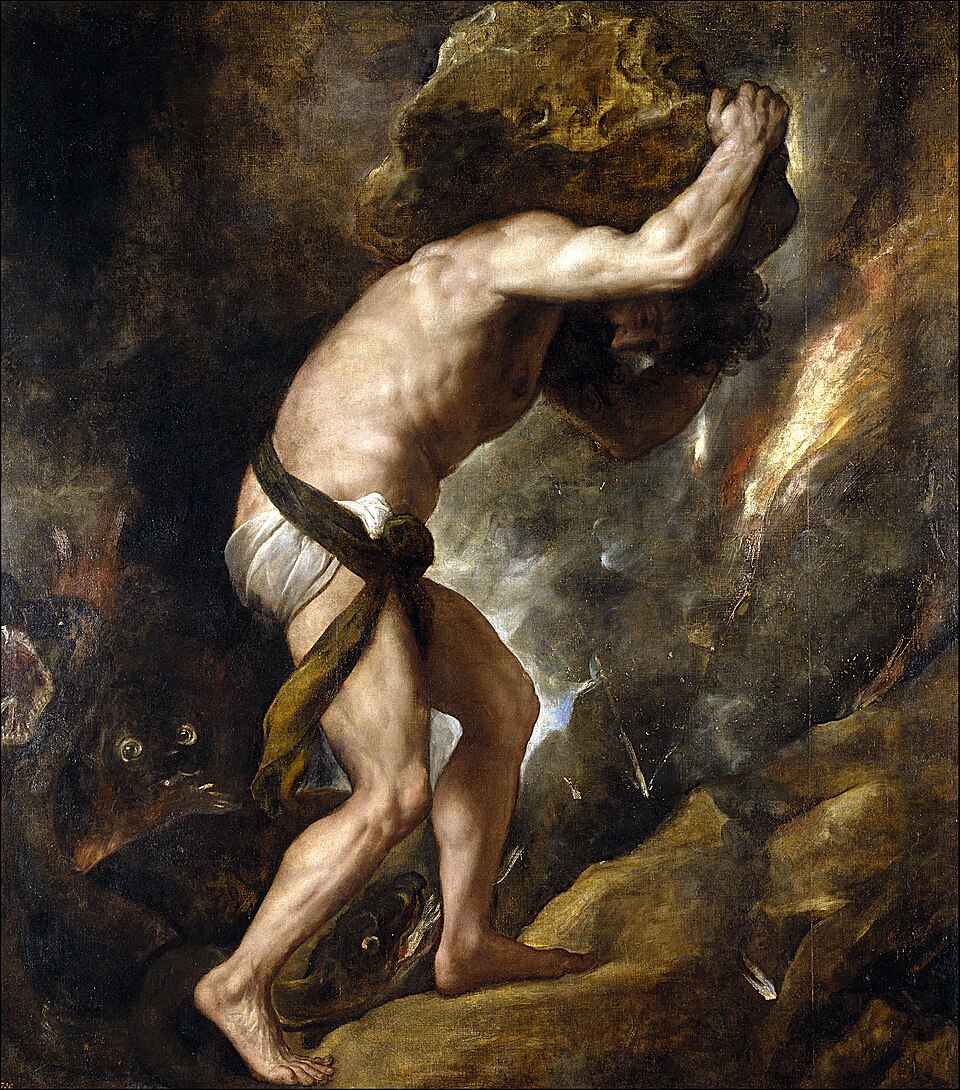
A giant figure strains under a boulder on his shoulders, climbing through darkness and flame. Titian painted Sisyphus for a queen's hall of the damned, and for a time experts even doubted it was his.
The story behind the painting
On his first visit to Augsburg, Titian received a commission from Mary of Hungary, sister of Emperor Charles V, for large pictures of Tantalus, Sisyphus and Tityus. Two were painted in the first half of 1549 and by August already decorated the Great Hall of her palace at Binche, when Philip was her guest. Tityus followed only around 1553. Wikipedia dates Sisyphus to 1548 to 1549, while Wikidata gives the 1540s. Titian's source was Ovid's Metamorphoses, which describes the eternal sufferings in the underworld, where Sisyphus must push or chase the rock that always rolls down the hill again.
What to look for
The canvas is huge, 237 by 216 cm, and filled with one colossal body. Sisyphus pushes his rock up the mountain, cliffs closing around him while, in Georg Gronau's words, a whirlwind blows the flames of the underworld up around him. His dark body stands against a grand, gloomy background. Charles Ricketts noted that Titian returned here to the bold foreshortening of his Santo Spirito ceilings. He also observed that the picture has been darkened by smoke from one of the many fires that damaged the Spanish royal collections, so the colours we see today are not quite those Titian left.
Meaning and intent
Since Homer, Sisyphus had been known as the craftiest of men, and his punishment was endless labour without result. Gronau imagined the hall as it once looked: colossal single figures, each picture more than two metres square, superhuman in form, struggling in torment. To him it seemed that Titian used these human forms to symbolise the struggles of the forces of nature, and that memories of the mountains of his early home helped him paint the masses of rock. Ricketts thought the free handling anticipated Titian's later style.
Legacy
Queen Mary took the pictures to Spain. In the sixteenth century they hung in the Alcázar of Madrid and gave the room its name, the Pieza de las Furias, the room of the Furies. In time Tantalus was lost. Tityus and Sisyphus were once thought, on old testimony, to be copies by Sánchez Coello, but Gronau counted them among Titian's finest original creations, and Ricketts agreed they are rightly given to Titian. Recorded in the Royal Alcázar in 1700 and the New Royal Palace from 1747, Sisyphus has been in the Museo del Prado since 1819.
Schon gewusst?
- Oil on canvas, 237 by 216 cm, painted around 1548-1549.
- Commissioned by Mary of Hungary, sister of Charles V.
- Based on Ovid's Metamorphoses.
- In the Museo del Prado since 1819.
Über den Künstler
Tizian (1488-1576)
Museo del Prado · mythologische Malerei · Venezianische Schule
Mehr von Tizian
 Venus von Urbino - Titian (1538)
 Mariä Himmelfahrt - Titian (1510s)
 Himmlische und Irdische Liebe - Titian (1510s)
 Kaiser Karl V. nach der Schlacht bei Mühlberg - Titian (1548)
 Flora - Titian (1517)
 Allegorie der von der Klugheit beherrschten Zeit - Titian (1550)
 Diana und Actaeon - Titian (1550s)
 Bacchus und Ariadne - Titian (1520s)
Werke verwandter Künstler
 Das letzte Abendmahl - Jacopo Tintoretto (1563)
 Der heilige Markus befreit den gefesselten Sklaven - Jacopo Tintoretto (1540s)
 Die Hochzeit zu Kana - Paolo Veronese (1560s)
 Das Gastmahl im Hause des Levi - Paolo Veronese (1573)